
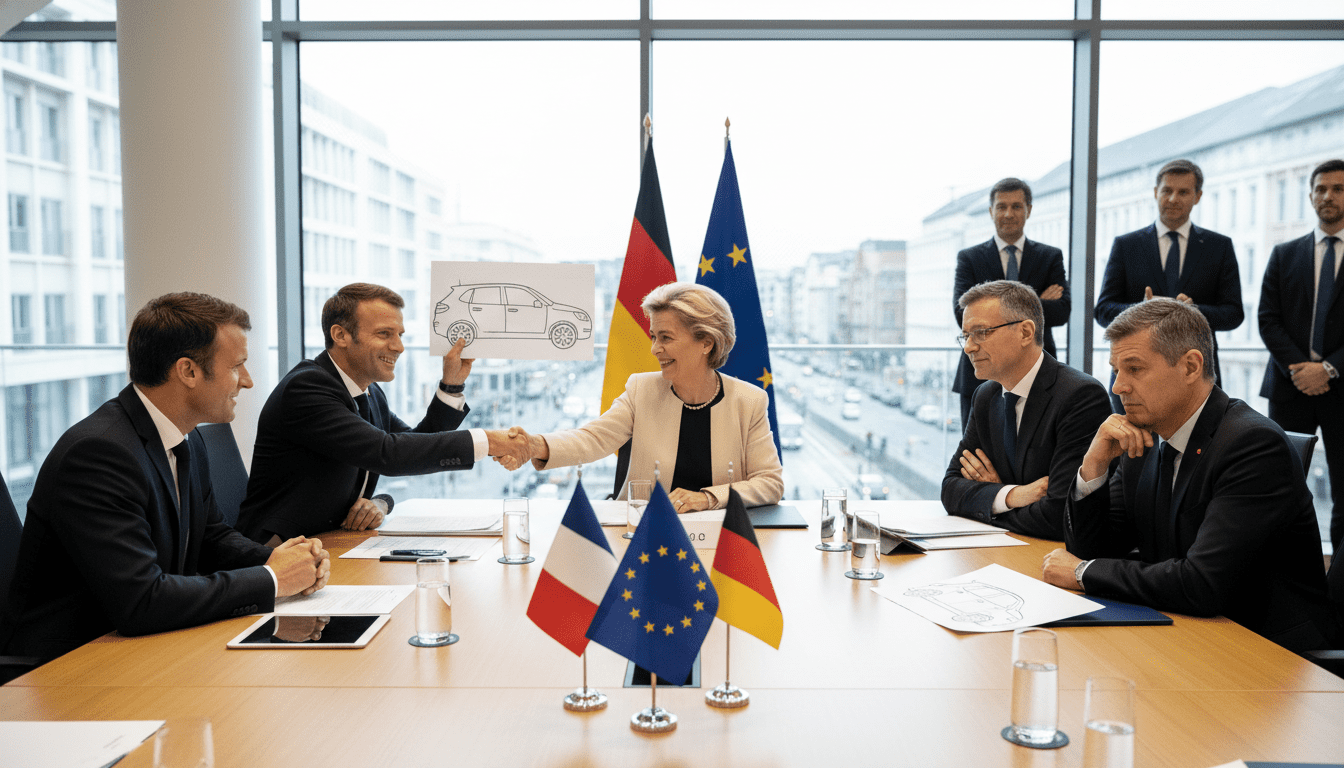
EU emissions rules under scrutiny as Brussels debates small-car advantages
Brussels is considering changes to EU emissions rules that could create a new small-car category and ease targets for French makers like Renault and Stellantis, raising alarm among German automakers.
The European Commission is reportedly weighing regulatory revisions that would treat compact vehicles differently under current CO2 accounting, a move proponents say would reflect size and use, while critics argue it risks skewing competition. The debate has intensified as Renault and some Stellantis brands struggle to meet existing EV sales thresholds, prompting political interventions and industry lobbying in the corridors of EU power. Brussels deliberations now center on whether technical rule changes and a fresh legal category for small cars should be adopted, and what effects such steps would have on market balance and emission reductions.
Brussels deliberations on EU emissions rules
Brussels officials are said to be discussing targeted alterations to the EU emissions rules that would give preferential treatment to smaller passenger cars. Proposals under consideration include adjustments to how average fleet emissions are calculated, potentially weighting compact models more favorably. Supporters argue such changes would reflect vehicle usage patterns and consumer needs, particularly in dense urban environments where small cars are common.
Opponents counter that reworking the rules to favor specific vehicle segments risks creating uneven playing fields and could undermine the Commission’s broader climate targets. The debate has coincided with heightened political involvement from national capitals, increasing scrutiny over whether technical rulemaking is being influenced by industry allegiances.
French industry pressure and political backing
French automakers have faced mounting pressure to accelerate electrification while maintaining market share in core segments like city cars and small family vehicles. Executives from Renault and several Stellantis brands have publicly acknowledged the difficulty of meeting strict EV quotas, especially where consumer demand and charging infrastructure lag. Industry representatives have thus lobbied Brussels for regulatory flexibility that would better reflect their product mix.
At the political level, some elected officials in France are said to have advocated for measures that would protect domestic industrial interests. This convergence of commercial urgency and political support has amplified calls in Brussels for carve-outs or transitional arrangements to ease compliance burdens on manufacturers with heavier exposure to compact segments.
A proposed legal category for small cars
One concrete idea gaining traction is the creation of a distinct legal category for small cars, separate from the current passenger vehicle classifications. Under such a framework, vehicles meeting defined dimensional and performance criteria could qualify for lighter regulatory treatment or targeted incentives. Potential benefits discussed include adjusted CO2 targets, exemptions from certain fees, or preferential access to urban mobility schemes.
Proponents contend a small-car category could better match regulation to distinct mobility needs and allow manufacturers to scale production of efficient urban vehicles. Critics warn the measure could be used to shield specific models from emissions accountability, leading to loopholes that diminish the overall effectiveness of EU climate policy.
Implications for German automakers and market dynamics
German manufacturers, which compete strongly in larger vehicle segments and have invested heavily in high-performance electric models, view the prospect of preferential rules for small cars with concern. Adjustments that lower obligations for compact vehicles could shift compliance burdens and potentially expose German firms to higher fines or tighter penalties if averages are skewed. Market observers warn this could intensify trade and political tensions between member states at a time when the industry is already navigating supply-chain and transition costs.
Automotive analysts also note that any reallocation of regulatory incentives—such as parking privileges or tax advantages linked to a new vehicle category—could reshape consumer preferences and urban mobility planning across Europe. The cumulative commercial impact would depend on the precise contours of any rule change and the timeline for implementation.
Environmental trade-offs and technology options
Beyond competitive effects, the debate touches on how Europe intends to meet its transport-sector emission goals. Some industry voices argue that a realistic approach must combine electrification with complementary technologies such as e‑fuels and hybrid systems, especially for segments where full battery adoption is slower. They call for regulatory frameworks that weigh infrastructure readiness and lifecycle emissions rather than imposing uniform mandates that may not align with market realities.
Climate advocates, however, caution that diluting standards for particular vehicle classes could slow the shift away from fossil fuels and complicate the path to net-zero transport. The balance between pragmatic transition measures and preserving the integrity of climate commitments is central to the policy choices facing Brussels.
Next steps and political calculus in Brussels
Any formal change to the EU emissions rules would require legal drafting by the Commission followed by consultations with member states and the European Parliament. Observers expect intense lobbying from industry groups and national governments as technical assessments are finalized. Timelines remain uncertain, but officials indicate that detailed impact analyses and stakeholder hearings would precede any legislative proposal.
Given the political sensitivities, Brussels faces a difficult calculus: reconcile industrial competitiveness and social acceptability with the EU’s climate obligations, while avoiding perceptions that rulemaking is being steered toward narrow national advantage.
The outcome of this process will shape not only how carmakers meet targets but also the competitive structure of Europe’s auto market and the policy instruments available to cities and governments managing transport emissions. Decisions in the coming months will test whether Brussels can craft rules that are both technically coherent and politically sustainable.
