
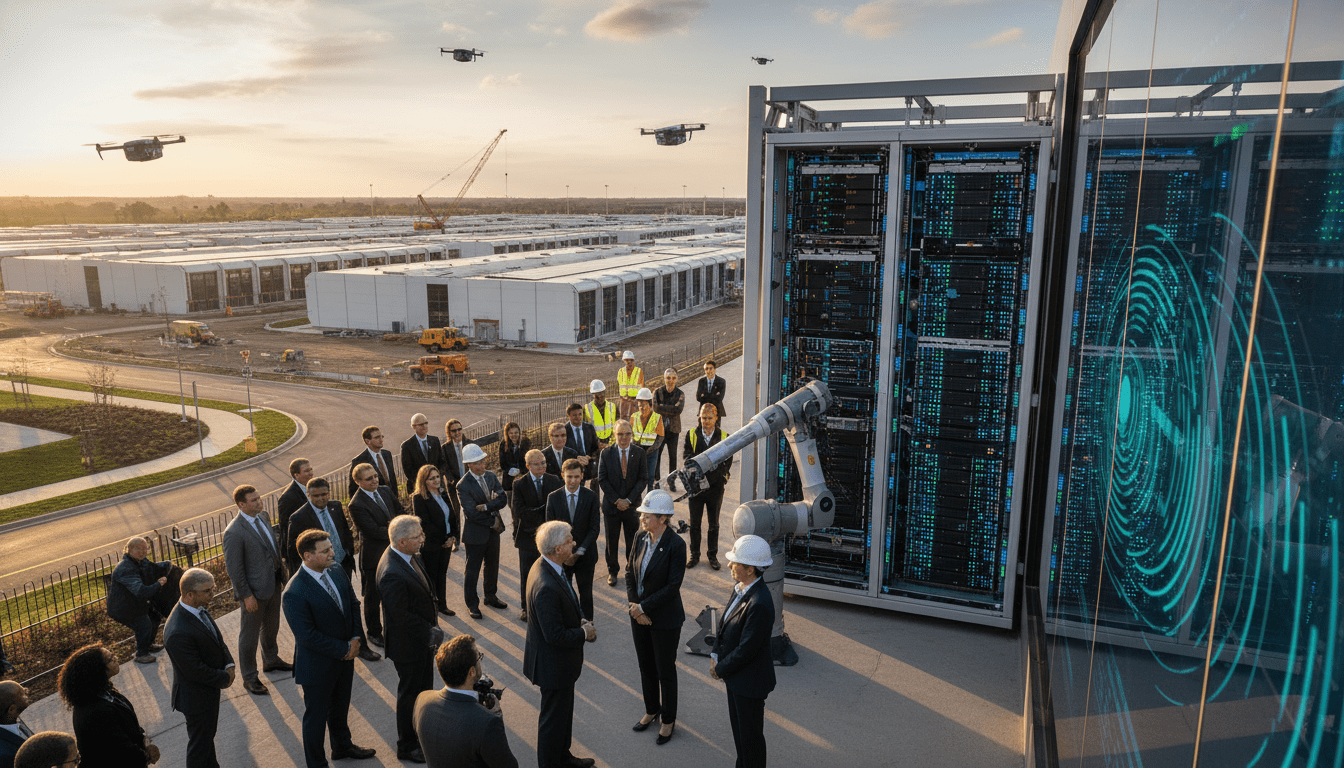
AI investment surge fuels U.S. growth as data‑center building and supercomputer imports climb
U.S. AI investment in data centers and high‑performance computing is driving robust economic growth, with roughly $50 billion spent on new facilities and record imports of advanced computers boosting output.
The American economy has shown unexpected resilience in recent quarters, powered in large part by a wave of AI investment in data centers and high‑performance computing equipment. Investors put roughly $50 billion into constructing new data‑center facilities in the past year, a figure that covers buildings only and excludes the costly servers and accelerators that populate them. At the same time, trade data point to a dramatic rise in imports of large computing systems, underscoring how AI investment has become a central engine of U.S. capital spending since the advent of widely used generative models in late 2022.
Data‑center construction hits new highs
Investors increased spending on data‑center construction sharply over the last 12 months, with industry tallies showing a year‑over‑year rise of roughly one‑third. Those totals refer to physical plants rather than the computing hardware inside them, and they reflect a surge in corporate and cloud provider commitments to expand capacity. Observers note that the construction surge represents the visible first stage of a broader investment cycle that will require substantial additional outlays for servers, networking and specialized cooling.
High‑performance computer imports soar
Concurrently, imports of large computing systems have accelerated to historically high levels, with annualized estimates in recent trade reports approaching the low hundreds of billions of dollars. That increase — more than double year‑ago levels in percentage terms — reflects demand for GPUs, custom AI accelerators and supporting infrastructure from hyperscalers, cloud providers and enterprise buyers. Industry analysts say the flood of high‑end compute is a direct response to commercial AI workloads that require orders of magnitude more processing power than traditional enterprise applications.
AI spending eclipses traditional capital categories
Spending on data centers and computing hardware has outstripped other categories of tangible business investment in recent quarters. Capital allocation to these digital‑age assets now exceeds outlays for single‑family housing, factories, power plants and conventional industrial projects in recent comparative measures. At the same time, renewable energy investments — notably in solar and battery storage — are rising across the country, creating a parallel wave of infrastructure deployment that complements the growth of compute capacity.
Semiconductor demand signals broader industrial momentum
A sharp uplift in semiconductor orders is accompanying the AI investment wave, with chips now embedded across vehicles, appliances, industrial equipment and consumer devices. Manufacturers typically place chip orders six to twelve months ahead of production scaling, so current demand patterns are widely interpreted as a leading indicator of an impending manufacturing expansion. Executives and supply‑chain analysts say that the surge in chip demand could presage wider industrial activity as companies gear up capacity to meet AI‑driven product and automation needs.
Tax and trade decisions have amplified investment incentives
Recent U.S. tax rules permitting immediate expensing of capital purchases have reinforced the investment cycle by improving short‑term returns on new equipment and facilities. At the same time, limited use of import tariffs on advanced technology components has reduced barriers for firms seeking specialized compute gear abroad. Economists caution that these policy choices interact with market forces and global supply constraints, shaping the timing and distribution of new investment across sectors and regions.
Global competitors watch a potential reshoring trend
The scope and speed of the U.S. build‑out have prompted close attention from industrial economies overseas, where investment in traditional manufacturing has been comparatively muted. Policymakers and business leaders in Europe and Asia are evaluating responses ranging from incentives for domestic chip fabrication to partnerships with cloud providers, as they assess the competitive implications of heavier U.S. capital spending on AI infrastructure. Supply‑chain strain for critical components has already influenced procurement strategies and could accelerate efforts to diversify production footprints.
The momentum behind AI investment in data centers and high‑performance computing is now a defining feature of the U.S. capital landscape, and its ripple effects — from semiconductor demand to energy infrastructure — will shape industrial patterns in the months ahead. Observers say the coming quarters will reveal whether the current wave sustains output, leads to significant job growth in new industries, and prompts further policy shifts to manage supply‑chain and competition dynamics.
