
Part-time work in Germany reaches record share as full-time roles decline
Part-time work in Germany reaches new highs: 31.9% in microcensus and near 40% by IAB, reshaping hours, gender roles and sector employment and families.
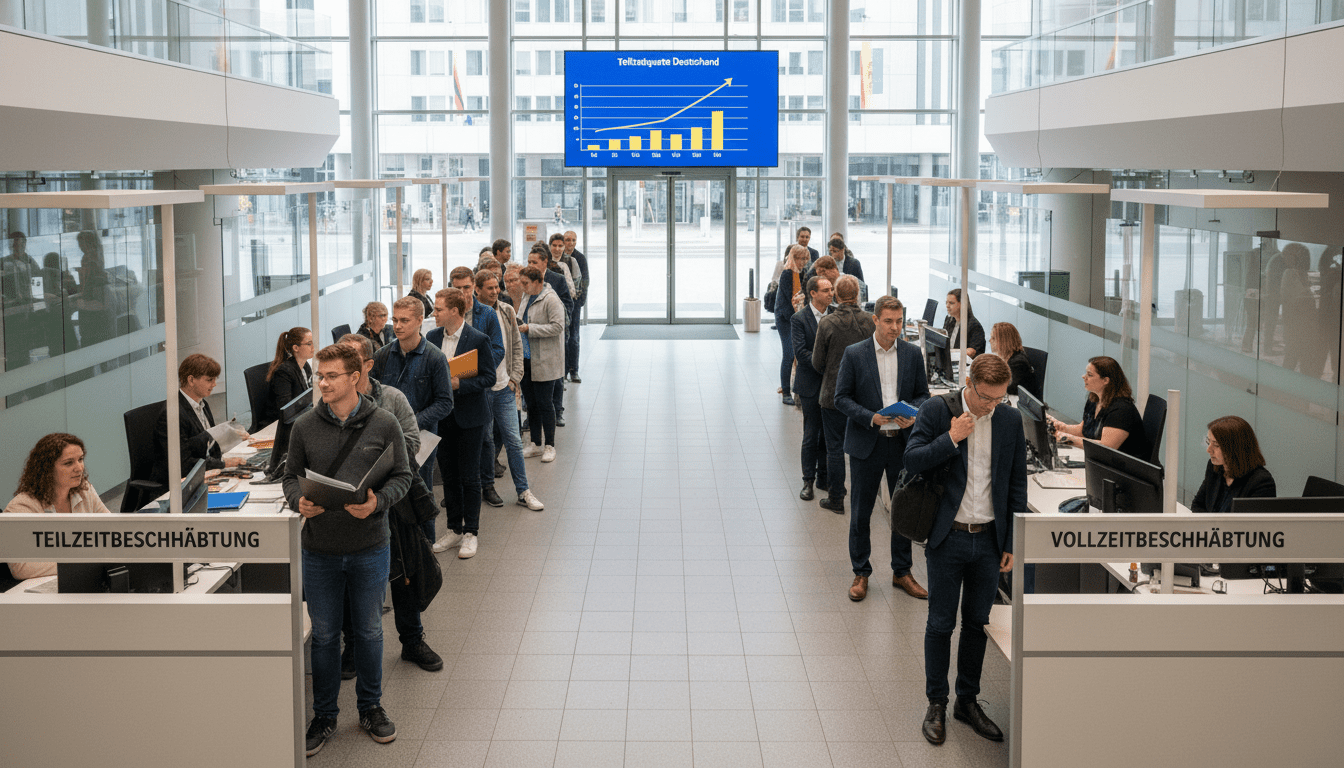
Part-time work in Germany has become significantly more common, with the Federal Statistical Office reporting a record share of workers on reduced hours. According to the microcensus, 31.9 percent of employed people worked part-time last year, averaging 21.3 hours per week. This trend is confirmed by other calculations and is reshaping how employers, households and policymakers view the labour market.
Record share reported in official microcensus
The Statistisches Bundesamt derived a part-time rate of 31.9 percent from its annual microcensus analysis. Those in part-time positions logged an average 21.3 weekly hours, a small rise from the prior year and two hours more than in 2015. The office’s figures mark the highest proportional use of reduced hours in the dataset’s recent history.
Full-time weekly hours remained stable in the microcensus, with full-time employees averaging 39.9 hours. That figure is slightly lower than a decade ago when average full-time hours were about 40.5 per week. The stability in full-time hours contrasts with the steady expansion of part-time arrangements.
Alternative calculation finds nearly 40% in part-time
A separate working-time computation by the Institute for Employment Research (IAB) produced an even higher part-time share in March, estimating 39.9 percent on its data basis. The IAB reported 16.88 million people in part-time jobs, up about one percent from 2024, while full-time employment fell to roughly 25.43 million. Differences between the microcensus and IAB figures reflect varying methodologies but point to the same broad shift toward shorter working hours.
The IAB’s calculation also shows a modest contraction in total hours worked nationwide, underscoring that more workers are choosing or being offered reduced schedules even as aggregate labour inputs edge down.
Industry loses full-time positions as care and social sectors expand
The decline in full-time positions was most visible in industry, where job losses contributed to the fall in full-time employment. By contrast, sectors traditionally composed of more part-time roles—such as health and social services—saw gains in employment. The sectoral shift highlights structural changes in demand across the economy and the growing weight of care-related activities.
Those patterns have implications for wage structures, benefits coverage and employer staffing strategies, since part-time roles often carry different contractual conditions than full-time positions.
Gender gap remains large but male part-time increases faster
Women continue to make up the majority of part-time workers: more than half of employed women—50.6 percent—worked part-time in 2025, according to the Federal Statistical Office. For men the rate was far lower at 14.3 percent, but the male part-time share has risen faster in recent years compared with women. In 2015 the rates were roughly 48 percent for women and 10.6 percent for men, showing a marked increase among men over the past decade.
The persistence of a significant gender gap points to enduring divisions in household responsibilities and labour market roles even as more men opt for reduced hours.
Family status and age strongly influence working hours
Part-time employment is particularly concentrated among parents, with 66.4 percent of employed mothers with children under 18 working reduced hours, compared with just 8.6 percent of fathers in the same group. Those figures underline how childcare responsibilities continue to shape mothers’ labour-market participation. Experts note that many women would choose to increase their hours if more stable childcare options were available.
Age also correlates with part-time incidence. The share of part-time workers climbs with age: roughly one-third of 55-year-olds worked part-time, more than half of those still employed at 65 did so, and the prevalence rises sharply for workers approaching retirement. These patterns reflect a mix of phased retirement choices, health considerations and employer practices for older employees.
Political debate intensifies over “lifestyle” part-time and support services
The expanding use of part-time work has become a focal point in political debate, with a proposal from the CDU’s economic wing titled “No right to lifestyle part-time” provoking pushback from unions and labour researchers. Critics argue the language risks stigmatizing flexible, shorter hours that many workers choose for family, education or health reasons. Proponents of protecting flexible arrangements say they are essential for keeping people attached to the labour market across life stages.
Yvonne Lott of the Hans-Böckler-Stiftung framed substantial part-time as “self-determined working” that increases labour participation and supports work–life balance. She and other analysts emphasize that expanded, reliable childcare and public support would enable many who currently work part-time to increase their hours if they wished.
The broader labour-market picture shows only modest overall change in employment numbers even as hours and work patterns shift. The IAB reported about 45.98 million people in employment last year, a near-stable total, with roughly 61.26 billion hours worked nationwide, slightly down year on year. Average weekly hours across all employed people stood at 30.4, unchanged from the previous year, indicating that the rise in part-time work is reshaping the composition of hours without producing large swings in aggregate time worked.
