
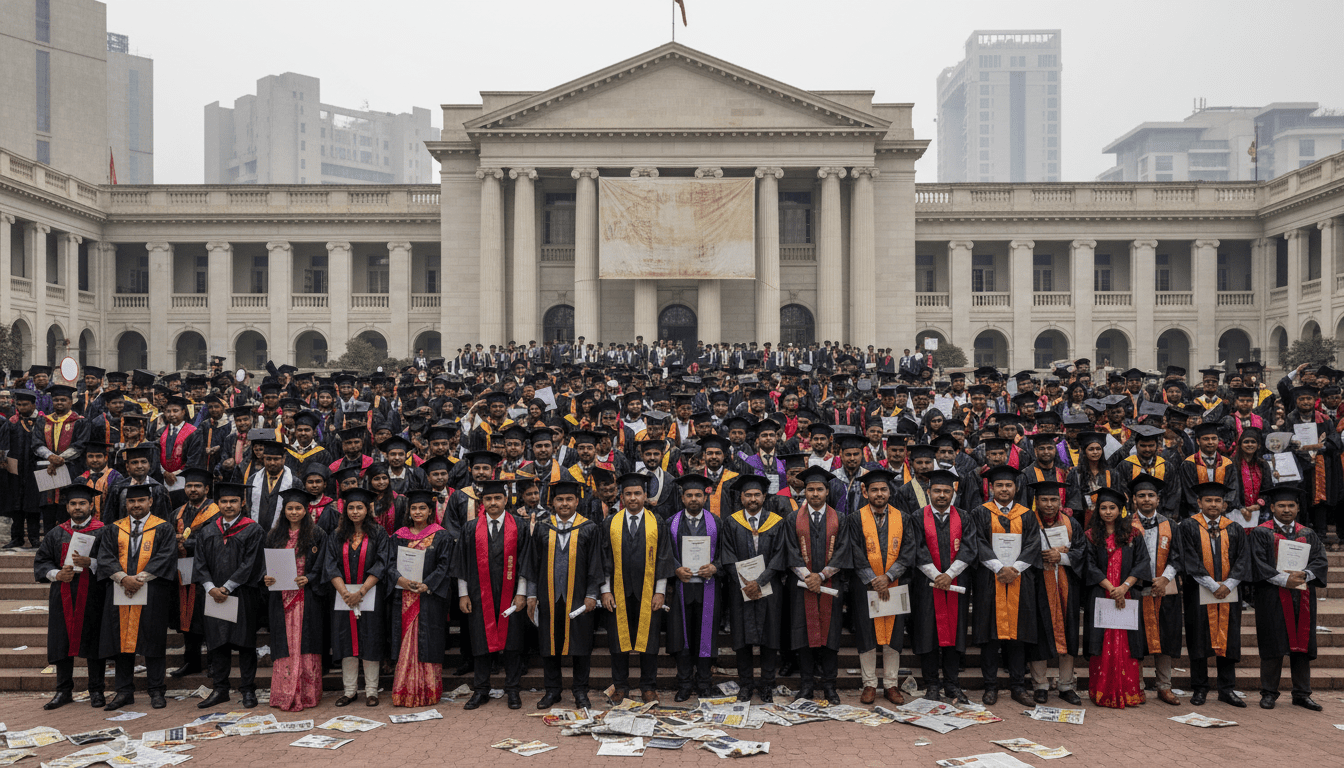
India’s graduate unemployment deepens as Noida delivery riders expose the human toll
India’s graduate unemployment is stark as a new study finds most university graduates fail to secure stable work, highlighted by a Noida delivery rider’s daily struggle.
In Noida a college graduate named Subash Chander begins long workdays on a motorcycle that belie the city’s marketed image as an IT and education hub. His experience underscores a growing national problem as recent research shows a large majority of new graduates do not find fixed employment in their first year after leaving university. The contrast between promised opportunity and everyday precarity is central to a widening debate about India’s economic model.
Noida’s promise and a graduate’s reality
Noida advertises IT parks, modern infrastructure and leading universities as evidence of an economic boom that will create opportunities for young professionals. Yet many graduates with degrees are unable to translate qualifications into steady employment and decent wages in the suburbs of New Delhi.
Chander’s routine is emblematic. Ten years after finishing university in Varanasi he works long hours as a courier and rideshare driver for app platforms, often earning only a few euros a day. His story is not an isolated anecdote but part of a broader mismatch between educational output and job creation.
Study finds most graduates without a fixed job
A national study released earlier this year reports that a large share of university graduates fail to secure permanent positions during their first year on the labour market. The finding has alarmed economists and policymakers who point to structural bottlenecks in the labour market and the education system.
Experts quoted in the study argue that producing more graduates has not been matched by sufficient growth in quality jobs. The result is underemployment and a proliferation of gig and informal work that offers little security and few benefits for young degree holders.
Daily grind on the delivery routes
On a single morning in Noida Chander checks the Ola and Rapido apps for rides and parcel jobs, often losing assignments to faster competitors. When work comes it pays low sums and can vanish for long stretches as supply of drivers outstrips demand.
His living conditions reflect the economics of precarious work. Renting a ten square metre room for a quarter of his monthly income, he shares that his wife and child have returned to the village because steady urban life was unaffordable. The physical toll of long hours and polluted air compounds the insecurity of erratic income.
Macro pressures weighing on domestic demand
Rising energy costs and shifts in currency reserves have added strain to household budgets and government policy. Authorities have responded with gradual fuel price increases and calls for public restraint to limit foreign exchange outflows, but such measures also depress domestic consumption.
Economists warn that low or falling demand can be as harmful as high inflation for a developing economy because it signals weakened purchasing power and slower growth. For young jobseekers, weaker demand translates into fewer openings in services and manufacturing that can absorb large cohorts of graduates.
Industry response and mixed investment signals
Some sectors have created jobs through large scale manufacturing and digital services, with notable firms expanding production in India. Such investments have generated millions of direct and indirect roles but are concentrated in certain skill bands and regions.
Net direct investment into real economy projects remains modest relative to the ambitions of rapid industrialisation. International portfolio flows have also shown volatility, which contributes to uncertainty for companies considering long term capital spending. The patchwork of progress underscores why many graduates still struggle to find placements that match their qualifications.
Policy choices for sustainable job creation
Experts and university researchers say the shortfall in jobs reflects both insufficient private investment in labour intensive industries and an education system that does not always equip students for market needs. Calls for stronger vocational training, incentives for small and medium enterprises and improved ease of doing business have grown louder.
Policymakers face a twofold task: boost demand for quality jobs while ensuring that growth translates into broad based employment rather than headline GDP gains. Without coordinated reforms the risk is that millions more graduates will continue to leave universities each year with limited prospects.
The human consequences are immediate and personal as in Noida where a degree no longer guarantees a path out of poverty and where everyday survival falls to app screens and uncertain fares.
