
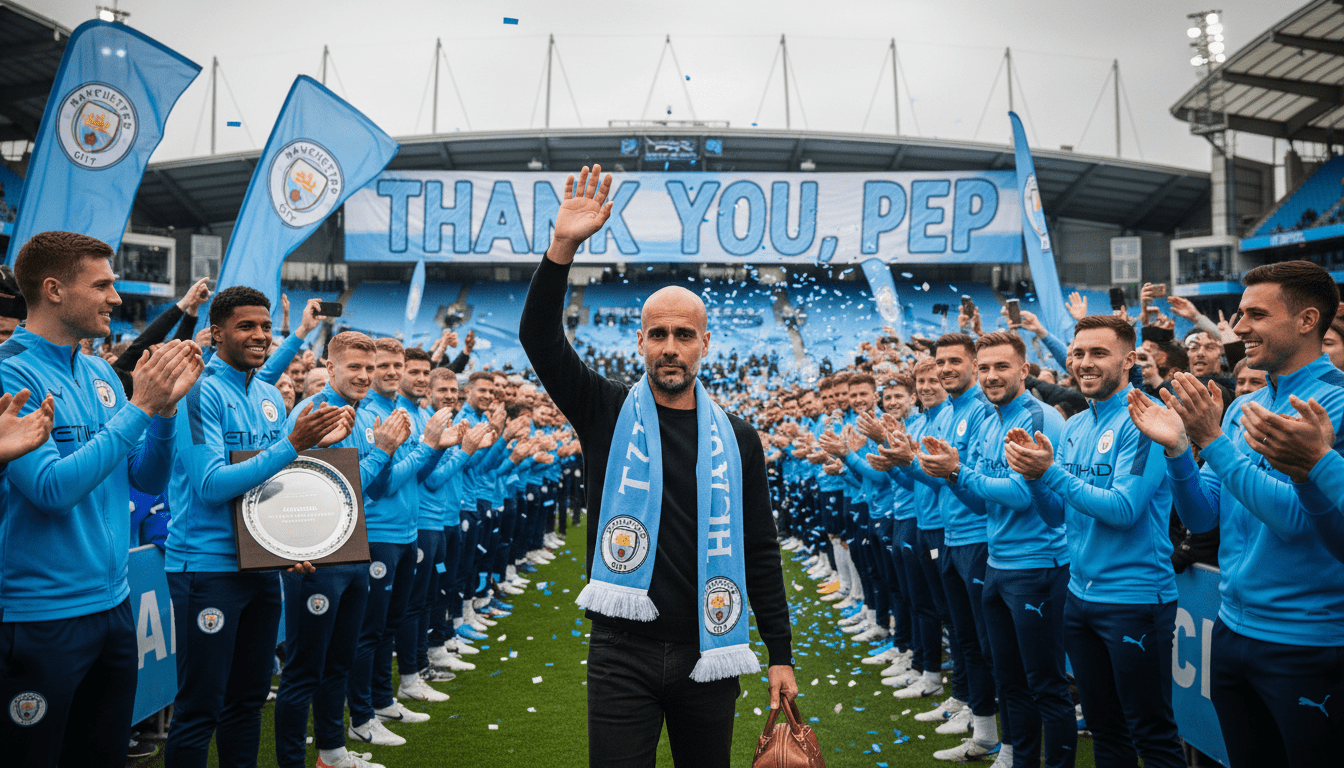
Pep Guardiola exits Manchester City after ten trophy-laden years
Pep Guardiola has stepped down as Manchester City manager after a decade that delivered 17 major trophies and a profound tactical shift in English football.
Pep Guardiola left Manchester City on the back of a 1-2 defeat to Aston Villa, but the result was secondary to a farewell that celebrated a decade of sustained success and transformation at the Etihad. The club honoured him with the naming of the expanded North Stand and vowed a statue, while Guardiola, visibly emotional, signalled he will not return to frontline coaching for the immediate future. City announced Enzo Maresca as his successor and said Guardiola will take on an ambassadorial role within the City Football Group.
Guardiola’s decade closes amid public tributes
The final whistle at the season’s curtain saw players, staff and supporters focus on Guardiola’s legacy rather than the scoreline. City’s hierarchy immediately moved to enshrine his tenure with stadium recognition and long-term commemorations. Guardiola acknowledged the outpouring, telling assembled fans and club officials that the memories matter more than the trophy count.
His departure was not abrupt; Guardiola had indicated in public that his energy for day-to-day management was waning despite a contract that still had time remaining. Club sources said City had hoped to retain him, but both parties agreed the transition should be orderly to preserve the progress established over ten years.
Enzo Maresca to take charge of the first team
The club confirmed Enzo Maresca as Guardiola’s successor, a choice that reflects continuity in coaching philosophy and tactical approach. Maresca, long considered part of Guardiola’s coaching orbit, is viewed as someone who can maintain City’s emphasis on possession and structured buildup while introducing his own managerial imprint. The appointment signals a deliberate attempt by City to limit disruption and preserve the identity Guardiola instilled across the squad.
Maresca inherits a squad that dominated domestically and has been built around Guardiola’s methods, but he will also face the immediate challenge of managing expectations and steering the club through unresolved external pressures. How he balances tactical orthodoxy with the pragmatic adjustments that characterized Guardiola’s later seasons will shape City’s next era.
Seventeen trophies and a redefined English game
Under Guardiola, Manchester City amassed six Premier League titles, three domestic cups and a long-sought Champions League triumph, among other silverware, reaching a total of 17 major trophies. Beyond the hardware, his influence is measured in the tactical ripple effects across English football: teams adopted more nuanced pressing, intricate buildup from goalkeepers, and an emphasis on positional play. Analysts and opponents alike credit Guardiola with accelerating a structural modernization of coaching and player development in England.
That influence extended beyond the first team into coaching networks, youth academies and rival clubs, where Guardiola’s emphasis on ball retention and spatial control became a blueprint rather than an anomaly. The result was a league that became tactically richer, producing more varied match plans and intensifying rivalries with coaches who tailored styles specifically to counter City’s blueprint.
Evolution from aesthetic purity to pragmatic pragmatism
Guardiola’s tenure was also a story of tactical evolution. Early seasons emphasized near-total possession and finely tuned positional rotations, but over time he allowed greater directness to coexist with his stylistic ideals. The signing and deployment of a powerful striker like Erling Haaland exemplified that shift, as Guardiola blended explosive attacking options with his established passing framework. Critics who once accused him of stubbornness later acknowledged his willingness to adapt.
Historic confrontations with managers such as Jürgen Klopp highlighted the contrasts and helped refine Guardiola’s approach. High-stakes matches produced tactical novellas—games that tested and often expanded Guardiola’s methods—forcing adjustments that contributed to City’s prolonged domestic dominance and eventual European success.
Champions League heartbreaks and ultimate vindication
Guardiola’s quest for Europe’s top prize included painful reversals, most notably the 2016–17 Champions League exit after a second-leg collapse against AS Monaco. Those defeats became formative, with Guardiola acknowledging tactical miscalculations and retooling his squad and mentality in response. Persistence paid off when City completed a career-defining Treble that included the Champions League, an achievement many regard as the crowning moment of his Manchester spell.
The Champions League victory validated the tactical iterations and personnel choices made across multiple seasons and silenced long-standing critics who argued he could not translate domestic dominance into continental success. It also cemented his position in the modern pantheon of club coaches.
Financial allegations cast a long shadow over achievements
Guardiola’s record at City is complicated by ongoing allegations from the league that the club breached financial regulations over an extended period. Authorities have outlined more than a hundred alleged breaches, some dating back to 2009, encompassing reporting practices, sponsorship declarations and cooperation during investigations. Manchester City has consistently rejected the accusations, and the matter remains unresolved, leaving a constitutional footnote to the club’s sporting accomplishments.
Guardiola has repeatedly stated his trust that the club operated properly, but the uncertainty surrounding the legal and regulatory scrutiny raises questions about how his legacy will be judged in the longer term. For now, City and Guardiola depart the season under a cloud of investigation even as the immediate focus for supporters and the club is the sporting farewell.
Pep Guardiola will now step into a different role within the City Football Group, taking on ambassadorial duties while stepping back from daily management, and Manchester City will begin the task of translating a decade of Guardiola-crafted identity into a sustainable future under new leadership.
