
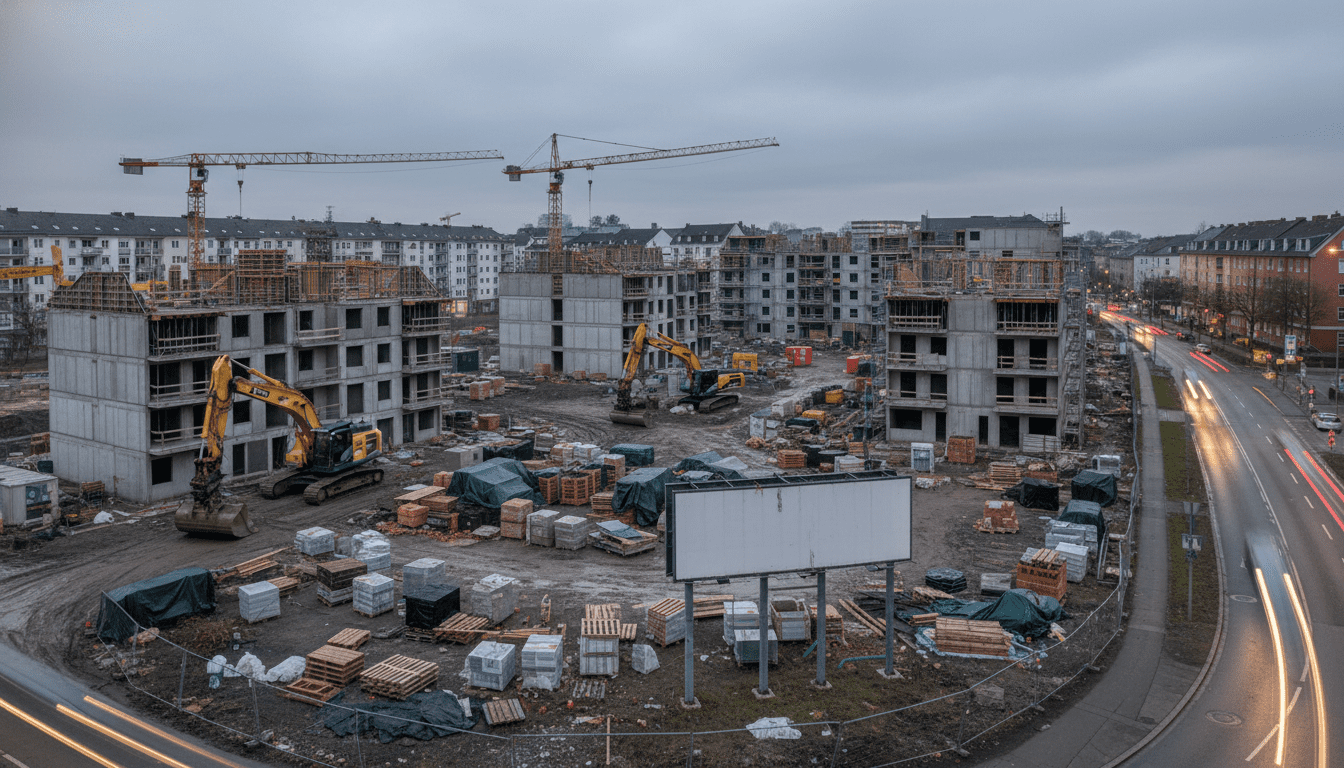
Housing construction in Germany falls 18% as costs and regulations stall new builds
Germany’s housing construction fell 18% to 206,600 new units last year as rising costs, regulation and municipal demands curb development and slow delivery.
New housing starts fall 18% to 206,600 units
The German housing market recorded a sharp drop in new construction, with new apartments completed last year falling 18% to 206,600 units. That follows an already significant decline of about 14% the year before, underscoring a multi-year downshift in new supply while urban demand remains high.
Supply shortfalls are most acute in large cities where rents are rising and vacancy rates are low, yet approvals and completions are being pushed further back. Analysts and builders warn that even recent upticks in permits will take time to translate into occupied homes.
Municipal requirements and planning constraints
City and municipal rules are a major factor in project costs and timelines, with requirements for underground parking, daycare capacity and open-space contributions adding complex layers to planning. When local councils insist on extensive amenities or infrastructure contributions, developers often scale back or abandon projects because margins no longer support construction.
This dynamic means that loosening federal rules alone is insufficient; local decisions determine whether plots are economically viable for housing. Observers note that cities that relax nonessential demands can see faster and cheaper development, which would help relieve pressure on the rental market.
Federal measures aim to ease rules but results are mixed
Federal Building Minister Verena Hubertz (SPD) has pushed measures such as the so-called “Wohnungsbauturbo” and a simplified building type labeled E to reduce regulatory friction and accelerate construction. These reforms are intended to lower red tape and speed approvals, but their effect depends heavily on adoption and implementation at the municipal level.
Even where federal signals are positive, administrative capacity remains an obstacle: planning authorities with backlogs and slow digital processes limit how quickly projects can move from permit to shovel. Faster digital permitting and streamlined procedures in local administrations are repeatedly identified as necessary steps to translate policy into more homes.
Regulatory pressure affects landlord incentives
Landlords and investors face a regulatory environment that many say has grown less favorable to new supply, with measures such as the Mietpreisbremse and altered rules on heating-cost allocation making lettings and returns more uncertain. Political debate has also included proposals ranging from a formal rent cap to more aggressive measures such as expropriation of major housing companies in some cities.
These interventions can reduce the private-sector appetite to build rental housing or to offer units as furnished short-term rentals, shrinking the range of market responses to demand. Industry representatives argue that predictable, targeted incentives would do more to increase rentals than further restrictions.
Industry shifts toward prefabrication and digital methods
Builders and developers are increasingly turning to industrialized construction methods and digital planning to reduce time and cost pressures. Prefabrication of walls, modular room units and off-site assembly can shorten on-site schedules and improve price predictability, offering a potential path to deliver more units at lower cost.
However, scaling these methods requires upfront investment, standardization and a stable pipeline of orders; fragmented municipal requirements and bespoke project demands limit economies of scale. Where developers, municipalities and suppliers coordinate, pilot projects have shown quicker delivery and lower unit costs.
Conversions and rooftop additions provide near-term relief
One bright spot in the data is that new homes added within existing buildings fell by only about two percent, suggesting that conversions, infill and attic extensions are more resilient than greenfield projects. Expanding upward and repurposing underused space can be a faster route to additional units, especially in dense urban neighborhoods.
Policymakers and planners are discussing incentives to encourage such measures, including loosening rules on upzoning, simplifying permission for loft conversions and supporting brownfield redevelopment. Even with more permits issued recently, the time between approval and occupancy means visible improvements in supply will lag, keeping pressure on renters in the near term.
The interplay of higher construction costs, municipal requirements and regulatory intervention has produced a pronounced slowdown in Germany’s housing construction exactly when urban demand is strongest. Unless federal reforms are matched by local policy changes, faster administration and greater industry adoption of prefabrication, the shortfall in new homes is likely to keep rents elevated and make affordable urban housing harder to find.
