
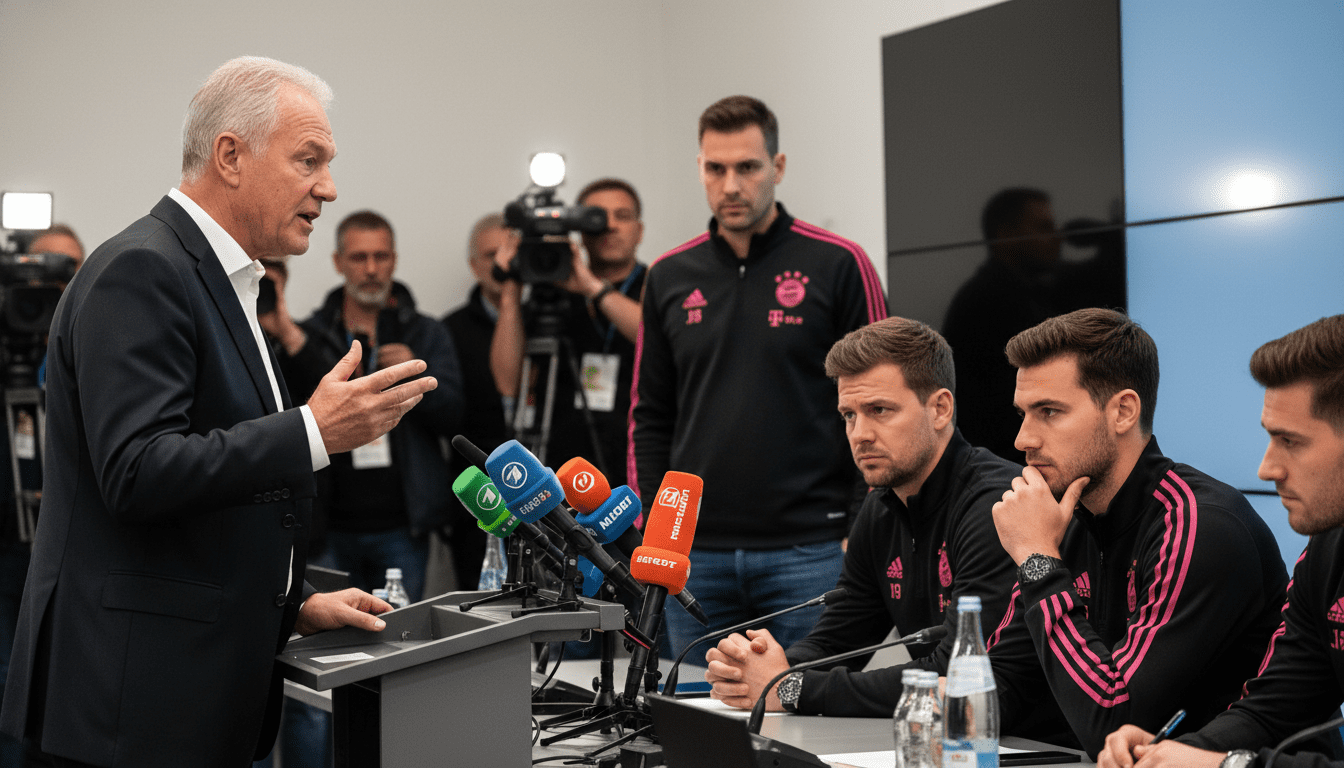
Uli Hoeneß criticises Julian Nagelsmann over Neuer decision and Kimmich role ahead of World Cup
Uli Hoeneß criticises Julian Nagelsmann over his handling of Manuel Neuer, questions Kimmich’s tactical role and urges more cohesion ahead of the World Cup.
Uli Hoeneß has once again publicly criticised Julian Nagelsmann, focusing on the coach’s communication around the goalkeeper situation and the deployment of Joshua Kimmich. Hoeneß said the timing and manner of announcements about the starting goalkeeper were inappropriate, while defending the sporting case for Manuel Neuer. The veteran Bayern figure also argued that positional decisions for key players risk undermining leadership and collective preparation ahead of the tournament.
Hoeneß renews his critique of the goalkeeper handling
Hoeneß described the sequence of events over the Germany goalkeeping spot as poorly managed and untimely. He said an early declaration that Oliver Baumann would be number one, followed by planning to use Neuer, created avoidable confusion within the squad.
Despite the criticism of process, Hoeneß did not dispute the sporting rationale for selecting Neuer as the starting goalkeeper. He framed his comments as technical and tactical concerns rather than a personal attack, urging clearer communication from the coaching staff.
Dispute over the Baumann announcement and squad messaging
The controversy centers on an announcement made in spring that assigned Baumann as Germany’s World Cup No. 1, a decision Hoeneß argued should not have been publicised so far in advance. He claimed the premature message undermined team clarity and left room for mixed expectations.
Those management and messaging errors, Hoeneß warned, can have consequences beyond media headlines by unsettling player preparation and internal hierarchy. He suggested that selection decisions should be managed in a way that preserves unity and reduces avoidable distraction.
Kimmich’s deployment at right-back questioned
Hoeneß was equally critical of deploying Joshua Kimmich at right-back rather than in his customary midfield role. He argued that Kimmich’s leadership and playmaking are most effective in central areas and that shifting him to the flank diminishes his influence.
To bolster midfield control, Hoeneß proposed a compact central pairing built around Kimmich and a club teammate, advocating for a midfield “block” that would mirror successful club structures. He warned that misplacing a leadership figure could cost the national team control in key moments.
Assessment of the 26-man World Cup squad
Assessing the 26-man list named by the coach, Hoeneß described the selection as broadly solid but stopped short of calling it world-class. He acknowledged several strong options while raising concerns that the group still lacks the cohesion expected of top international sides.
Hoeneß singled out the federation’s recent match schedule, suggesting that a failure to use friendlies for genuine team-building left players insufficiently prepared to operate as a unit. His critique emphasized process and preparation rather than individual talent alone.
Calls for more collective training and repeated assemblies
A central element of Hoeneß’s argument is that assembling a functional national team requires repeated, focused sessions rather than single, intermittent gatherings. He recommended bringing core groupings together multiple times to forge tactical understanding and mutual trust.
Hoeneß estimated that playing together “three, four, five times” would be necessary to convert talented individuals into a cohesive side capable of sustained success at the World Cup. His prescription underlines a belief that familiarity and shared patterns are as important as roster quality.
Nagelsmann’s public stance and reactions across German football
The national coach has responded with restraint, saying he respects Hoeneß’s record and is rarely personally offended by public criticism. He noted that he seeks to learn from outside commentary while continuing to pursue his tactical plan and selection criteria.
Reactions around German football have been mixed, with some voices backing Hoeneß’s emphasis on communication and preparation and others defending Nagelsmann’s autonomy and recent results. The exchange has reopened a broader debate about the balance between media messaging, player management and on-field strategy.
Tensions between high-profile figures have sharpened scrutiny on Germany’s final preparations for the tournament in the United States, Mexico and Canada. With the World Cup approaching, both the coaching staff and federation face pressure to demonstrate clearer internal alignment and to convert individual quality into a resilient team.
