
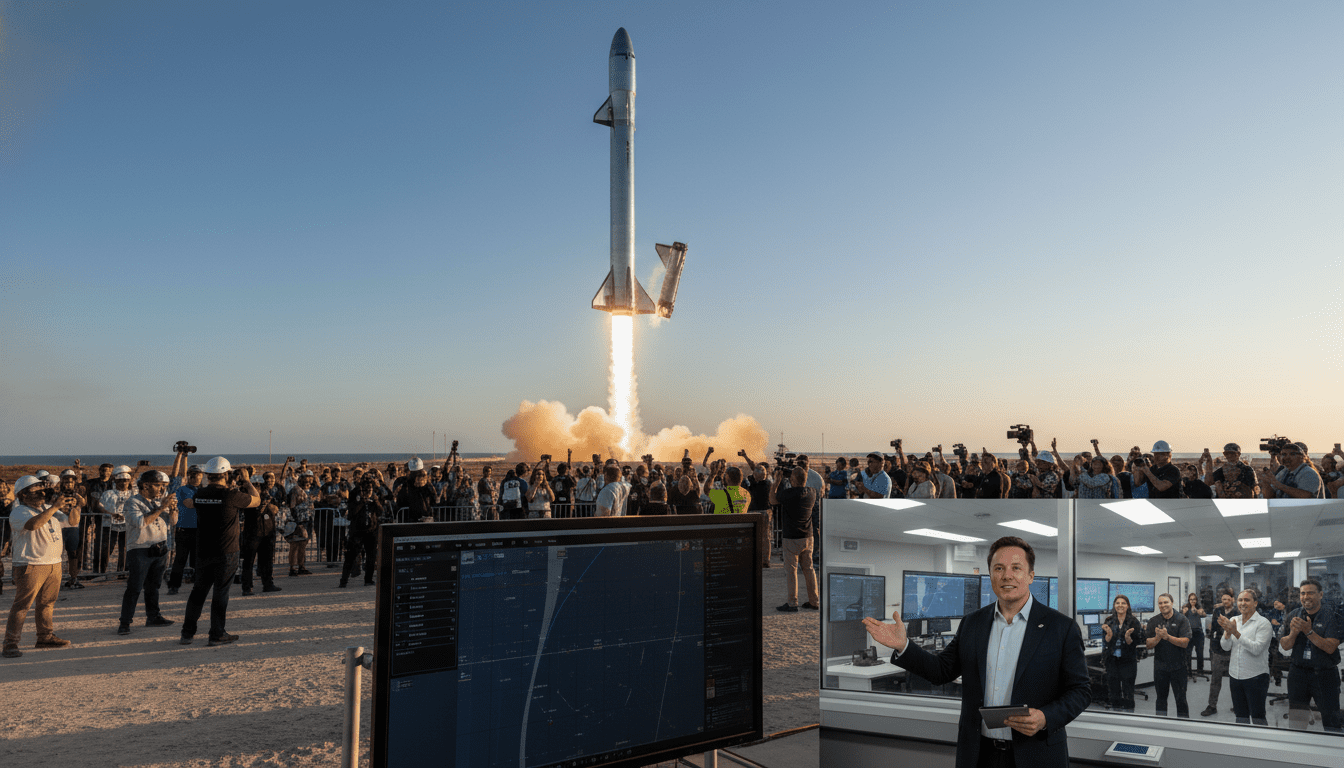
SpaceX completes twelfth Starship test using upgraded third-model configuration
SpaceX completed its twelfth Starship test on May 22, 2026 using a new third-model configuration; upper stage deployed satellites before failing on reentry.
SpaceX on Friday, May 22, 2026, carried out the twelfth test flight of its Starship rocket using a freshly updated, third-model configuration, a milestone the company said followed an aborted attempt the previous day. The Starship test — central to SpaceX’s stated development and financial plans — launched at about 18:30 local time from the Brownsville, Texas, facility and demonstrated both successes and setbacks in a largely routine but technically complex mission. The flight used redesigned engines and a modified launch pad and ended with the upper stage delivering satellites before breaking up on atmospheric reentry.
Flight timeline and immediate results
The vehicle lifted off at 18:30 local time and separated into its two stages after roughly three minutes, as planned, with the Super Heavy booster returning toward the Gulf of Mexico and the upper Starship stage continuing into orbit. Ground tracking indicated that one engine failed on the lower stage and another on the upper stage during ascent, but the mission still achieved most of its stated flight objectives. After circling the Earth for just over an hour and releasing multiple satellites, the upper stage reentered and was observed to explode in the Indian Ocean upon atmospheric descent.
New third-model configuration and pad alterations
This flight marked the first operational use of SpaceX’s third major Starship design iteration, which includes reworked engines and structural adjustments intended to improve reliability and performance. Engineers also altered the launch pad at the Boca Chica complex near Brownsville ahead of the test, changes described by the company as part of an ongoing effort to refine ground operations and support higher-frequency launches. SpaceX characterized the updated configuration as an important step toward achieving routine, reusable operations for both stages of the system.
Technical context and reusability ambitions
Starship is designed as a two-stage, roughly 120-meter system consisting of a reusable Super Heavy booster and the Starship upper stage, both engineered for recovery and repeated flights. SpaceX has repeatedly emphasized the recovery objective — including plans to have both stages return to the pad and be captured by large mechanical arms — although the pad-capture maneuver was not attempted during this test. Previous missions since Starship’s first orbital attempt in 2023 have produced a mix of early explosions and longer, largely successful flights; the company says iterative testing is part of achieving full reusability.
Financial stakes and R&D investment reported in IPO prospectus
The flight came only weeks before SpaceX’s planned initial public offering, and the company’s IPO prospectus highlights Starship as the primary focus of its research-and-development budget. The prospectus disclosed that SpaceX spent about $3.0 billion on R&D last year and roughly $930 million in the first quarter of 2026, with total investment in Starship exceeding $15 billion to date. Company filings warn that delays in Starship development could materially affect SpaceX’s growth strategy, underlining how technical progress is tightly linked to the firm’s near-term financial plans.
Operational uses: Starlink, NASA and commercial targets
SpaceX intends Starship to serve multiple roles, from deploying large batches of Starlink satellites to supporting NASA’s Artemis lunar program with a crewed lander variant. The prospectus projects the first commercial payloads on Starship in the second half of 2026, a timetable many industry analysts regard as ambitious. SpaceX’s Starlink business — responsible for a majority of the company’s revenue and currently the only profitable segment — is a primary near-term customer for the rocket, while NASA’s lunar ambitions and potential commercial point-to-point Earth transport represent longer-term markets.
Market implications ahead of the planned June IPO
SpaceX’s June 2026 public offering is expected to be one of the largest in history, with media reports citing plans to raise roughly $75 billion and an aspirational market capitalization near $1.75 trillion. The outcome of that listing, and investor appetite for a company still investing heavily in Starship, will depend in part on technical progress demonstrated by flights such as this one. Company executives have positioned Starship as essential to SpaceX’s growth narrative, and the latest test both advanced engineering objectives and highlighted areas still requiring refinement.
The twelfth Starship test thus represents a mixed but meaningful advance for SpaceX: it validated the new, third-model configuration in flight and succeeded in placing satellites into orbit, while also exposing engine reliability challenges and the hard realities of reentry recovery. As SpaceX moves toward a high-profile public listing in June 2026 and aims for commercial Starship operations later this year, engineers and investors alike will be watching whether the program can sustain rapid iteration while reducing the technical anomalies seen in recent flights.
