
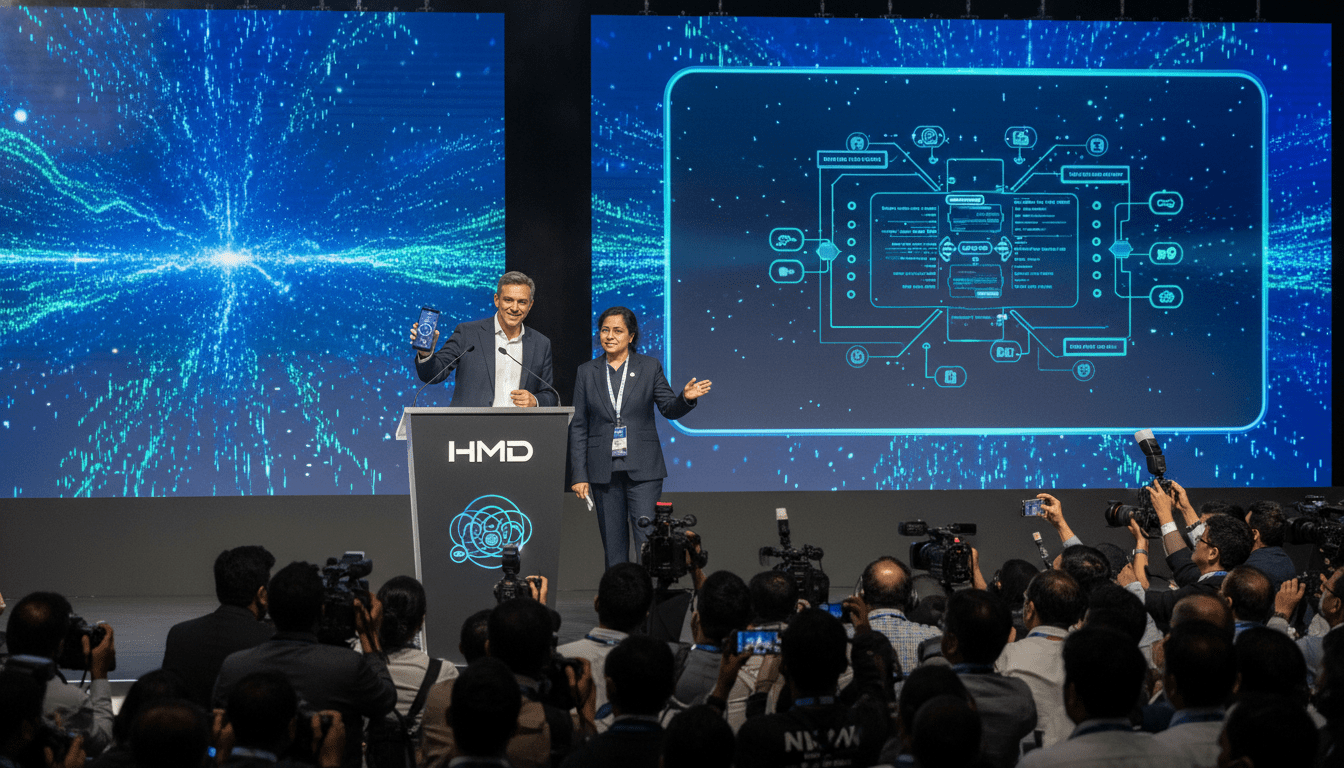
HMD Vibe 2 5G Launches in India Preloaded with Sarvam’s Indus AI Assistant
HMD launches the Vibe 2 5G preloaded with Sarvam’s Indus AI assistant, targeting India with regional languages on affordable hardware priced at ₹10,999.
The Finnish handset maker HMD Global has introduced its first smartphone, the HMD Vibe 2 5G, which ships in India with Sarvam’s Indus chatbot preinstalled. The move embeds a locally trained 105-billion-parameter AI model on an entry-level Android device and positions the device as a low-cost on-ramp to regionally fluent conversational AI for Indian users. The Vibe 2 5G is priced at ₹10,999 and carries a large 6,000mAh battery, putting the HMD Vibe 2 5G directly into the budget smartphone segment.
Indus chatbot integrated at launch
HMD has preloaded the Indus app developed by Indian AI startup Sarvam on the Vibe 2 5G, making the assistant available out of the box to buyers in India. The Indus application runs on Sarvam’s 105-billion-parameter language model, which the company developed and debuted at the India AI summit earlier this year. HMD’s decision to bundle the app aims to accelerate consumer exposure to a locally engineered conversational AI tailored for India’s linguistic environment.
Language support and technical limits
Sarvam’s Indus assistant supports 22 Indic languages and handles mid-sentence code-switching, a capability designed to reflect how many users naturally mix Hindi and English or other regional tongues. The model’s language breadth is intended to address the gap left by English-first AI tools in India. However, Indus currently requires an online connection to function and does not offer a hardware shortcut or integrated device trigger to summon the assistant directly from the Vibe 2 5G’s interface.
Device specifications and pricing strategy
The Vibe 2 5G is positioned as a mid-range Android handset with a focus on battery life and affordability. Its 6,000mAh battery is a core selling point alongside 5G connectivity at a price of ₹10,999 (about $114). HMD has said the Vibe series will also receive the Indus chatbot and flagged plans to introduce a feature phone carrying Sarvam AI in the coming months. The combination of low price and AI bundling reflects a strategy to seed regional AI adoption through inexpensive hardware.
Market context and HMD’s footprint
HMD’s smartphone market share in India has been negligible, with analyst firm IDC not listing the company among the top 15 smartphone vendors in 2025. The company retains a foothold in feature phones, where it held roughly a 4% share in India last year. Observers note that bundling an indigenous AI assistant with both smartphones and feature phones could be a pragmatic route for HMD to expand reach while testing consumer appetite for regional AI experiences.
Early download numbers and adoption challenges
Adoption for Indus is still nascent. According to Appfigures, the Indus app has recorded just over 293,000 downloads in India across platforms in the three months since its launch, a modest figure when compared with established global competitors. For context, ChatGPT has been downloaded tens of millions of times in India, illustrating the steep challenge for a regional entrant to scale quickly. HMD and Sarvam appear to be treating the Vibe deal as a distribution experiment rather than a mass-market breakthrough at this stage.
Strategic importance of a feature-phone rollout
Industry watchers argue the upcoming feature-phone integration may prove pivotal. Feature phones remain widely used across India, particularly in smaller towns and among first-time internet users, and bundling speech-enabled local language AI into such devices could significantly broaden reach. For Sarvam, access to a large installed base through low-cost devices would provide a direct channel to users who are otherwise underserved by English-centric AI apps.
Sarvam’s funding and enterprise focus
Sarvam has emerged as one of India’s better-funded AI startups and has pursued enterprise as well as consumer-facing initiatives, particularly voice-based solutions tailored for businesses. Reports indicate the company is in advanced discussions for a substantial funding round that could value it around $1.5 billion, with plans for roughly $300 million in new capital. That backing helps explain Sarvam’s ability to ship a large model and strike commercial distribution deals with device makers like HMD.
Industry analysts say the HMD-Sarvam partnership is a visible test case for how homegrown AI can be distributed in emerging markets, where linguistic diversity and low-cost hardware make global incumbents less directly applicable. HMD’s CEO and Vice President for India and APAC, Ravi Kunwar, described the initial phase as focused on getting Indus into consumers’ hands and then working on features and stickiness to boost ongoing engagement.
While the early metrics are modest, the partnership highlights a broader play: coupling localized AI with affordable hardware to seed usage in markets where language and device economics limit adoption of mainstream AI tools. Whether that strategy yields scale will depend on user experience improvements, offline capabilities, and HMD’s ability to roll the assistant into the much larger feature-phone base.
Looking ahead, the commercial test in India will be closely watched by investors, device makers and AI developers as a model for bringing regional AI assistants to mass-market users in emerging economies.
