
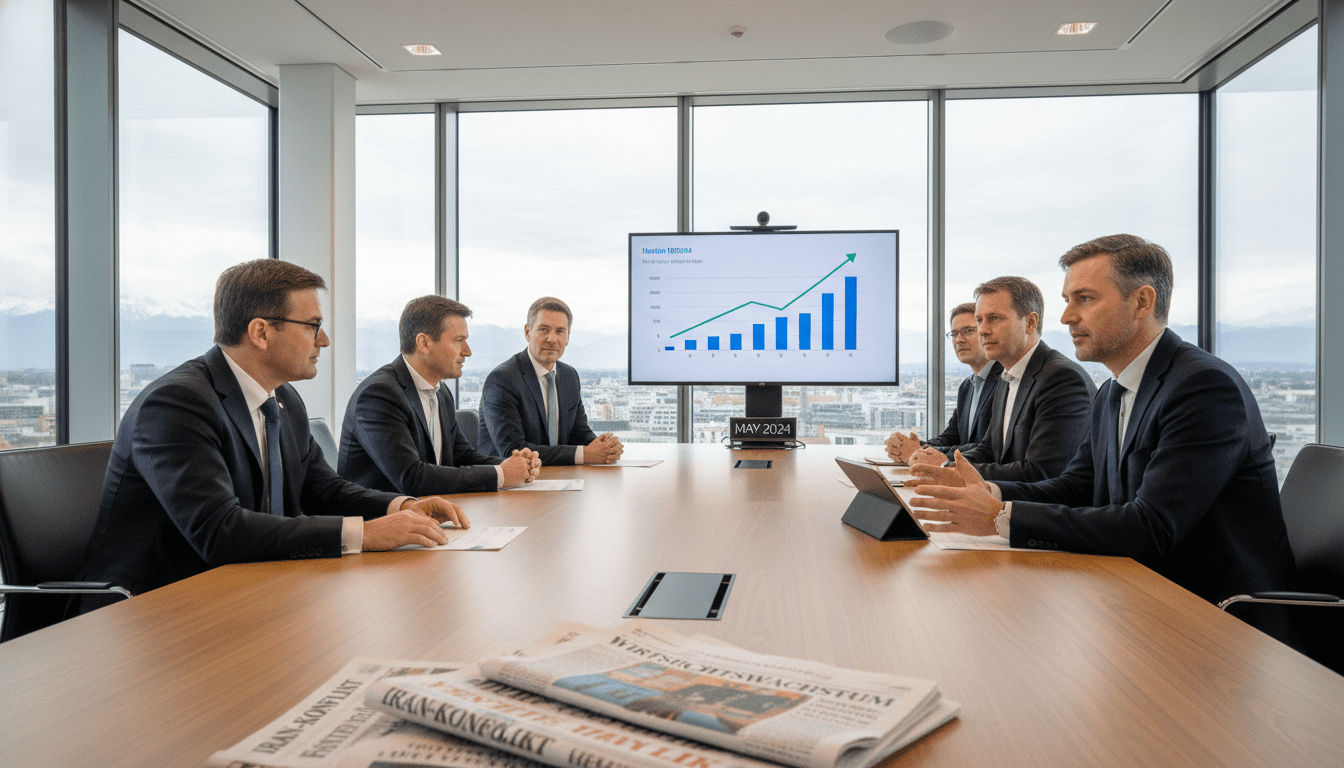
Ifo business climate index edges up to 84.9 in May as services rebound
Ifo business climate index edges to 84.9 in May as services rebound; German economy shows fragile stabilization amid rising energy costs and Iran-war fallout.
The Ifo business climate index rose slightly to 84.9 in May from 84.5 in April, signaling a modest improvement in corporate sentiment even as uncertainty persists across the German economy. The uptick came in spite of concerns linked to the Iran conflict and higher energy prices, with expectations from firms improving more than economists had forecast. Business leaders reported marginally better assessments of current conditions, but Ifo officials cautioned that the recovery remains shallow and vulnerable.
Ifo index records a surprise uptick
The Munich-based Ifo Institute reported the index climbed to 84.9, beating median economist expectations for a decline to 84.2. The change reflects both slightly improved appraisals of present business and firmer outlooks for the coming months. Ifo president Clemens Fuest described the situation as a tentative stabilization, while survey head Klaus Wohlrabe stressed that sentiment is still at a low level.
The gain is modest in absolute terms, but notable given the backdrop of geopolitical risk and inflationary pressure. Analysts said the result suggests companies are adapting to recent shocks, yet they warned that momentum is fragile and could reverse if energy costs or trade conditions worsen.
Services sector leads the recovery
The May survey showed the services sector delivering the strongest improvement, with expectations rebounding after sharp falls in prior months. Service firms reported better demand prospects and a more positive view of ongoing business activity, lifting the sector’s contribution to the overall index.
Improvement in services points to resilient consumer-facing and business services activity despite squeezes on household purchasing power. Economists noted that services are often more domestically oriented and less exposed to immediate energy-cost volatility than manufacturing, which may explain the relative resilience.
Trade and consumer demand remain weak
Retail and wholesale firms continued to report subdued sales as consumers curb spending amid higher prices for fuel and everyday goods. The Ifo analysis pointed to reduced purchasing power after inflation rose following energy price increases linked to the Iran conflict. Firms in trade said households were prioritizing essentials and delaying discretionary purchases.
Export-oriented traders and manufacturers cited softer foreign demand, leaving the overall external outlook cautious. While some companies reported pockets of steady order books, the consensus signaled restrained consumption that will likely temper growth in the near term.
Industry and construction show divergent trends
Industrial sentiment remained constrained by elevated energy costs, with sectors such as chemicals particularly affected by higher fuel and feedstock prices. Manufacturers reported that energy-intensive production and input-price volatility are weighing on margins and investment plans. The industry’s assessment of future activity improved only marginally compared with services.
Construction activity diverged within its subsectors: civil engineering benefited from public infrastructure projects tied to state spending, whereas residential and commercial building faced headwinds. Rising borrowing costs and higher construction financing made many private projects less profitable, reducing high-rise and housing starts in several regions.
Macro outlook points to stagnation in second quarter
Ifo’s reading suggests the German economy may stagnate in the current quarter after a modest 0.3 percent expansion in the first quarter. The institute’s updated projections incorporate the economic impact of the Iran conflict and elevated energy prices, leading to a forecast of around 0.6 percent growth for the year as a whole. That outlook assumes continued subdued domestic demand and restrained export momentum.
Policy makers and market observers said the slim positive in business sentiment should not be interpreted as a robust recovery. They emphasized that the outlook depends on energy-price trajectories, consumer confidence, and external demand conditions, any of which could swing the economy back toward contraction.
Survey scope and methodological notes
The Ifo Institute based its monthly assessment on responses from roughly 9,000 business executives across Germany’s major sectors. The questionnaire asked firms to evaluate both current business conditions and expectations for the next six months, allowing the institute to construct separate subindices for industry, services, trade and construction. The sampling provides a timely snapshot of corporate sentiment but can be sensitive to short-term events and swings in commodity prices.
Ifo officials noted that while the headline index improved, it remains at a level historically associated with weak growth, underscoring the tentative nature of the recovery. They urged caution in drawing broad conclusions from a single month’s data and highlighted the need to monitor subsequent readings for confirmation.
The small rise in the Ifo business climate index offers a brief respite for Germany’s policymakers and companies, but the institute’s assessment leaves open the risk that persistent inflation, elevated energy costs and international instability could stall the fragile improvement.
