
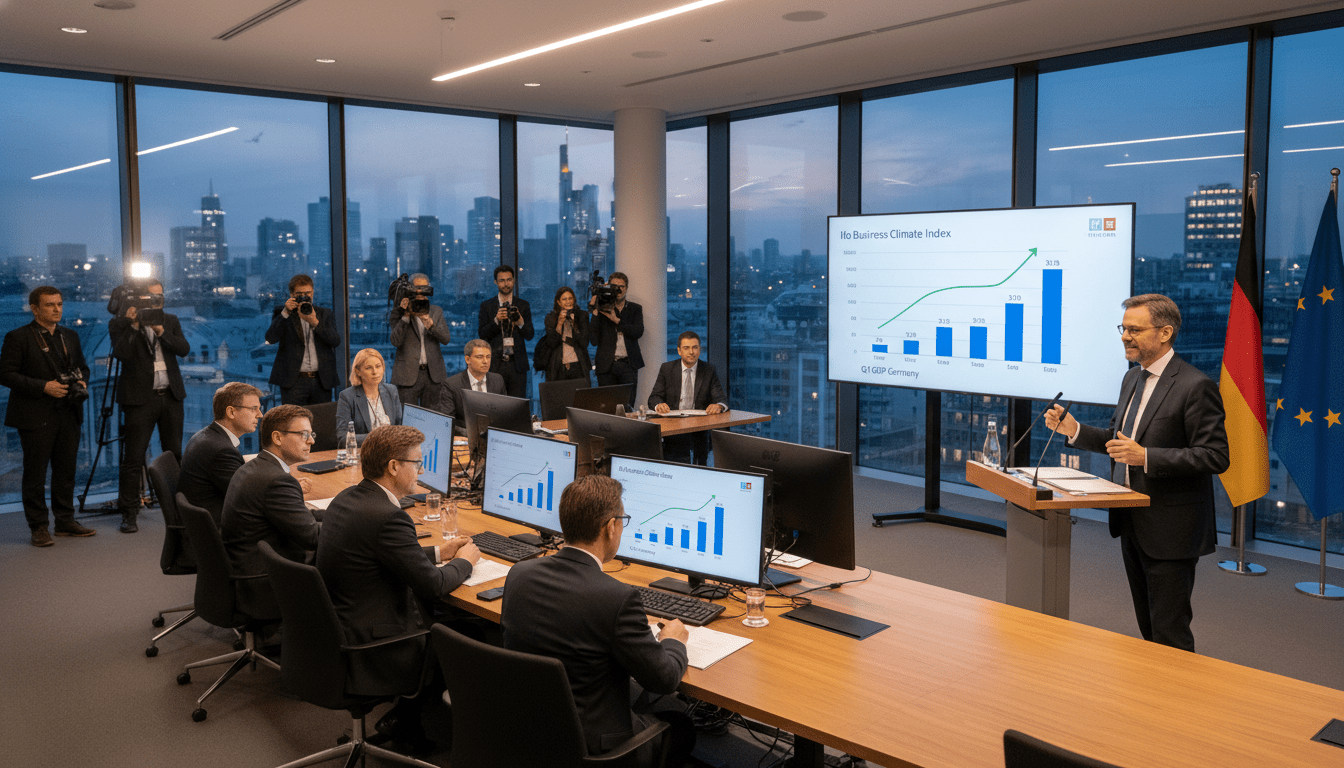
German economy shows tentative stabilisation as Ifo index edges up and Q1 growth confirmed
Germany’s economy received modest confirmation of stability in May as the Ifo business climate ticked up and first-quarter GDP data showed a small rebound. The Ifo business climate index rose to 84.9 in May, signaling a slight easing of pessimism among firms, while official statistics confirmed real GDP grew 0.3 percent in January–March. (fxstreet.com)
Ifo index records small gain, mood remains fragile
The Ifo Institute’s monthly survey showed business sentiment improved marginally after a period of sharp declines tied to geopolitical tensions. Firms reported a somewhat better assessment of their current situation and slightly less gloomy expectations for the months ahead, but the index level remains well below long‑run norms. Economic analysts warned that the uptick reflects stabilization at a low level rather than a sustained recovery.
Manufacturing leads the cautious improvement
Most of the improvement in May came from the manufacturing sector, where companies judged their current business situation more positively than in recent months. Survey responses suggested production and order books are stabilising, though firms continue to report weak domestic demand and elevated uncertainty over energy supplies. Construction stood out as the exception, with sentiment in the building sector remaining depressed by weather‑related disruption and long‑running investment weakness.
Exports and state spending drove Q1 expansion
Official data showed exports and government consumption were the main contributors to growth in the first quarter, reversing the contraction seen at the end of 2025. Total exports of goods and services rose markedly at the quarter’s start, while public consumption strengthened, helping deliver the 0.3 percent quarter‑on‑quarter gain in real GDP. Analysts noted that exports alone contributed a significant share of the quarter’s expansion, underscoring Germany’s dependence on external demand for near‑term growth. (destatis.de)
Private investment languishes at historically low levels
Despite the headline growth, domestic investment remained weak: private construction activity is at levels comparable with the early 2010s and overall private gross capital formation has barely recovered. There was a modest rebound in private equipment investment in Q1, but this followed a long period of contraction and leaves aggregate investment well below pre‑pandemic trajectories. Economists say the chronic shortfall in business investment is a structural drag that will curb medium‑term productivity gains unless addressed.
Energy supply risks could blunt the recovery
Policymakers and forecasters caution that the fragile improvement depends heavily on assumptions about energy shipments from the Gulf and the reopening of key shipping lanes. The Bundesbank has warned that higher energy prices and supply disruptions could push inflation up and leave the economy stagnating in the near term, with risks tilted to the downside if deliveries do not normalise. That assessment highlights how geopolitical developments in the Middle East have translated quickly into domestic economic headwinds for Germany. (bundesbank.de)
Consumers cautious as sentiment edges up only slightly
Household spending showed little momentum at the start of the year, with private consumption broadly flat as households absorbed higher energy costs and growing uncertainty. Consumer confidence rose a little in May — the NIM/GfK consumer climate improved from around −33.1 to −29.8 points — but the index remains historically weak and suggests spending will stay subdued while inflation and energy costs bite into real incomes. Analysts said a sustained recovery in consumption will require both improving real wages and more predictable energy markets. (nim.org)
The overall picture is one of tentative stabilisation rather than clear recovery: external demand and public spending provided a visible boost in the opening quarter, while domestic investment and household spending remain the economy’s weak spots. With the near‑term outlook hinging on energy flows and geopolitical developments, policymakers will be watching incoming data closely for signs that the fragile improvement is turning into a broader upswing.
