
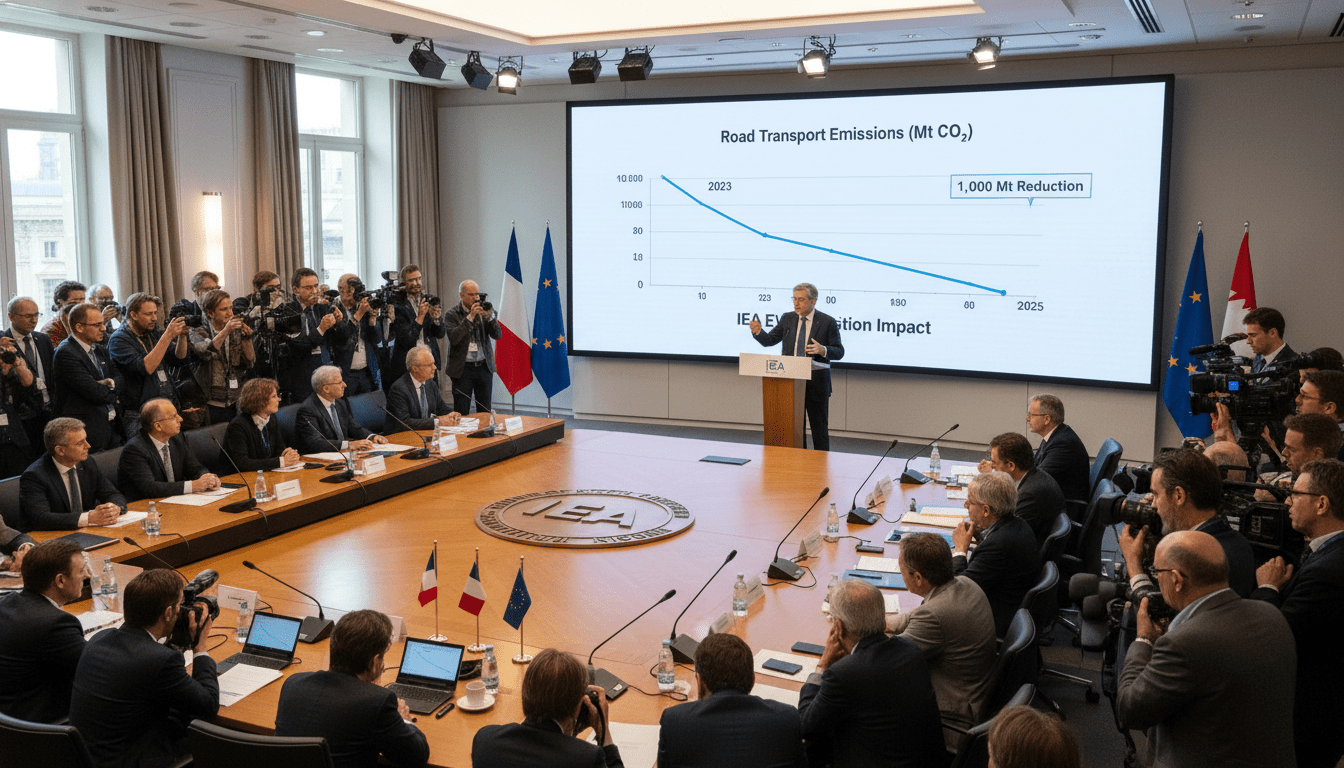
IEA: Electromobility Could Cut Road Transport Emissions by About 1 Billion Tonnes by 2035
IEA projects electrification could reduce road-transport greenhouse gases by ~1 billion tonnes by 2035; Germany’s new e‑car subsidy has triggered a surge in applications.
Electromobility is set to shrink direct greenhouse‑gas emissions from road transport by roughly 1,000 million tonnes of CO₂ and other gases by 2035, the International Energy Agency (IEA) projects, while demand for electric‑vehicle incentives has spiked in Germany. The forecast frames a significant emissions saving against a global transport sector that still contributes billions of tonnes of CO₂, underscoring both the potential and limits of vehicle electrification. Policymakers face a twin challenge: scaling clean electricity supply and steering rapid uptake in markets that account for most future traffic growth.
IEA projects 1 billion‑tonne reduction by 2035
The IEA’s scenario attributes the roughly one billion‑tonne reduction to the growing share of battery electric vehicles and improvements across vehicle and power‑system efficiency. This “well‑to‑wheel” approach counts emissions from battery production and electricity generation as well as tailpipe cuts, giving a fuller picture of climate benefits. Under current policy trajectories the reduction is meaningful but not sufficient to offset rising traffic in many regions.
Electrification alone will not erase transport’s climate footprint without changes in energy supply and vehicle use patterns. The IEA’s estimate therefore highlights both the scale of gains that are achievable with electromobility and the remaining emissions that require further measures.
Global emissions context and road transport trends
Road transport remains a major source of direct emissions; the IEA notes an increase of about 10 percent in direct road emissions from 2015 to 2025 driven largely by more vehicle kilometres travelled. The agency estimates that direct emissions from road vehicles in 2025 are measured against a global emissions baseline that runs into many tens of billions of tonnes when all sectors are included. That context tempers the headline gains from electrification: even substantial reductions in road emissions translate into modest downward pressure on total global emissions.
Other analyses referenced by international agencies place the entire transport sector’s emissions in the multi‑billion‑tonne range, including rail, shipping and aviation. Those sectors will also influence whether overall climate targets remain within reach.
Regional divergence with China and emerging markets
The IEA scenario shows divergent trajectories: in advanced economies with strict climate policies the number of vehicle kilometres is projected to grow modestly while CO₂ emissions fall due to cleaner vehicles and fuel standards. China, by contrast, is forecast to see a strong increase in road activity — with kilometres travelled rising by roughly a third — while electrification reduces direct emissions by more than a third.
Emerging and developing economies present a critical risk to global gains. Many of those countries are expected to expand road networks and vehicle fleets rapidly, and currently lack comprehensive policies to constrain emissions or accelerate electrification. As a result, their rising emissions could offset much of the decline achieved elsewhere unless policy and infrastructure catch up quickly.
Well‑to‑wheel caveat and the role of electricity
The IEA underscores that electrification’s climate benefit depends on the carbon intensity of electricity and the lifecycle emissions of batteries. Electric vehicles eliminate tailpipe emissions but shift emissions upstream to power plants and manufacturing sites unless those processes are decarbonized. The agency therefore applies a well‑to‑wheel accounting method to capture emissions from electricity generation and battery production.
That caveat means the same number of electric cars can produce different climate outcomes in different countries. Rapid grid decarbonization and cleaner battery supply chains enhance the net emissions savings from electromobility, while heavy reliance on fossil‑fuel power can blunt or even negate them.
Projected surge in electricity demand for EV charging
Widespread adoption of electric cars will require a substantial expansion of electricity supply and distribution capacity. The IEA notes that EVs on the road used about 250 terawatt‑hours (TWh) of electricity in 2025, and projects charging demand would need to rise roughly six to sevenfold to reach between 1,500 and 1,700 TWh by 2035 under different policy scenarios. That implies rapid investment in generation, grid upgrades and smart charging to manage peaks.
Meeting this additional demand with low‑carbon electricity is essential if electromobility is to deliver the forecasted emissions reductions. Policymakers must therefore coordinate vehicle incentives with power‑sector decarbonization and infrastructure planning.
German subsidy sees immediate high demand
In Germany the federal government’s new e‑car subsidy drew an immediate response: the environment ministry reported roughly 18,000 applications within 24 hours after the scheme opened, characterizing the volume as a “large surge” in interest. The instrument, administered by the Federal Office for Economic Affairs and Export Control (BAFA), is designed to support up to 800,000 vehicle purchases with a total funding envelope near three billion euros.
The subsidy applies retroactively to first registrations from January 1 and offers grants that vary by vehicle type, household income and number of children, with amounts ranging roughly from €1,500 to €6,000 per vehicle. Plug‑in hybrids are eligible but receive smaller support than pure battery electric vehicles, reflecting policy emphasis on full electrification.
The early uptake underscores consumer responsiveness to direct financial incentives, but also raises questions about administrative capacity and the speed of matching incentives to charging and grid readiness across regions.
The IEA’s findings and Germany’s subsidy rollout together illustrate that electromobility can be a powerful tool in reducing transport‑sector emissions, provided it is paired with decisive action to decarbonize electricity, scale charging infrastructure and align policy across countries experiencing the fastest growth in vehicle kilometres.
