
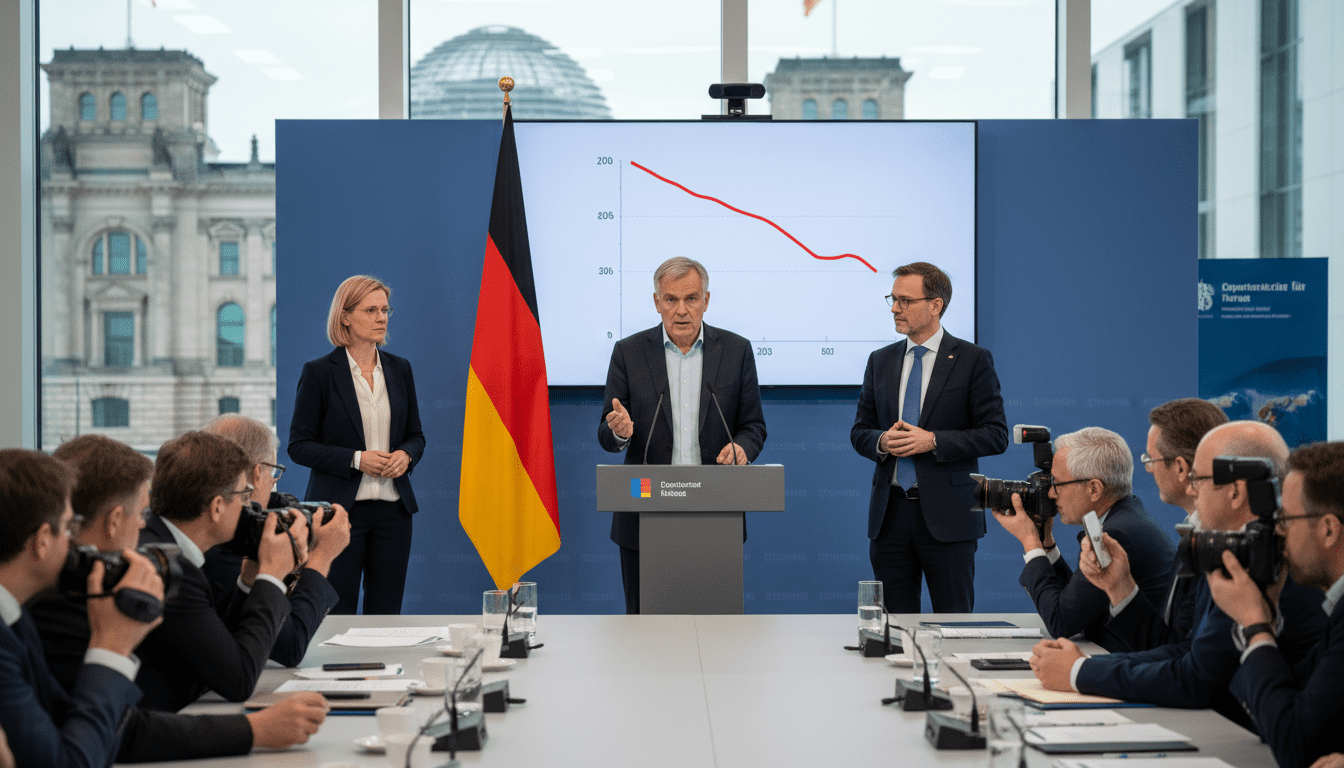
Germany Faces Likely Shift from Net-zero 2045 After Expert Council Review
Germany’s net-zero 2045 target is now widely seen as at risk after a new review by the federal Expert Council on Climate Issues, which finds reliable CO₂ reductions up to 2030 but warns of deteriorating prospects thereafter. The council’s assessment, shared with government officials, indicates current policies may fall short of achieving full carbon neutrality by 2045 and suggests alternative pathways, including an 88 percent reduction by that date or aligning with the EU’s 2050 net-zero goal.
Expert Council Confirms Near-Term Emissions Drop but Flags Long-Term Risks
The report affirms that Germany’s CO₂ emissions are projected to decline steadily through 2030 under existing measures, providing a narrow window of certainty for near-term climate planning. Beyond 2030, however, the council warns that trends could worsen, driven by uncertainties in technology deployment, policy implementation and sectoral uptake. Officials and analysts interpret the findings as a prompt to reassess both targets and instruments rather than abandon climate ambition altogether.
Government and Parties Acknowledge Target Shortfalls
Federal ministers have privately and publicly acknowledged that reaching legally mandated climate targets will be challenging, with some conceding the 2045 net-zero date may not be feasible under current trajectories. The Expert Council’s conclusions echoed those admissions, adding statistical weight to political discussions about adjusting timelines. Parties across the spectrum are now debating whether to recalibrate objectives or intensify policy measures to preserve the 2045 goal.
Proposal to Pursue 88 Percent Reduction by 2045 Gains Traction
One option highlighted by the council and gaining attention in political circles is formally targeting an 88 percent reduction in greenhouse gases by 2045, rather than full neutrality. That benchmark corresponds roughly to a previously stated 2040 reduction ambition and would represent a compromise between immediate realism and long-term decarbonization. Advocates say this approach could be paired with a renewed commitment to net-zero by 2050, bringing Germany into line with European Union timelines.
Business Groups and Some Lawmakers Call for Pragmatic Reassessment
Representatives from the Mittelstands- und Wirtschaftsunion and other industry voices argue against dismissing pragmatic proposals out of ideological reflex, noting the economic and technical constraints producers face. Parliamentary State Secretary Gitta Connemann and other CDU-affiliated figures have urged policymakers to weigh flexible target adjustments alongside measures to safeguard competitiveness. Industry leaders have indicated they could accept a delayed net-zero date if accompanied by clear transition plans and predictable regulatory frameworks.
Technology Mix and Policy Tools Under Renewed Scrutiny
The Expert Council stresses that achieving even revised targets will depend on a broader technology mix, not solely rapid electrification through wind, solar, heat pumps and EV charging infrastructure. The report underscores the potential role of green gases, temporary fossil-based flexible capacity, and carbon capture and storage in managing seasonal and system-level imbalances. Analysts note that framing these options as mutually exclusive would be counterproductive; instead, policy should enable multiple mitigation pathways to scale in parallel.
Legislative Measures and Sectoral Programs Face Questioning
The council’s review also highlights uncertainty about the effectiveness of recent legislative initiatives, including the contested heating law and the government’s wind expansion plans. It recommends rigorous evaluation of such instruments and flexibility to adjust course where outcomes fall short of expectations. Lawmakers are being urged to avoid blanket rejections of contested measures while ensuring close monitoring and rapid corrective action if targets slip.
Germany’s climate dilemma, as laid out by the Expert Council, reframes political debate: whether to hold to an increasingly improbable legal target or to design a more resilient strategy that balances ambition with technological and economic realities. The coming weeks are likely to see intensified consultations across ministries, business groups and climate experts as policymakers decide whether to formally revise the net-zero timetable or double down on implementation to try to salvage the 2045 objective.
