
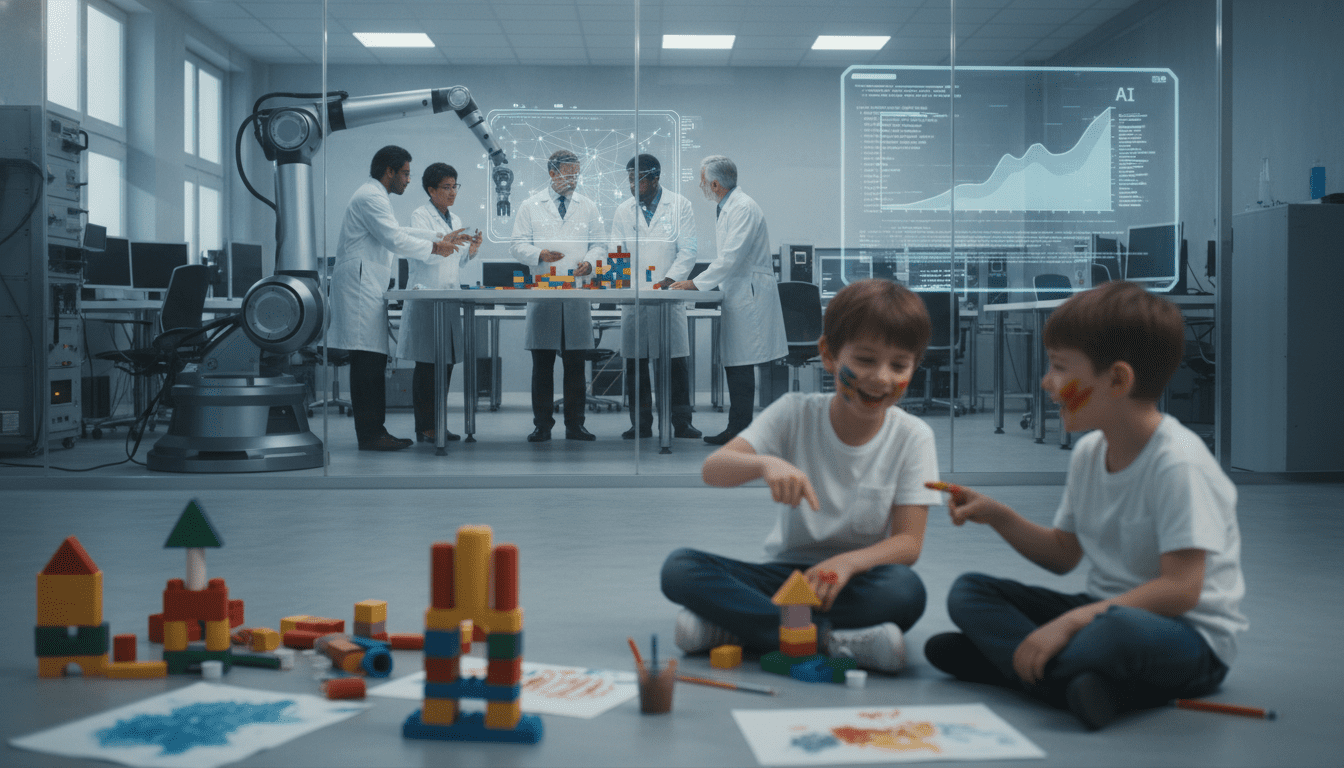
Brain vs AI: Why the Human Brain Still Holds Key Advantages Over Modern Systems
Brain vs AI analysis: a comparison of where biological cognition still outperforms silicon-based artificial intelligence in common sense, energy use and flexible learning.
The debate over brain vs AI has returned to the forefront as researchers and commentators weigh the limits of contemporary machine learning against human cognition. Recent essays and discussions argue that, despite rapid advances in narrow tasks, the human brain retains clear advantages in generalization, energy efficiency and contextual reasoning. This piece summarizes those arguments and outlines the technical and societal implications as the two technologies continue to develop in parallel.
Human common sense remains difficult for statistical models
Statistical learning systems excel at pattern recognition within large datasets but stumble when required to apply broad, everyday knowledge to novel situations. The human brain encodes a dense web of causal, social and physical expectations that allow people to infer intent, predict outcomes and navigate ambiguous scenarios with little explicit information. This capacity for background knowledge — often called common sense — remains a major challenge for current AI architectures that rely on correlation rather than causal understanding.
Common-sense failures in AI are visible in surprisingly simple tasks: misinterpreting context, generating implausible explanations, or making brittle decisions when data shift slightly. Researchers say bridging that gap will require new models that embed causal inference, multimodal grounding, and richer world models — not just larger datasets or parameter counts. Until those changes arrive, many human judgments will continue to outpace algorithmic ones in messy, real-world settings.
Energy and hardware contrast: twenty watts versus megawatts
One of the starkest contrasts in the brain vs AI comparison is energy consumption and form factor. A typical human brain operates on roughly 20 watts of power, fitting within a mobile, self-healing biological substrate optimized by evolution for efficiency and robustness. Modern large-scale AI systems, in contrast, depend on data centers, GPUs and specialized accelerators that require orders of magnitude more electricity and cooling infrastructure for training and inference at scale.
That difference matters practically: energy constraints shape where and how systems can be deployed, and they influence lifecycle costs and environmental impacts. Engineers are addressing the gap with techniques like quantization, pruning, and on-device inference, and with hardware innovations such as neuromorphic chips that mimic neuronal computation. Nevertheless, the brain’s combination of low power draw, dense connectivity and adaptive maintenance remains a benchmark for designers seeking more sustainable AI.
Learning from few examples: the brain’s sample efficiency
Humans learn new concepts from remarkably small amounts of data, often from a single exposure or a handful of examples. This sample efficiency stems from a lifetime of structured priors, hierarchical representations and mechanisms for rapid abstraction. Most machine learning models, by contrast, demand enormous labeled datasets and extensive compute to reach comparable performance on narrowly defined tasks.
Improving sample efficiency in AI is an active research area, with methods such as meta-learning, self-supervised pretraining and model-based reasoning showing promise. These approaches attempt to equip systems with reusable skills and inductive biases that reduce data hunger. Yet even with progress, current systems typically lag behind the brain’s ability to transfer learning across domains with minimal supervision.
Perception, embodiment and contextual grounding
Perception in humans is deeply integrated with bodily action and social interaction; vision, touch and proprioception are continuously calibrated through movement and engagement with the world. This embodied cognition gives people context-rich signals that ground concepts and allow rapid error correction. Many AI systems, by contrast, still process inputs in isolation, divorced from continuous sensorimotor feedback.
Robotics and multimodal AI research aim to close that gap by combining language, vision and action, and by training agents in environments where consequences of actions inform representation learning. Early results suggest that embodiment can enhance robustness and generalization, but building machines with the continual, lifelong interaction patterns of human beings remains a formidable engineering and scientific task.
Brittleness, explainability and safety concerns
Where the brain vs AI comparison tilts sharply is in error modes and interpretability. Humans can often explain decisions, admit uncertainty, and adjust behavior when stakes change. Many AI models, particularly deep neural networks, can be confident yet wrong, susceptible to adversarial inputs, and opaque in their internal logic. Those properties raise safety and governance concerns when systems are deployed in healthcare, transportation or criminal justice.
Mitigations include transparent model architectures, rigorous evaluation under distributional shifts, and hybrid systems that combine statistical perception with symbolic reasoning for accountability. Policymakers and organizations are increasingly focused on setting standards for robustness, certification and human oversight to manage the risks that flow from AI’s current limitations.
Where research is likely to converge next
The trajectory of both biological understanding and AI engineering points toward hybrid approaches. Neuromorphic hardware, causal and model-based AI, and multimodal learning are all areas where inspiration from brain function informs technological design. At the same time, cognitive science benefits from computational models that formalize hypotheses about learning and representation.
Investment choices, academic priorities and industrial roadmaps will determine which avenues accelerate. A pragmatic view treats the brain vs AI question not as a zero-sum contest but as a guide for where improvements are most necessary: efficiency, generalization, grounded reasoning and safety. Progress in those areas will come from interdisciplinary work and open evaluation.
The comparison between silicon giants and carbon-based life is not a verdict but a roadmap. The human brain remains superior in energy efficiency, contextual reasoning and sample-efficient learning, while AI leads in scale, speed and narrow-task performance. Recognizing these complementary strengths should shape research agendas and policy, aiming to build systems that augment human capabilities while respecting the limits exposed by the continuing brain vs AI conversation.
