
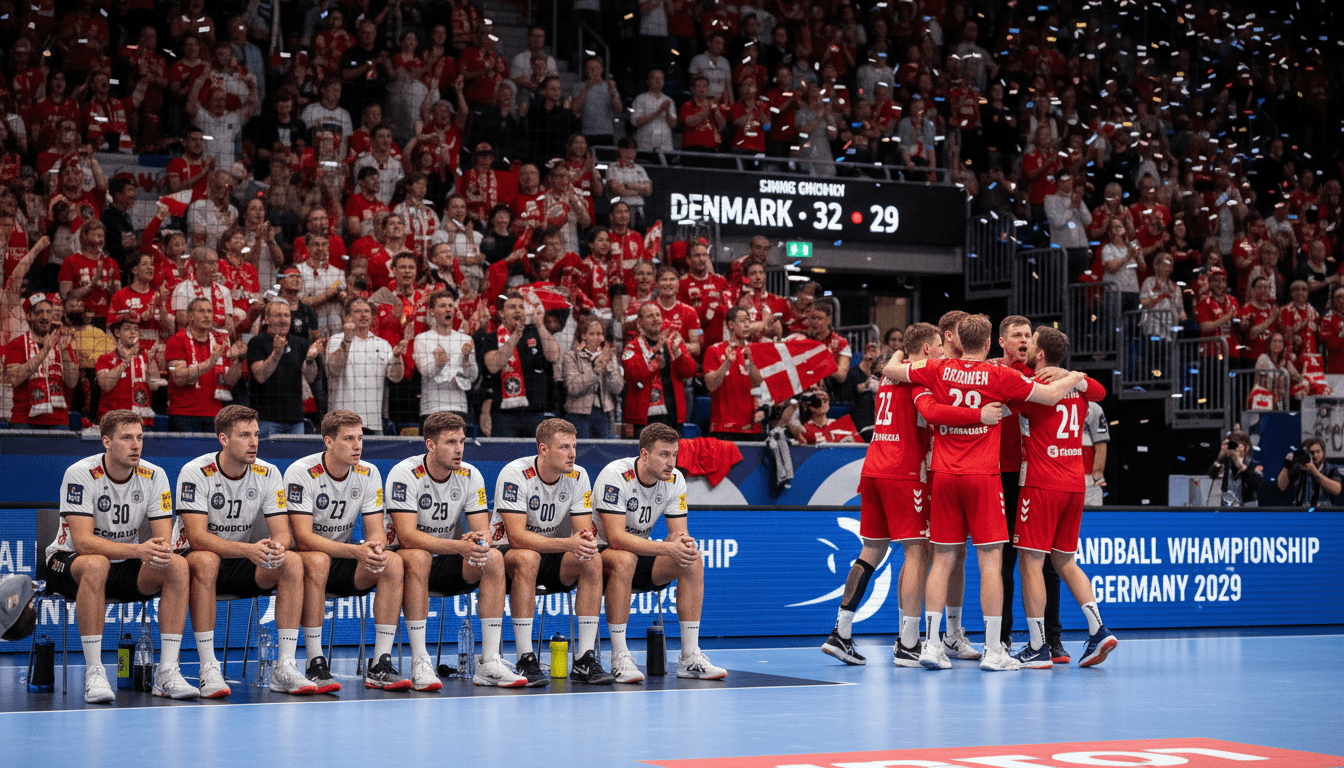
Germany vs Denmark handball: Denmark wins 36-28 in Copenhagen as Germany falters ahead of Cologne rematch
Germany vs Denmark handball: Denmark beat Germany 36-28 in Copenhagen as Emil Nielsen excelled; first-half errors proved decisive before the Cologne rematch.
Germany’s senior national team suffered a 28:36 (13:21) defeat in Copenhagen in the latest Germany vs Denmark handball test match, extending a decade-long run of losses to the Scandinavian side. The visitors struggled through a catastrophic first half, permitting Denmark to build a lead they never surrendered. The result leaves Germany with significant tactical and defensive questions eight months before the home World Championship.
Denmark seize control early and maintain margin
Denmark opened the match with sustained pressure and clinical finishing, establishing a lead that grew steadily through the first half. Mathias Gidsel contributed to the scoreboard while the Danish attack forced frequent German errors and turnovers. By halftime the Danes led 21-13, a deficit Germany failed to erode despite improved play after the break.
Denmark’s approach combined quick transitions with high-percentage shots, forcing Germany into reactive defense and hurried offensive attempts. The margin was not solely a product of individual brilliance but of coordinated pressure that disrupted Germany’s rhythm. The sustained advantage allowed Denmark to manage the tempo through the second half and close out the match decisively.
Emil Nielsen decisive in goal for Denmark
Danish goalkeeper Emil Nielsen produced a series of key saves that stifled Germany’s early attempts and shifted momentum toward the home side. By the 37th minute Nielsen had already accumulated a double-digit save tally, frustrating German shooters and amplifying the visitors’ shooting woes. His presence between the posts made several open or routine attempts much harder to convert.
Nielsen’s performance also allowed Denmark to play with confidence further down the court, knowing counterattacks could be initiated off saves. That dynamic placed additional pressure on the German defense and contributed to the match’s widening scoreline. The goalkeeper’s role was a decisive factor in a contest where margins were created and then defended.
Germany’s first-half errors prove costly
The German side produced an unusually high number of missed shots and technical mistakes in the opening 30 minutes, undermining their strategic plans. Several clear opportunities were squandered, while passes were intercepted or misplaced at crucial moments. Ex-national goalkeeper Silvio Heinevetter highlighted the volume of “free throws left unused” and the technical lapses that contributed to the deficit at half.
These early turnovers fed a negative feedback loop: Germany’s attackers rushed attempts to compensate, which played straight into Denmark’s defense and Nielsen’s hands. The cumulative effect was an insurmountable halftime margin that the team could not fully erase in the second half. The first-half performance will likely be the primary point of review for coaching staff ahead of the rematch.
Tactical experiments fail to change trajectory
Bundestrainer Alfred Gislason deployed several experiments, including more frequent use of the seven-against-six offensive scheme, removing the goalkeeper for an additional field player. The tactic produced mixed results and failed to generate the expected momentum, as Germany continued to miss high-value opportunities. Additionally, the change exposed lapses on the transition defense that Denmark exploited to maintain their lead.
Goalkeeper rotation also became a talking point when Andreas Wolff was substituted at halftime for David Späth after a below-par first period. The coaching staff sought fresh options to shift the match flow, and Späth delivered some notable saves in the second half. Nevertheless, the tactical adjustments arrived too late to overturn the early damage and will form part of the coaching review process.
Individual performances and new faces in the squad
Some German players responded positively in the second half, with Renārs Uščins providing attacking impetus and linking play more effectively than in the first period. Left wing Vincent Büchner made his senior debut and scored, giving the coaching staff both a glimpse of new talent and useful match minutes under pressure. Juri Knorr, however, struggled early with finishing, converting only one of his first four attempts.
For Denmark, consistent scoring from established figures and the performance of Gidsel kept the pressure on Germany all evening. The balance between experienced match-winners and role players allowed Denmark to absorb Germany’s phases of improved play without losing control. Individual takeaways will feed directly into selection and tactical discussions for both teams moving forward.
Gislason acknowledges second-half improvements and looks to Cologne
After the match Bundestrainer Alfred Gislason emphasized positives from the second half while acknowledging the unacceptable opening period. He praised the team’s improved defensive compactness and phases in which Germany pushed the Dänen under pressure, but he also underlined the need to eliminate easy mistakes. The coach framed the result as a lesson to be acted on before the teams meet again.
Germany and Denmark will meet again on Sunday in Cologne at 15:30, offering the hosts an immediate chance to respond and to refine the tactical approach ahead of the home World Championship. The rematch represents a timely opportunity to address the glaring first-half issues and to test whether the second-half adjustments can be sustained. For Germany, the fixture is more than a friendly—it is a measure of progress and a preview of the tactical calibrations required for larger tournaments.
The defeat in Copenhagen underlines how fine margins and game-management determine results against elite opposition, and it leaves Germany with clear priorities: tighten early-game execution, improve goalkeeper consistency, and make the seven-against-six option more effective. The Cologne encounter will offer the first concrete indication of whether those priorities have been translated into on-court improvement.
