
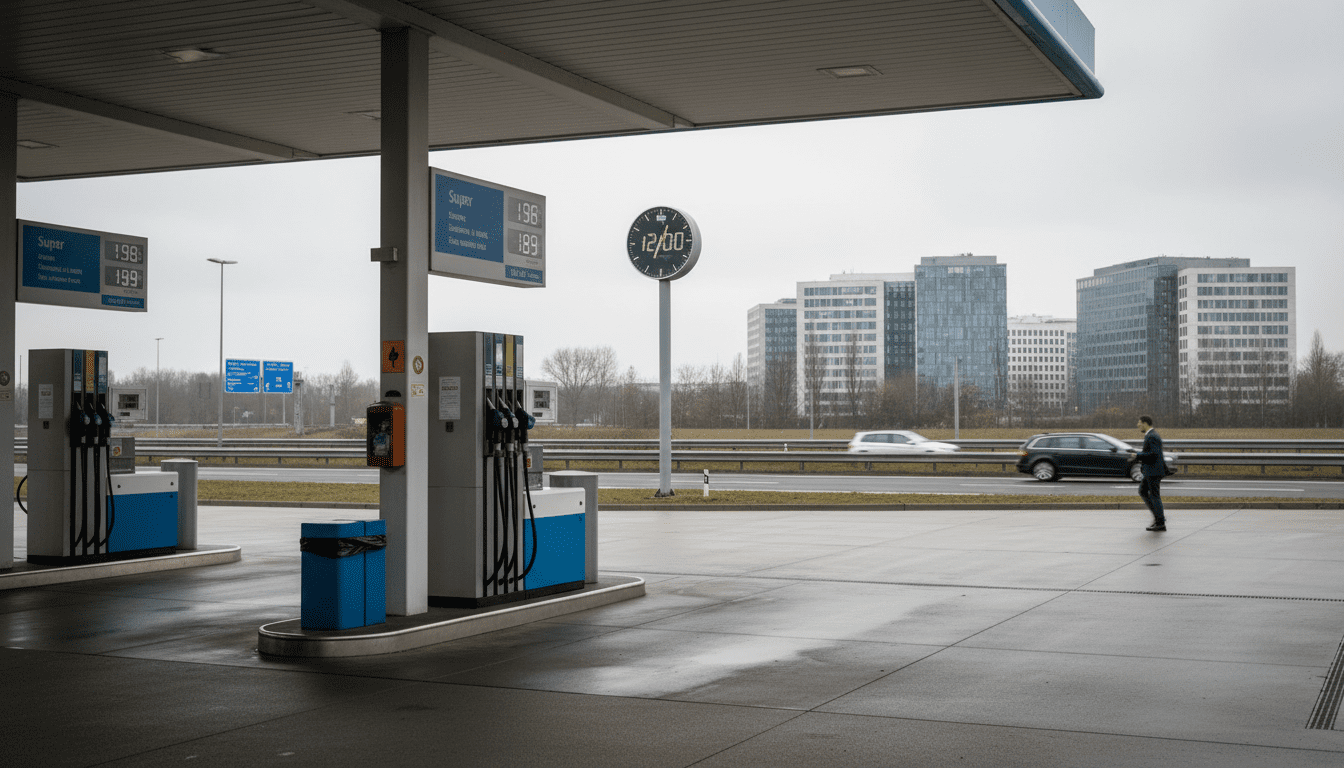
Germany’s tank rebate and 12‑o’clock rule partly cut pump prices but lifted oil-company margins, studies say
Germany’s tank rebate and 12‑o’clock rule partly lowered pump prices but lifted oil producers’ margins; regulators flag enforcement gaps and debate extension.
Since April 1, 2026, when Germany restricted fuel price increases to a single daily change at 12:00, and on May 1, 2026, when the government introduced a temporary fuel tax cut (the “tank rebate”) of roughly 16.7 cents per liter, the measures have altered pricing at the pumps but produced mixed results for consumers and competition. Early studies and industry analyses show retail prices have fallen in many places and that a large share of the tax cut has been passed on to motorists, yet researchers and consumer groups warn the 12‑o’clock pricing rule has in some cases increased margins for oil companies. Policymakers and regulators are now weighing enforcement gaps, distributional effects and whether the rebate should be extended beyond its scheduled end in June 2026.
New rules and objectives
The government introduced two linked interventions to blunt a sharp rise in fuel costs linked to geopolitical tensions: a limit on intra‑day price increases, allowing suppliers to raise pump prices only once daily at noon, and a temporary reduction in the energy tax on fuels of about 16.7 cents per liter. Together, officials said, the measures should make prices more predictable for consumers and provide direct relief at the pump. The pricing rule took effect April 1, 2026; the tax cut began on May 1, 2026, and is currently set to expire at the end of June 2026 unless extended.
Academic findings on price effects
Independent research teams have already begun to quantify the policies’ impact. A joint study by the ZEW Mannheim and the Düsseldorf Institute for Competition Economics found that the 12‑o’clock rule coincided with higher average retail margins for petrol in the fortnight after the rule’s introduction compared with the two weeks before. For petrol, margins increased by roughly six cents per liter on average in that window, while results for diesel were more volatile and less conclusive. These findings suggest the timing constraint reduced competitive flexibility and led suppliers to build risk premia into posted prices.
Who has benefited so far
Analysts say the tank rebate itself appears to have been passed on largely to consumers, though not perfectly. The Monopolkommission and Germany’s ifo Institute estimate the industry returned most of the roughly 16.7‑cent cut to motorists, with ifo calculations around May 11, 2026, indicating pass‑through of about 14 cents for diesel and 15 cents for petrol. Consumer advocates and the ADAC noted that market pressure and public scrutiny prompted broader pass‑through, but both academics and regulators warn that pre‑existing wholesale price patterns and structural competition issues on Germany’s wholesale markets may have muted the rebate’s full consumer benefit.
Compliance problems and enforcement limits
Despite the government’s goal of greater transparency, monitoring has uncovered numerous suspected breaches of the noon‑only increase rule. Media analyses and app‑based monitoring flagged thousands of probable illegal price hikes in April and early May, concentrated in certain regions and notably around the Munich area. The Federal Cartel Office reported that average daily price changes at some stations fell from an estimated 20 per day before the rule to about five per day after April 1, 2026, but its president also acknowledged “a significant number of deviations,” some technical and some substantial. Fines for deliberate breaches can reach up to €100,000, but responsibility for sanctioning rests with state authorities, and coordination gaps mean not all potential violations have yet been processed.
Political debate on extension and costs
The tank rebate remains politically contested. Some ministers and regional leaders have signalled support for extending the tax cut beyond June, arguing it helps commuters, businesses and rural drivers who rely heavily on road transport. Others, including the Monopolkommission, oppose prolongation on grounds of high fiscal cost—estimated by experts at roughly €1.6 billion—and the rebate’s blunt, regressive distributional effects that do not address underlying wholesale market concentration. Chancellor comments in early May 2026 described the rebate’s impact as mixed, while the economics ministry pointed to regional and fuel‑type variation and signalled ongoing analysis.
Next steps: evaluation and stakeholder talks
Under current plans the fuel pricing law and the 12‑o’clock rule are to be evaluated after one year, with a stakeholder “round table” scheduled at six months to review practical implementation and enforcement. Regulators say they are compiling continuous monitoring data to assess whether the tax cut was fully passed through and whether the timing rule improved consumer information without inadvertently raising prices. State authorities must still be identified in some cases to process alleged non‑compliance, and coordination between federal monitoring and Länder sanctions will shape how swiftly breaches are sanctioned.
The immediate outlook is one of cautious settlement: pump prices have eased in many areas since May 1, 2026, and the tank rebate delivered a substantial portion of its intended relief, but independent studies and watchdogs caution that the noon pricing constraint has encouraged margin‑raising behaviour in parts of the retail network. Policymakers face a narrow window to decide whether the temporary measures should be prolonged, amended or allowed to lapse, and upcoming evaluations and regional compliance reports will be decisive in that debate.
