
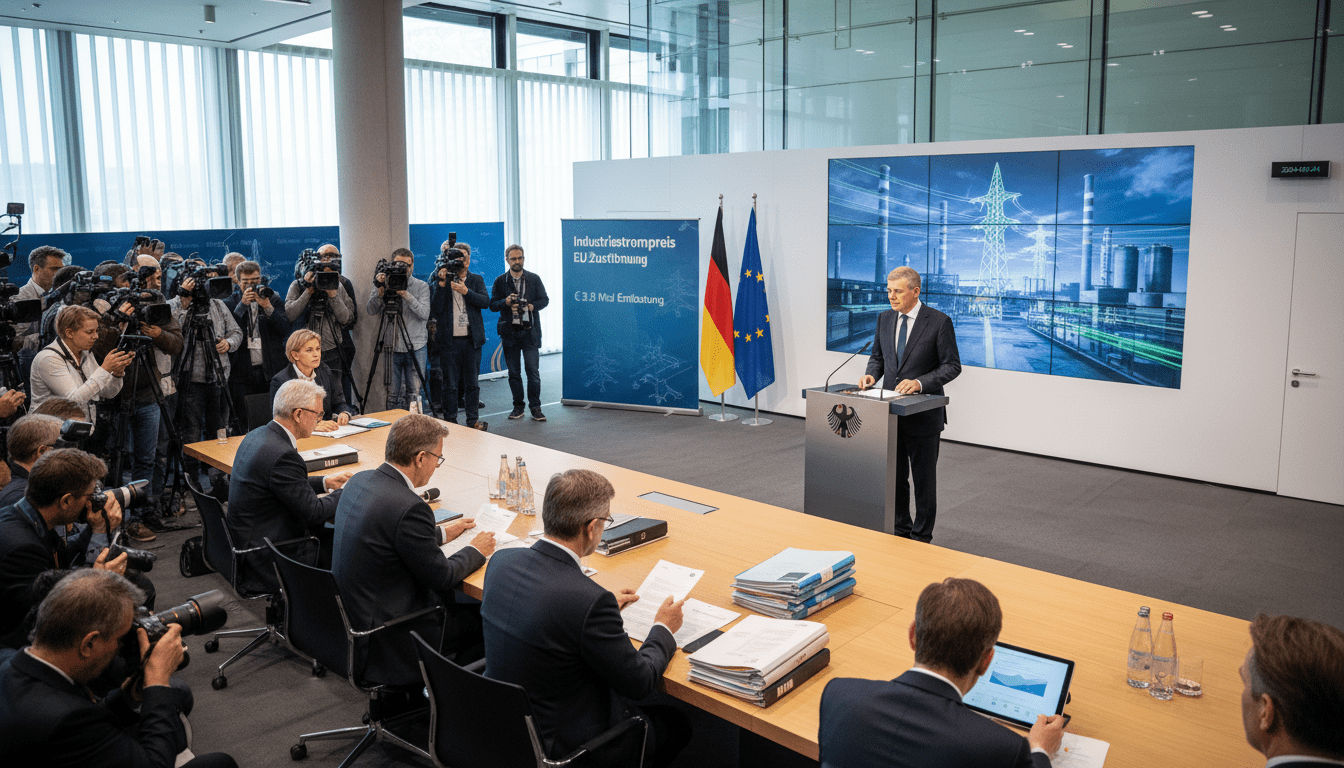
Germany’s Industriestrompreis Approved by EU to Subsidise Industrial Power Costs
Germany’s Industriestrompreis, approved by Brussels, subsidises industrial electricity through 2028. Who qualifies, how it works, costs, and industry reactions.
The German government has won EU approval for the new Industriestrompreis, a targeted subsidy designed to ease electricity costs for energy‑intensive manufacturers and shore up competitiveness. The measure is retroactive to January 1 and runs until the end of 2028, with initial applications for the scheme expected in early 2027. The policy aims to prevent relocations of production and protect jobs in sectors deemed strategically important.
Brussels approval and legal framework
The European Commission cleared the measure in mid‑April under the new CISAF state‑aid framework, allowing Germany to offer temporary aid linked to climate investments. The approval sets precise conditions on eligibility, duration and compliance to ensure the subsidy aligns with EU competition rules. Germany must implement the scheme in a way that channels a significant share of public funds into carbon‑reducing measures.
Eligibility, timing and scale
The subsidy applies to companies listed on the EU’s designated Kuebll list, a catalogue used to determine which industrial activities qualify for energy cost relief. Eligible sectors include chemistry, producers of rubber and plastics, glass manufacturers and semiconductor fabrication, among others. The federal ministry estimates that up to about 9,500 companies could potentially apply for the aid across the industrial landscape.
Mechanics of the subsidy
Under the Industriestrompreis, companies receive subsidised electricity for up to half of their annual consumption, charged at half the reference wholesale price but never less than a floor of five eurocents per kilowatt‑hour. The reference used for calculations is the one‑year wholesale electricity futures price fixed on January 1 of the accounting year, intended to provide planning certainty for firms. Firms choosing to participate must commit to specified “countermeasures” within a four‑year window.
Climate countermeasures and the Flexbonus
Recipients are required to reinvest at least 50 percent of the financial relief in climate protection measures such as rooftop photovoltaics, efficiency upgrades, storage systems or internal grid improvements. The scheme includes a Flexbonus incentive: if at least 80 percent of the countermeasures increase demand flexibility—shifting consumption toward periods of high wind or solar output—the subsidy amount is increased by ten percent. The mechanism is designed to synchronise industrial consumption with renewable generation and relieve grid stress.
Economic assessments and criticism
Several economists have voiced reservations, warning that the Industriestrompreis may distort competition and reduce incentives for efficiency. Analysts at the Leibniz Centre for European Economic Research have argued that selective price relief can treat similar firms unequally and risk dampening long‑term innovation. Industry associations and experts also caution that the temporary nature of the aid could complicate planning for multi‑year decarbonisation projects, which often require longer lead times.
Practical savings and fiscal implications
Industry groups have modelled likely financial effects and find substantial variation depending on consumption levels. One trade association’s example assumes a firm with annual consumption of 200,000 kWh and a reference price of 8.75 cents per kWh; under that scenario the subsidy would reduce costs by roughly €3,750 before requiring firms to reinvest half of that amount. Larger users stand to gain far more: illustrative government figures suggest a gas producer using about 550 GWh could see annual relief around €11 million, while a cement plant consuming roughly 160 GWh could save about €3.3 million per year. Brussels has capped the German budget for the measure at €3.8 billion and emphasised that substantial portions of the aid must be directed to climate‑friendly investments.
Interaction with existing support schemes
The new instrument sits alongside Germany’s existing electricity cost compensation for industry, known as the Strompreiskompensation. Firms may apply for both programmes, but they cannot receive overlapping payments for the same volumes of electricity under current rules. The EU’s recent crisis‑aid framework contemplates limited cumulation for part of the year, but Berlin has not yet translated that possibility into national law. Which scheme is more advantageous will depend on firm size, eligibility and the pattern of electricity use; in some cases the older compensation delivers higher per‑kWh relief, while the Industriestrompreis may be accessible to a broader set of companies.
The Industriestrompreis represents a calibrated effort by the German government to protect energy‑intensive industry while steering some of the financial benefit toward decarbonisation and demand flexibility. Policymakers, economists and industry groups will now focus on implementation details, application procedures and how the obligations to invest in climate measures are verified and enforced.
