
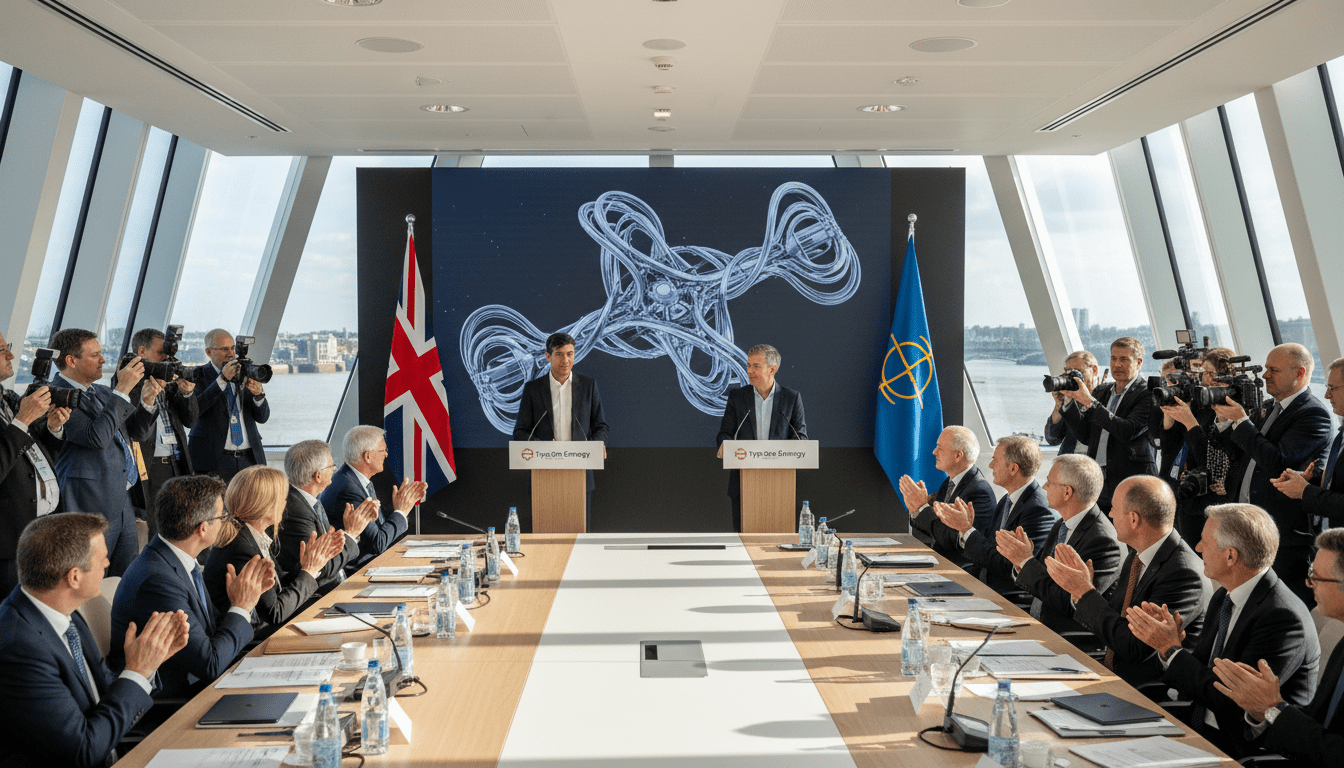
UK consortium led by Type One Energy signs deal to pursue 400 MW commercial fusion reactor in Britain
Type One Energy and partners form UK Infinity Fusion consortium to build a 400 MW commercial fusion reactor in the UK, targeting completion around the mid-2030s.
Type One Energy, backed by Breakthrough Energy Ventures, Tokamak Energy and Aecom this week signed a contract to form the UK Infinity Fusion consortium and pursue construction of a 400 megawatt commercial fusion reactor in Britain. The companies say the project, based on Type One’s Stellarator design, could be completed around the mid-2030s and will draw directly on lessons from a U.S. pilot project in Tennessee. The agreement marks a rare cross‑Atlantic industrial collaboration aimed at moving fusion from experiment toward utility‑scale deployment.
Consortium agreement and project scope
The UK Infinity Fusion consortium brings together Type One Energy, Oxford‑based Tokamak Energy and U.S. infrastructure firm Aecom under a formal agreement signed this week. The partners described a plan to design and build a roughly 400 MW fusion power plant in the United Kingdom using Type One’s Stellarator architecture.
Companies involved say the project will leverage technological work already underway in the United States, where Type One is partnering with the Tennessee Valley Authority on a demonstration reactor. The consortium framed the UK plant as a first commercial step that would apply engineering practices and regulatory experience gained from the Tennessee pilot.
Stellarator design and technical strategy
Type One Energy’s choice of a Stellarator geometry departs from the tokamak approach used by several other private firms and by ITER. The Stellarator uses complex, three‑dimensional magnetic coils to confine the plasma continuously, an architecture Type One argues can provide operational advantages for a commercial plant.
Tokamak Energy’s expertise in high‑temperature superconductors is a key technical pillar for the consortium, the partners said, and Aecom will contribute large‑scale infrastructure planning and delivery capabilities. The companies emphasized that scaling a Stellarator to 400 MW will require intensive engineering development and factory‑scale production of precision superconducting coils.
Link to U.S. pilot and regulatory steps
The British proposal is explicitly tied to a parallel Type One project in Tennessee, where the company and the Tennessee Valley Authority have advanced a separate reactor plan that aims to begin operations in the early‑to‑mid 2030s. Type One has recently filed permitting applications for the U.S. site, and the UK consortium expects to incorporate the operational and licensing lessons from that deployment.
Partners said the timeline for the UK plant depends on regulatory approvals, supply chain build‑out and the technical outcomes of the U.S. pilot. They framed the British project as complementary rather than competing, with the transatlantic collaboration intended to accelerate industrial learning and reduce risk.
Funding, backers and market commitments
Type One Energy has raised more than $160 million from private investors, including Breakthrough Energy Ventures, the fund backed by Bill Gates. Tokamak Energy and Aecom add technical and logistical capital to the consortium, though the companies have not disclosed the full financing package for the UK plant. The public‑private funding landscape for fusion is evolving, with governments and corporate buyers increasingly signaling long‑term support.
In the United States, Commonwealth Fusion Systems has raised roughly $3 billion to build a 400 MW plant in Virginia and has a power purchase agreement with Google; its schedule calls for construction to start in 2027 and operation in the mid‑2030s. The presence of corporate off‑takers and large private funds underlines a growing market appetite for first‑of‑a‑kind commercial fusion projects.
Global competition and parallel projects
Governments and private investors in the United States, China and Britain are racing to convert decades of fusion research into industrialized plants. National programs such as ITER in France and experimental facilities like Germany’s Wendelstein 7‑X Stellarator in Greifswald continue to push scientific boundaries, while startups pursue divergent technical routes to commercialization.
Several European and German startups are advancing their own pilot plans, and some projects have attracted substantial public subsidies. The UK itself has committed funds to fusion development, including investments in prototype programs designed to help bridge the gap between laboratory demonstrations and grid‑connected plants.
Technical challenges and realistic timelines
Despite renewed momentum, fusion developers acknowledge major technical hurdles remain, particularly around achieving sustained net energy gain, robust plasma confinement for long durations, component lifetime under neutron flux and cost‑effective manufacturing of superconducting magnets. Experimental facilities have at times produced brief bursts of net energy, but scaling those results to continuous power delivery suitable for a commercial fusion reactor will demand sustained engineering breakthroughs.
Industry officials and some analysts caution that optimistic schedules could slip and that a true commercial fleet may take longer than current projections suggest. The consortium says its strategy is to proceed iteratively, using demonstration results and industrial engineering to narrow the gaps between experimental proof‑of‑principle and reliable power plant operation.
The UK Infinity Fusion deal signals a new phase of industrial coordination aimed at turning fusion’s long‑sought promise into deliverable electricity; whether that promise translates into grid‑scale plants by the mid‑2030s will now hinge on regulatory approvals, funding commitments and the outcomes of linked demonstration projects.
