
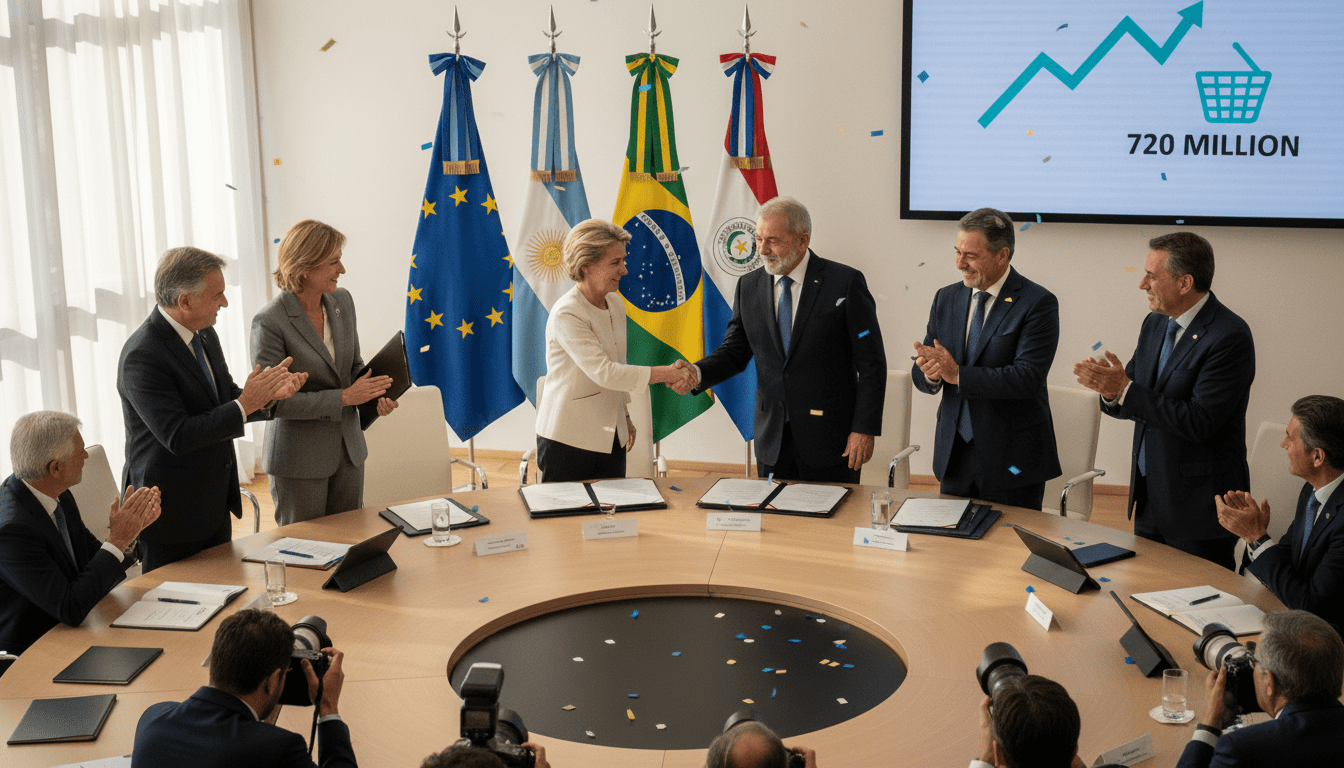
EU-Mercosur trade agreement provisionally enters into force, creating a 720 million-person market
EU-Mercosur trade agreement provisionally enters into force on May 1, 2026, creating a market of about 720 million people and opening export opportunities with built-in safeguards.
The EU-Mercosur trade agreement provisionally entered into force at midnight on May 1, 2026, establishing a broad free-trade framework between the European Union and the Mercosur countries of Brazil, Argentina, Uruguay and Paraguay. The deal will phase down tariffs and non-tariff barriers over time, aiming to boost the flow of goods and services across the Atlantic and to expand commercial ties. German industry groups and EU lawmakers described the move as a major step for transatlantic commerce, even as agricultural and regulatory concerns persist.
Agreement activated after decades of negotiation
The provisional activation follows more than 25 years of intermittent talks that culminated in a signed accord earlier this year, officials said. The text will apply in stages while national ratification processes continue in some jurisdictions, and the EU will monitor implementation closely. Provisional application allows the bulk of tariff reductions and market access rules to begin without waiting for every national legislature to complete formal approval.
Deal creates a single market for roughly 720 million people
European Commission figures cited by officials estimate the combined population and trading area created by the accord at about 720 million people, representing a significant new commercial space for exporters. The agreement includes tariff eliminations and quota arrangements designed to reduce trade costs in sectors ranging from manufactured goods to selected agricultural products. Negotiators framed the pact as a way to deepen ties with South America and to provide businesses with more predictable market conditions.
German industry anticipates expanded export opportunities
German companies, particularly in the automotive, mechanical engineering and pharmaceutical sectors, expect to see new openings as customs duties are rolled back and regulatory cooperation increases. The German Chamber of Commerce (DIHK) said the start of provisional application markedly increases the importance of South American trade for German firms, noting that although the region currently accounts for about 1% of German external trade, many firms expect measurable effects. A DIHK survey found that roughly 44% of internationally active companies foresee tangible impacts from the agreement.
Agricultural concerns prompt political safeguards
France and other member states raised objections over agricultural competitiveness during the ratification process, fearing an influx of lower-priced farm products could harm domestic producers. Lawmakers in the European Parliament asked the European Court of Justice to review aspects of the pact on January 21, 2026, and later backed a regulation providing emergency safeguards. That regulation allows the EU to reintroduce tariffs temporarily if sudden market disruptions threaten European farmers, giving capitals and Brussels a tool to mitigate short-term shocks.
Standards, environment and geopolitical messaging
Supporters of the agreement argue it sends a clear signal against protectionism and toward rule-based cooperation, while critics have focused on standards for pesticides, meat production and environmental protections. European trade officials and members of the European Parliament have emphasized clauses in the text that commit parties to certain sustainability and labor standards, but disputes over enforcement and equivalence remain. Proponents say the pact is also a geopolitical statement of shared economic openness at a time of rising trade tensions elsewhere.
Implementation, monitoring and business next steps
Implementation will proceed through a sequence of tariff cuts and regulatory alignments, with both Brussels and Mercosur capitals tasked with coordinating customs and standards measures. Companies will need to assess rules of origin, certification procedures and phased timelines to determine when cost advantages will materialize for specific product lines. Trade associations urged firms to begin preparing supply chains and compliance documentation now so they can react quickly as market access expands.
The provisional start of the agreement does not end political debate, and officials said ongoing monitoring and potential adjustments are likely as new trade flows are observed. Observers expect negotiations over finer regulatory details and the practical functioning of safeguard clauses to continue in the months ahead.
Commercial actors and policymakers will watch early trade data and sector-specific signals closely to judge the agreement’s initial effects. May 1, 2026, marks the beginning of a new era of EU-Mercosur economic relations, but the pace and distribution of benefits will depend on implementation, legal reviews and how both sides manage sensitive agricultural and regulatory issues in practice.
