
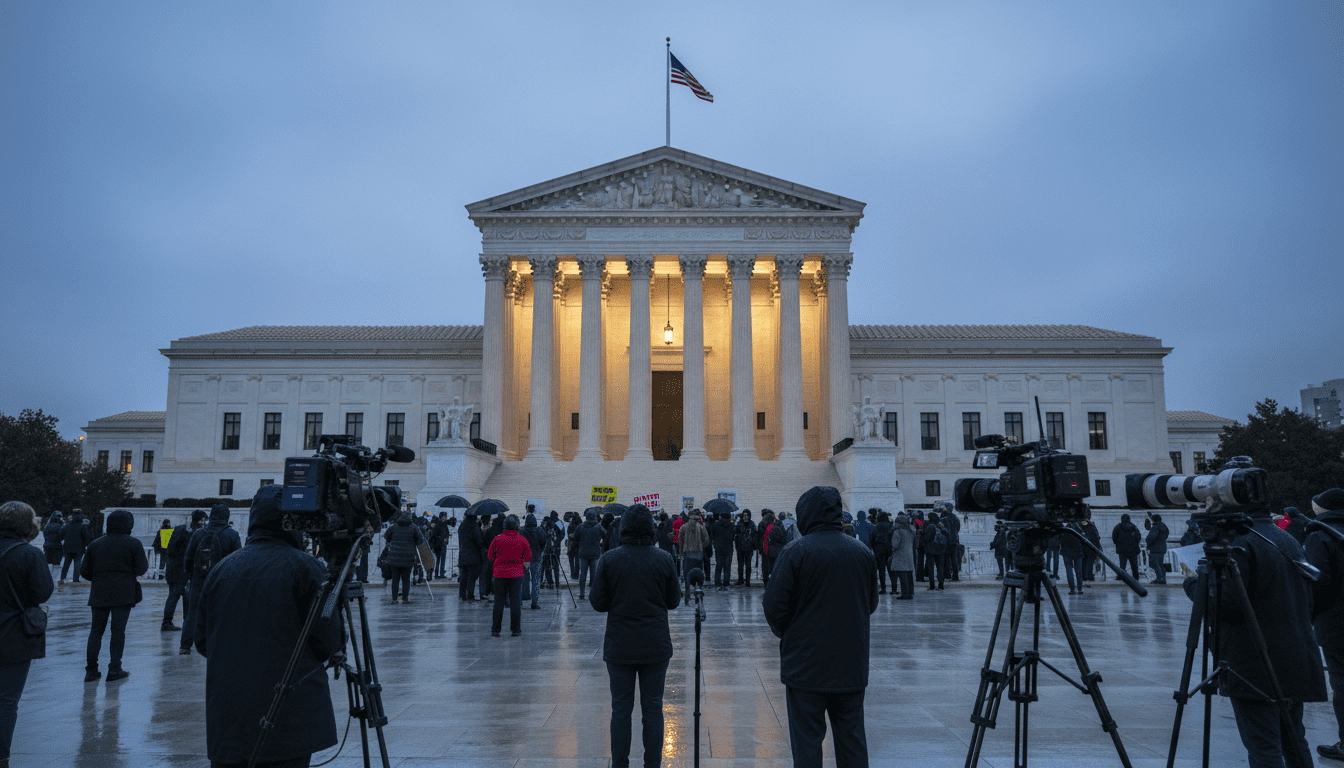
Supreme Court Hears Chatrie Case That Could Redefine Geofence Warrants
Supreme Court heard arguments in Chatrie v. United States weighing whether geofence warrants violate privacy and how location-data searches may be limited.
The U.S. Supreme Court on Monday considered a high-profile challenge to the use of geofence warrants, a law enforcement tool that requests location records from technology companies. The case, Chatrie v. United States, asks whether these broad searches of device location data run afoul of the Fourth Amendment’s protection against unreasonable searches. Advocates on both sides say the ruling could reshape how police access digital location information across the country.
Case details in Chatrie v. United States
Okello Chatrie, a Virginia resident convicted in a 2019 bank robbery, is the defendant at the center of the challenge. Investigators served a geofence warrant on a major technology company seeking records for all devices present in a defined area and time surrounding the robbery. Prosecutors relied on returned account data to identify suspects, and Chatrie later pleaded guilty and was sentenced to more than a decade in prison.
Chatrie’s legal team contends that the evidence obtained through the geofence warrant should have been suppressed because the warrant did not establish probable cause linking him to the crime before officers searched vast swaths of user data. Lower courts were divided, and the Supreme Court agreed to resolve whether the warrant procedure used here is constitutional.
How geofence warrants function in investigations
Geofence warrants allow investigators to specify a geographic area and timeframe and compel companies to disclose which accounts or devices were present in that area. In practice, companies may first provide anonymized or hashed location records and then supply identifying information for accounts of interest after further review. Law enforcement argues the method can quickly narrow potential suspects when other investigative leads are limited.
Critics say the technique operates as a digital dragnet because it returns information about large numbers of people who simply happened to be nearby, not only those suspected of wrongdoing. The core dispute is whether the initial, non-targeted sweep of users’ location histories constitutes an unreasonable search under established constitutional standards.
Privacy and Fourth Amendment arguments
Civil liberties groups and privacy technologists argue that geofence warrants violate the principle that the government must have individualized probable cause before searching a person’s records. They maintain that the practice lets authorities “search first and develop suspicions later,” exposing innocent bystanders’ movements to scrutiny. Amicus briefs from security researchers emphasized that ordering providers to comb through users’ accounts converts private archives of location history into a government-led search of private data.
Opponents of that view say many users voluntarily allow companies to collect and retain location information, and that a properly tailored warrant can be executed in a way that limits intrusion. The constitutional question hinges on whether people have a reasonable expectation of privacy in the detailed location records that tech firms store and whether that expectation is protected against broad government queries.
Government and law enforcement position
The U.S. government, represented at oral argument by the solicitor general’s office, defended geofence warrants as a lawful law enforcement tool when properly circumscribed. Government lawyers argued that a warrant directing a company to locate and produce relevant records is analogous to other forms of authorized searches and does not inherently sweep up unrelated private information if executed in good faith. Officials also urged the court to leave room for limited uses of the technique that assist in serious criminal investigations.
Prosecutors and police agencies have pointed to the practical value of geofence warrants in solving violent crimes and other serious offenses, especially when surveillance footage or eyewitness accounts identify only that a suspect used a mobile device near a scene. Law enforcement witnesses cautioned that an outright ban could remove a widely used investigative option.
What justices signaled during oral arguments
Across the arguments, several justices appeared skeptical of an absolute ban on geofence warrants, while others pressed hard on the privacy implications of broad location sweeps. Questioning suggested a possible middle path: the court might allow geofence warrants but impose stricter standards on how they are framed and executed. Commentary from legal scholars watching the proceedings noted that the court seemed open to narrowing the practice rather than eliminating it altogether.
Observers also highlighted disagreement over doctrines like the third-party records rule and the appropriate reach of the Fourth Amendment in the digital age. The justices’ exchanges indicated they are weighing both doctrinal precedent and the practical realities of modern data collection as they consider how to balance privacy and public safety.
Potential consequences for tech firms and users
A ruling that places tighter limits on geofence warrants could force companies to change how they store and process location information and could expand user privacy protections. Some providers have already altered practices, moving more location data to users’ devices rather than retaining comprehensive server-side logs. Conversely, a decision affirming broad warrant use could cement geofence searches as a routine investigative method across federal and local agencies.
Beyond corporate practice, the court’s decision could influence how courts interpret privacy expectations in other types of digital data, from search histories to wearable-device records. The outcome may also prompt legislative responses as Congress considers whether statutory reforms are needed to govern law enforcement access to location and other sensitive information.
The Supreme Court’s ruling in Chatrie v. United States is expected later this year and will provide a significant benchmark for how the law adapts to ubiquitous digital tracking. Observers from civil liberties organizations, law enforcement, and the technology sector are watching closely for a decision that will shape the contours of privacy and policing in the years ahead.
