
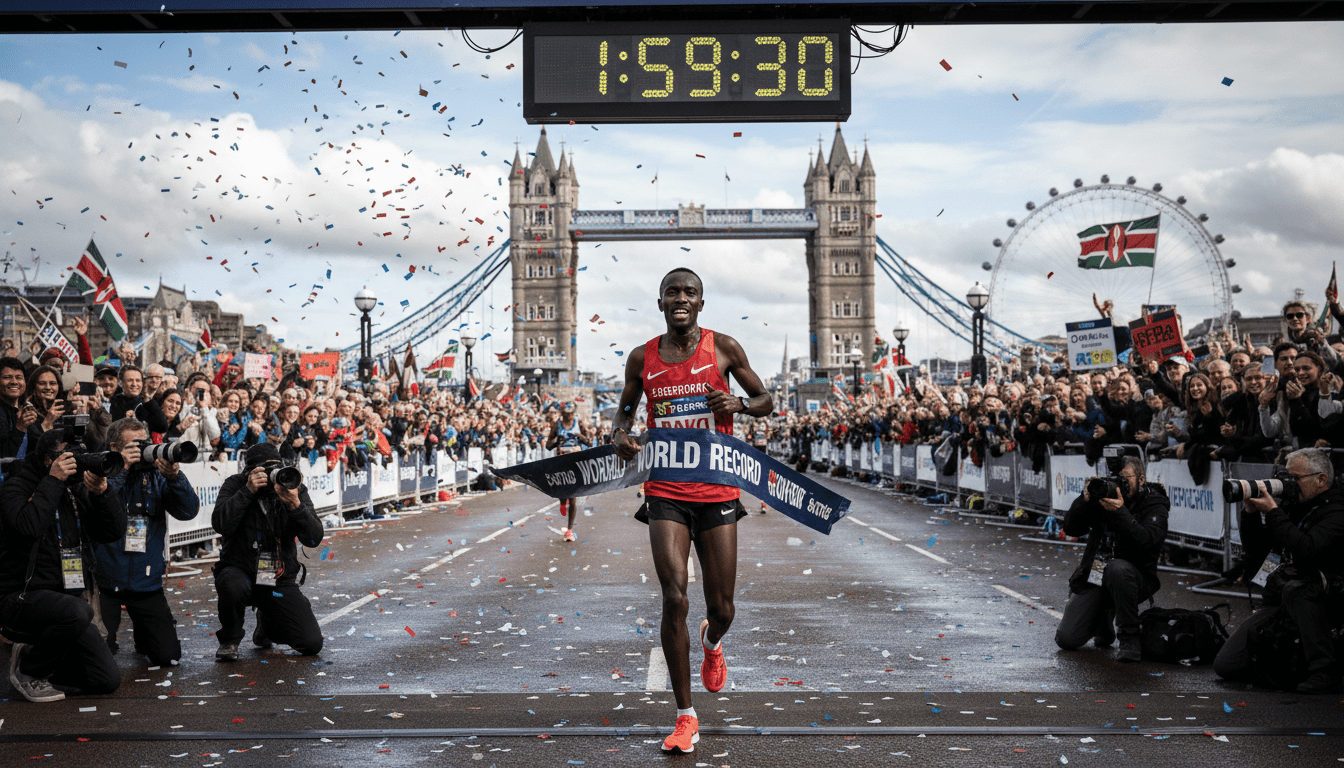
Sabastian Sawe Breaks Two-Hour Barrier to Win London Marathon in 1:59:30
Sabastian Sawe becomes first athlete to run a sub‑two-hour marathon in an official race, clocking 1:59:30 in London and rewriting marathon history.
Sabastian Sawe, the 29‑year‑old Kenyan, shattered expectations at the London Marathon by finishing in 1:59:30, becoming the first runner to break two hours in a sanctioned competition. The performance eclipsed Kelvin Kiptum’s 2:00:35 from Chicago 2023 by 65 seconds and established a new official world record. The race unfolded on a day of unusually fast conditions, aided by dedicated pacemakers and a tightly controlled pace from the outset.
Race conditions and tactical setup
The London course produced near‑ideal conditions for record attempts, with organizers deploying multiple pacemakers to maintain an aggressive tempo from the gun. A large leading pack stayed together through the early kilometers as athletes matched the prescribed splits with little deviation. That controlled rhythm allowed Sawe to conserve energy for a decisive move later in the race while the pacemaking plan held the field in check.
Decisive move after 30 kilometers
The decisive phase came just after the 30‑kilometer mark when Sawe and Ethiopia’s Yomif Kejelcha broke away from the main group. Kejelcha, making his marathon debut, immediately demonstrated endurance and speed over the classic distance. Sawe edged clear in the final kilometers to secure the sub‑two finish, showing a combination of sustained pace and composure under pressure that few elite competitors can match.
Context with previous sub‑two efforts
Sawe’s run joins a short list of historic sub‑two marathons but stands apart because it was achieved in a record‑eligible championship setting. Eliud Kipchoge famously completed a sub‑two marathon in Vienna in 2019, but that performance was staged under controlled conditions with rotating pacemakers and did not satisfy record criteria. Sawe’s time is therefore the first officially recognized sub‑two performance in open competition, shifting the benchmark for what is achievable in championship racing.
Legacy and memories of Kelvin Kiptum
Sawe’s new record carries additional poignancy given the legacy of Kelvin Kiptum, who ran 2:00:35 in Chicago in 2023 and was regarded as one of the sport’s brightest talents before his death in a road accident in February 2024. Sawe’s breakthrough will be seen by many as another step in the evolution of elite marathon running, following the rapid progression of times produced by a new generation of Kenyan and Ethiopian distance runners.
German contingent and Amanal Petros’ race
German record‑holder Amanal Petros aimed for a strong showing but was unable to maintain the blistering early pace. Petros stayed with the chasing group through much of the first half and remained on target for a competitive time before dropping back after about 25 kilometers. He crossed the line in 2:08:31 and placed 15th, missing his national record by more than four minutes and falling short of his pre‑race objectives.
Women’s competition and Tigst Assefa’s performance
In the women’s race, Tigst Assefa of Ethiopia won in 2:15:41, narrowly missing Paula Radcliffe’s long‑standing London course mark by 16 seconds. Assefa’s run was authoritative, showing strength across the latter stages as she distanced rivals and held a consistent tempo on a day built for fast times. Her performance further underscores the depth of elite women’s marathon running and the proximity of course records that have stood for decades.
Sawe’s achievement at London will prompt renewed discussion among athletes, coaches and organizers about pacing strategies, course setups and the conditions necessary to push human limits in road running. The sub‑two milestone in an officially sanctioned race sets a new standard for championship events and is likely to influence how major marathons approach future elite fields.
