
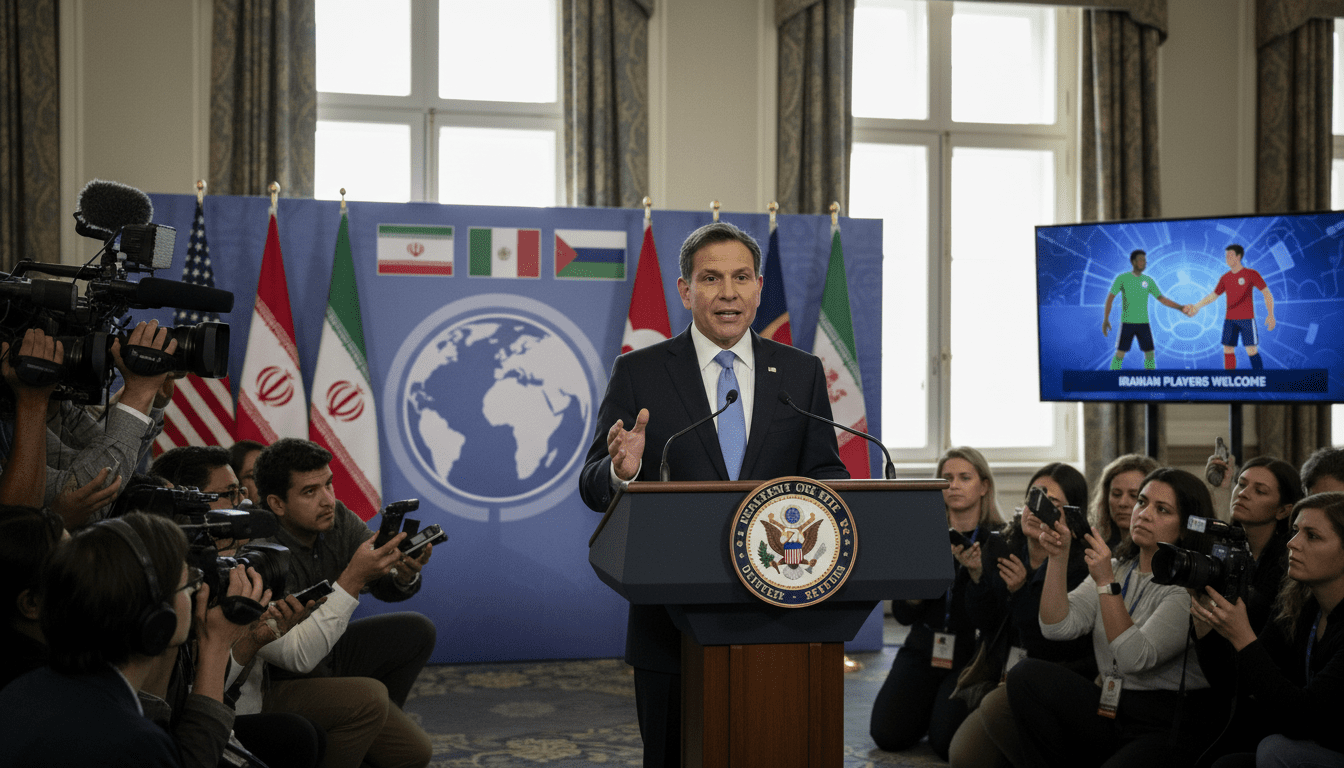
US official says Iran at World Cup players are welcome after envoy’s proposal to swap teams
US Secretary of State Marco Rubio said Iran at World Cup players will be welcome in the United States after a U.S. envoy suggested replacing Iran with Italy, prompting diplomatic pushback. The intervention by Paolo Zampolli, the U.S. special envoy for global partnerships, and the subsequent clarification from Washington have intensified debate over whether politics could upend sport ahead of the June tournament. (apnews.com)
Envoy Proposed Italy as a Contingency
Paolo Zampolli told media outlets he had floated the idea of Italy taking Iran’s tournament berth as a contingency if Iran were unable to participate. Zampolli framed the suggestion as pragmatic and non‑political, citing historical precedents for late substitutions in major tournaments. (washingtonpost.com)
The proposal was reported to have been conveyed to both the White House and FIFA leadership, and it immediately drew sharp reactions in Rome. Italian officials stressed that tournament places are earned on the field and rejected any notion of a politically arranged replacement. (bbc.co.uk)
Rubio Emphasised Athletes’ Entry Would Be Allowed
In Washington, Secretary of State Marco Rubio moved to distance the U.S. government from suggestions that Iran’s players be barred from competing. He said the United States would not prevent Iranian athletes from entering for World Cup matches, while indicating concerns about non‑athlete members of delegations who might have ties to militant groups. (apnews.com)
Rubio’s remark sought to draw a line between athletes and other entourage members, underscoring U.S. security screening practices while affirming a general commitment to uphold the sporting event’s access for competitors. The statement aimed to calm immediate diplomatic tensions and to reiterate that any exclusion of a qualified team would not be a straightforward unilateral decision. (apnews.com)
Italian Government and Sporting Bodies Reject the Idea
Senior figures in Italy responded with offence and dismay after reports of the proposed swap. Italy’s sports minister described the suggestion as inappropriate and impossible, while the president of the Italian Olympic Committee said the nation’s place in the sport is earned on the pitch. (bbc.co.uk)
Italy’s finance minister called the idea “shameful,” reflecting a broader national sensitivity following the Azzurri’s recent failure to qualify. Political leaders and sporting administrators stressed that any move to grant Italy a berth by political intervention would damage the integrity of competition. (washingtonpost.com)
FIFA’s Position and Tournament Rules
FIFA has repeatedly affirmed that the Iranian team’s fixtures are scheduled as planned and that it retains sole authority over membership and any replacement decisions. The organisation’s regulations allow FIFA discretion to replace a participating association, but the body has not signalled any intention to use that power in this case. (bbc.co.uk)
FIFA president Gianni Infantino has publicly stated his expectation that Iran will take part, emphasising that sporting competition should be kept separate from political disputes. That stance leaves the governing body as the principal arbiter should any last‑minute complications arise. (washingtonpost.com)
Security Concerns and the Iranian Team’s Preparations
The backdrop to the discussion is the ongoing military conflict affecting Iran and concerns about safety and logistics for teams and fans. Iranian authorities and the national team have said preparations for “proud and successful participation” continue, while some officials have raised the possibility of relocating matches if security conditions warrant. (apnews.com)
U.S. and tournament organisers have been planning security and visa arrangements, with officials indicating that while fans from certain countries may face travel restrictions, qualified competitors should be admitted subject to standard screening. The logistical and diplomatic complexity of hosting a team from a nation involved in active conflict remains a central focus for organisers. (washingtonpost.com)
The controversy has highlighted the tensions that can arise when high‑profile sporting events intersect with international crises, prompting governments, federations and fans to weigh the principles of competition against questions of safety and geopolitical consequence.
