
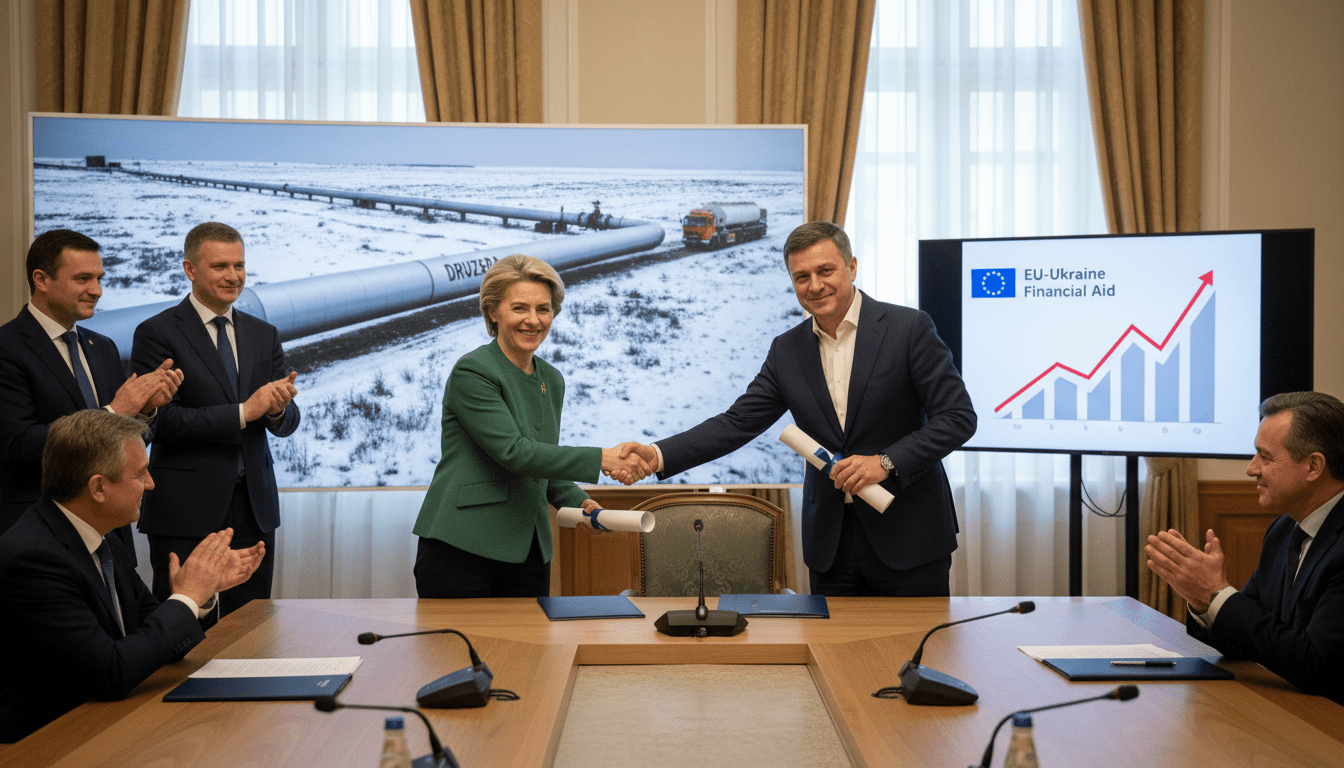
EU loan for Ukraine likely to be approved after Druzhba pipeline restart
EU loan for Ukraine likely approved after Druzhba restart; EU ambassadors backed an MFF amendment, clearing the way for €90bn credit and a May tranche.
The European Union’s planned €90 billion EU loan for Ukraine moved significantly closer to approval after EU ambassadors agreed on a legal change to the bloc’s multiannual financial framework on Wednesday, April 22, 2026. The written adoption procedure launched after the ambassadors’ sign-off is due to run until Thursday afternoon, April 23, 2026, officials said, and the loan becomes formally possible if no member state lodges a written objection. The decision follows a parallel technical move to restart flows of Russian oil via the Druzhba pipeline, a condition Hungary had attached to its earlier veto.
Council ambassadors approve MFF amendment
On April 22, 2026, the permanent representatives of the 27 EU member states gave their consent to amend the regulation that governs the EU’s medium-term budget. The change authorises the European Commission to raise funds on capital markets — up to €90 billion across 2026 and 2027 — and lend them to Kyiv on favourable terms. A written procedure to formalise the decision was opened immediately after the ambassadors’ meeting and will conclude on April 23, 2026, unless a state files a formal objection.
Druzhba pipeline repair and delivery timeline
Ukrainian authorities reported that repair work on the Druzhba pipeline network had been completed, enabling the resumption of flows that were halted in late January 2026 after a drone strike damaged a pumping station. Slovakia’s economy minister Denisa Sakova said on April 22 that Ukraine had begun pumping oil and deliveries were expected to arrive in Slovakia on April 23, 2026, a move that would allow supplies to reach Hungary as well. EU Council President António Costa publicly thanked Ukrainian President Volodymyr Zelenskyy for the repair work, citing the pipeline restart as key to resolving the diplomatic impasse.
Quid pro quo and the role of MOL
The restart removed the principal condition Hungary’s government had set for withdrawing its veto on the loan package. Budapest had demanded that oil transit resume before it allowed the legal act to proceed, while Kyiv initially sought an immediate release of funds; negotiators ultimately settled on a step-by-step arrangement. Hungary’s energy group MOL was brought into the process as a co-operator of the pipeline, giving Budapest a direct ability to monitor pressure re-establishment and the physical movement of product, sources close to the talks said.
How the €90 billion loan will be structured
The legal amendment to the EU’s financial framework allows the Commission to borrow on behalf of the bloc and pass on funds to Ukraine as interest-free loans. According to the agreed blueprint, roughly two-thirds of the package — about €60 billion — is earmarked for defence spending, with the remainder intended to plug budgetary gaps so Kyiv can continue paying wages, pensions and basic services. Kyiv is obliged to repay the loan only if Russia makes reparations of at least equal value under a future peace settlement; otherwise, member states ultimately carry the risk and frozen Russian assets provide an additional form of security.
Opt-outs, risk allocation and timing of disbursement
Hungary, Slovakia and the Czech Republic secured exemptions that exclude them from participating in the credit scheme and the financial risks that come with it, a concession that helped break the logjam. If the written procedure completes without objection on April 23, the Commission has indicated that Kyiv could receive the first tranche in roughly two weeks, around May 7, 2026. Officials stressed that the mechanics and guarantees underpinning the borrowing — including the use of budgetary headroom and frozen assets as backstops — remain central to legal and political acceptance among member states.
Domestic politics in Budapest and the European Council agenda
Prime Minister Viktor Orbán’s veto had drawn sharp criticism across the EU, but his stance softened after his electoral defeat, with Hungarian officials signalling a willingness to withdraw the block ahead of the incoming government taking office. Péter Magyar, the declared winner of Hungary’s recent vote, is scheduled to assume office in early May 2026; Budapest also announced that Orbán will not attend the informal European Council meeting in Cyprus on April 23–24, 2026. His absence ends a 16‑year uninterrupted presence in the summit format and leaves European leaders to discuss the broader regional implications of the loan and energy transit arrangements without him present.
The deal leaves open questions about longer-term enforcement of repayments and the political balance between energy security and foreign policy cohesion, but if the written procedure closes without a challenge on April 23, 2026, the EU will have cleared the legal path to deliver one of the largest coordinated financial support packages ever extended to a country at war.
