
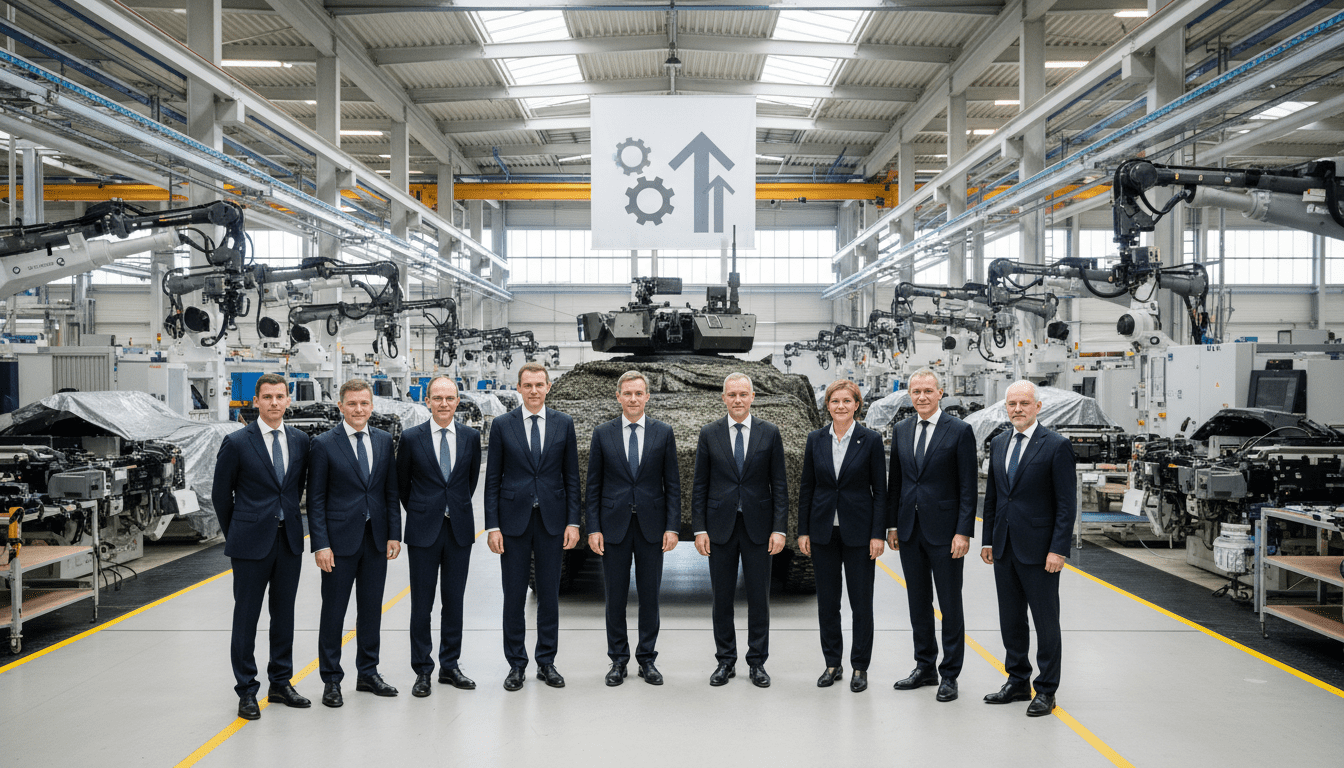
German machine builders pivot to defense as Hannover Messe spotlights weapons demand
German machine builders pivot to defense as firms pursue orders at Hannover Messe, confronting certification, contact and regulatory hurdles while seeking new growth.
Rapid shift at Hannover Messe
Delegates at the Hannover Messe this week signaled a decisive turn toward defense business as German machine builders seek to offset losses in traditional markets. Senior industry figures including Flender CEO Andreas Evertz and VDMA president Bertram Kawlath appeared alongside defense executives and government officials, underscoring how military demand has moved from the margins to the center of trade-floor conversations.
Speakers highlighted major contracts and strategic ambitions, with automotive supplier Schaeffler publicly outlining plans to build roughly €3 billion in revenue from armament and humanoid robotics in coming years. The presence of Germany’s federal defense minister and leaders from Rheinmetall reinforced that political momentum and procurement budgets are now driving opportunities for component suppliers.
Production slump accelerates search for new markets
The move into defense comes against a backdrop of weak production and shrinking demand in core sectors. German machinery production fell sharply in recent years, with an approximate 8 percent decline in 2024 followed by a near 5 percent drop in 2025, and industrial capacity utilization has eased to roughly 77 percent. These figures have left firms scrambling for revenue and intensifying efforts to diversify beyond the troubled automotive supply chain.
The VDMA’s forecast for 2026 remains muted, projecting only marginal growth of about 1 percent, which has increased the appeal of defense orders that can deliver substantial, multi-year volumes. Industry executives say defense contracts could help plug gaps left by carmakers, though they caution that military work cannot simply substitute for the scale and regularity of automotive business.
VDMA survey reveals growing defense customer focus
A recent VDMA member survey shows a clear change in sentiment among Germany’s machine builders toward the defense sector. Roughly 63 percent of respondents now rate the defense industry as an important or very important future customer, and about two-thirds already supply production technology or components to defense firms.
Optimism runs high among many firms: more than 40 percent of surveyed companies expect double-digit revenue growth from defense-related business as soon as 2026. VDMA president Bertram Kawlath described the shift as a structural opportunity, saying a doubling of defense revenue for parts of the sector within three to five years is realistic, even while noting the association itself is not a defense lobby.
Certification, contacts and standards remain major obstacles
Despite the appetite, German machine builders face a long list of entry barriers before they can become reliable suppliers to prime defense contractors. The VDMA survey and industry conversations repeatedly flagged missing contacts within military procurement, a lack of reference installations, and unfamiliarity with military norms and standards as key hurdles. Agencies such as the Bundesamt für Wehrtechnik und Beschaffung and BAFA introduce new regulatory interfaces that many midsize firms find daunting.
Certification processes are particularly problematic. Executives warned that approvals can be lengthy and costly, recalling cases where authorizations for special materials took years to secure. Industry leaders have urged pragmatic streamlining to avoid choking off the very small and medium-sized enterprises that form the backbone of Germany’s machine-tool and component sectors.
Manufacturers see scaling potential but set realistic limits
Company leaders emphasize that most machine builders will remain component suppliers rather than producers of complete military platforms. Andreas Evertz of Flender, which makes gearboxes used in wind turbines and potentially military vehicles, said the sector can scale to meet demand for components but that defense will not match the volume that the auto industry once provided. He compared the role of defense sales to a high-end niche rather than a volume-driven rescue for the entire sector.
At the same time, firms expect more collaboration and new partnerships as they adapt to defense requirements; examples include joint ventures to produce drones and other systems that combine mechanical expertise with electronics and software. Executives point to a broader reorientation: manufacturers across precision engineering and power transmission are positioning to serve navies, land forces and aerospace suppliers in concert with prime contractors.
Geopolitics opens market but brings competitive and regulatory shifts
The exclusion of certain foreign technologies from defense procurement has created space for European and German suppliers, industry respondents said, potentially improving competitive prospects for domestic firms. That geopolitical reality, coupled with large national and allied investment programs, has materially altered corporate calculations about entering defense markets.
Nonetheless, sector leaders stress the need for coordinated policy and faster administrative processes if the promise is to translate into sustainable jobs and investment. They argue that while defense opportunities are significant, they are one of several building blocks the machine industry will need to restore long-term growth and employment after a difficult multi-year downturn.
The industry’s pivot toward defense marks a notable reorientation for German machine builders, driven by geopolitics and procurement budgets but tempered by practical hurdles that will determine how many firms can convert interest into lasting business.
