
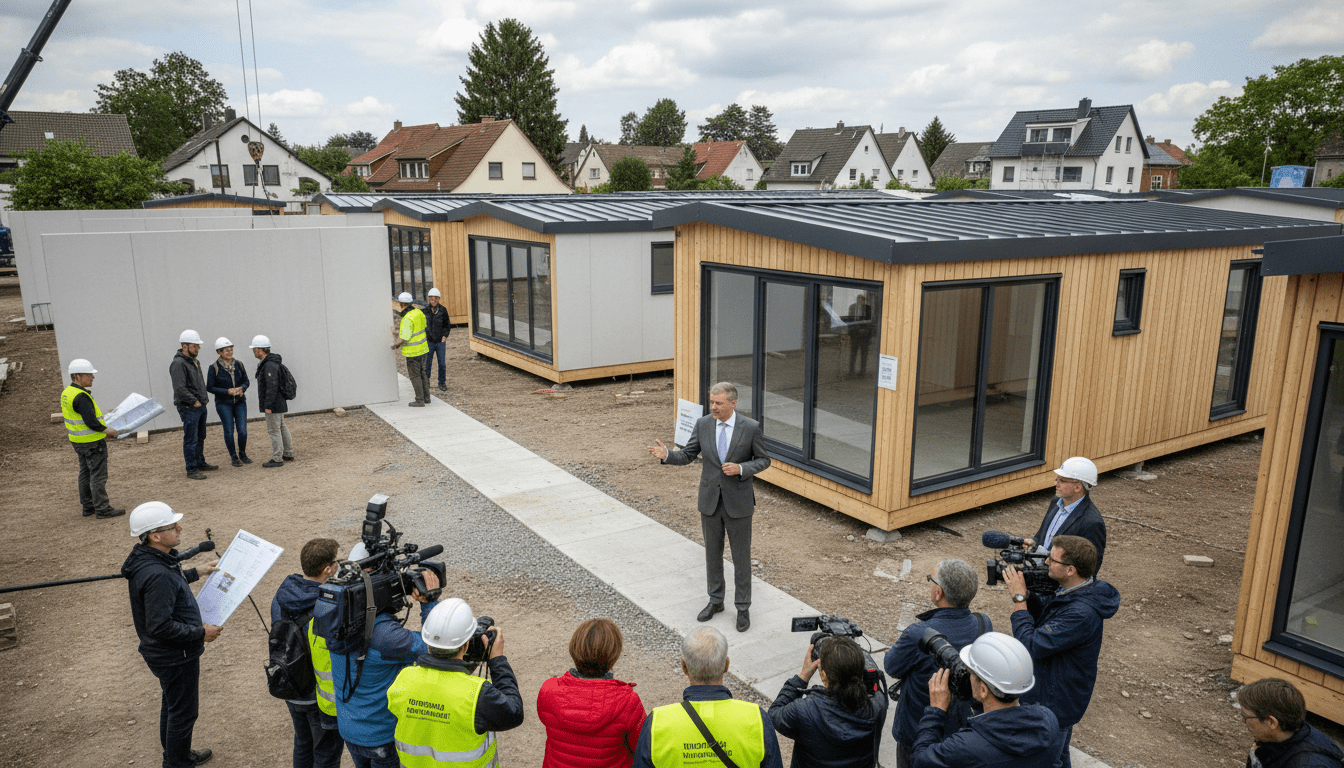
Prefab Homes Gain Ground in Germany as Buyers Trade Space for Affordability
Prefab homes gain ground in Germany as makers promote smaller, modular and budget designs to offset soaring costs, falling permits and buyer uncertainty.
Demand for prefab homes in Germany is rising as manufacturers respond to a post‑pandemic building slump by offering smaller, preconfigured and modular options designed to cut costs and speed delivery. Buyers who once insisted on generous floorplans are increasingly accepting reduced square metres and more standardized packages in exchange for price certainty and faster completion. The shift is driven by rising interest rates, higher construction costs and a sharp decline in new single‑family house permits compared with the pre‑crisis peak.
Drop in new‑build permits reflects market contraction
Last year Germany recorded roughly 50,755 permits for new single‑ and two‑family houses, less than half the level seen in 2021 when approvals topped 110,000. That collapse in permit activity is a visible sign of the wider cooling of the housing market, undercutting demand for bespoke, high‑cost projects. Industry observers say shrinking buyer confidence and broader economic fears have combined to depress the appetite for large, custom homes.
Manufacturers revive preconfigured ‘Aktionshaus’ offers
Several major prefab builders have reintroduced so‑called “Aktionshäuser” — fixed designs sold at guaranteed, reduced prices — to attract cost‑conscious buyers. Schwörer Haus, for example, markets a line of ten preconfigured models with limited external and internal choices to create clear pricing. Companies are pairing these packages with price guarantees of up to 18 months to reassure customers worried about volatile material and labour costs.
Size reduction becomes the primary cost lever
Producers and planners report that average living areas are shrinking as buyers seek economy; a 120‑square‑metre house is increasingly acceptable where 140 or 160 once prevailed. Reducing floor area cuts material and finishing costs directly and simplifies production in factory‑based systems. For manufacturers, standardizing dimensions and components enables tighter cost control and a faster delivery cadence that further trims overall expense.
Modular units offer scalability and lower foundations costs
Modular and stacked units are gaining traction as a compact, lower‑cost alternative to conventional prefab and solid masonry builds. Firms such as Sonnleitner and Weber Haus have launched series with small base modules that can be stacked or combined to expand living space up to roughly 145 square metres. In many sites, a prefabricated module can be delivered with an already cast base or sit on simpler point foundations, cutting excavation and civil‑works expense in hilly southern regions where foundations are a major driver of price.
Design trade‑offs and smarter space planning
As square footage is reduced, layout decisions and integrated furnishings have grown more important for buyers who refuse to sacrifice comfort. Companies report higher demand for built‑in storage, seat‑nooks and multifunctional rooms that replace dedicated utility spaces. Intelligent planning — for instance hiding laundry appliances behind sliding panels instead of a separate washroom — preserves usability while keeping costs in check.
Buyers seek financial transparency and supplier stability
The recent insolvencies among some developers and timber specialists have made stability a decisive factor for many prospective owners. Customers increasingly vet suppliers’ creditworthiness and ask for guarantees and clear price breakdowns before committing. Prefab manufacturers are using end‑to‑end responsibility for construction as a selling point, arguing that centralized coordination reduces the risk of subcontractor failures and delays.
The rise of prefab homes in Germany reflects both a supply‑side recalibration and a change in buyer priorities: affordability, speed and predictability now outweigh the old preference for large, bespoke floorplans. As manufacturers scale standardized production and refine modular offerings, the sector is positioning itself to serve a more cautious, cost‑sensitive market while preserving quality and energy efficiency.
