
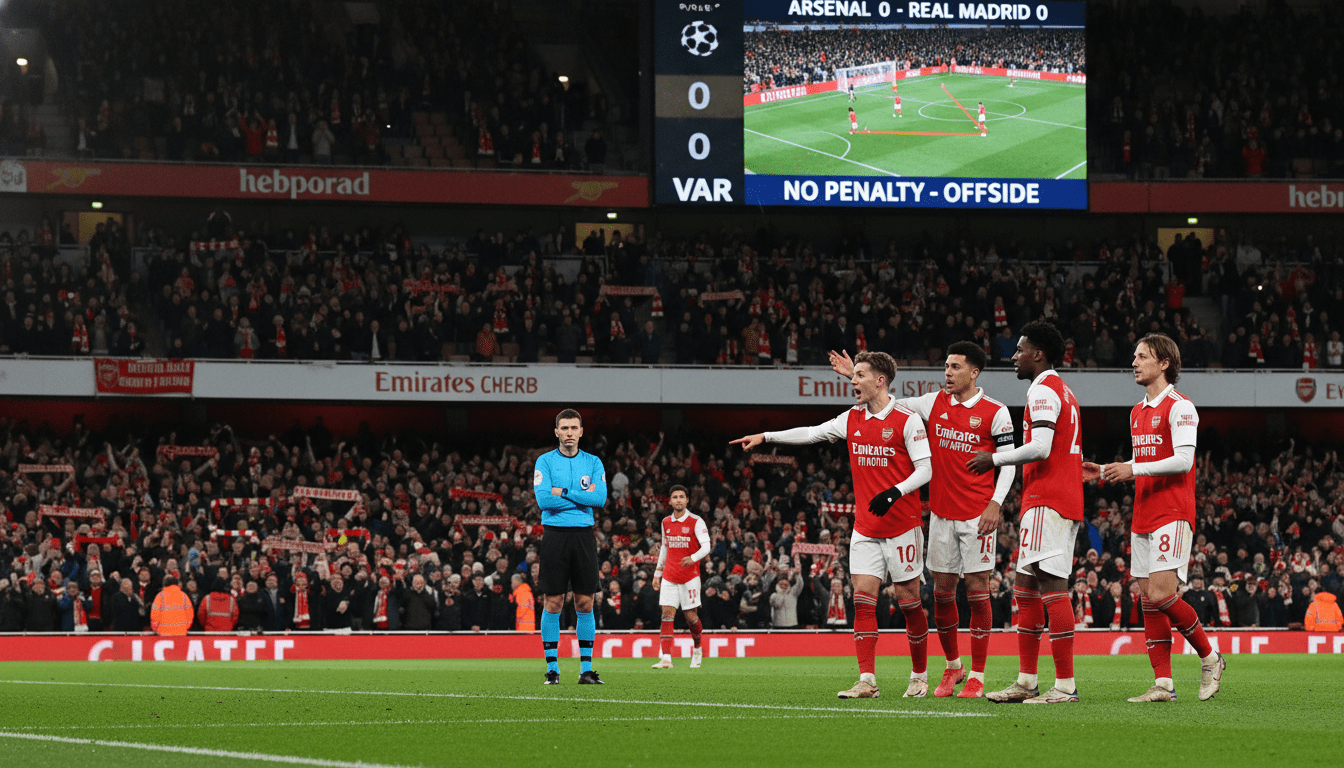
Arsenal held as Sporting threaten in tense pre-semi encounter ahead of Madrid tie
Arsenal were forced to settle for a hard-fought draw as Sporting Lisbon pushed the visitors and tested the Gunners’ discipline ahead of the Europa League semi-final first leg in Madrid on April 29, 2026. Eberechi Eze provided the main spark for Arsenal, but the match was defined by a contentious non-penalty decision, heavy physicality and two late strikes that hit the woodwork. The draw leaves Arsenal balancing domestic title concerns with a looming two-legged tie that will determine a place in the competition final.
Early control and Eze’s influence
Arsenal sought to assert control from the outset, probing Sporting’s defensive lines and looking to build confidence after a recent Premier League defeat. Eberechi Eze was a constant source of danger, drifting into pockets of space and unsettling Sporting with direct runs and quick combinations. Despite his influence, Arsenal were unable to fashion a clear, match-breaking opportunity in the opening exchanges.
The visitors’ intent was visible in their positioning, but chances tended to peter out at the final pass or were smothered by Sporting’s compact defending. Arsenal’s midfield movement allowed moments of fluency, yet the final delivery lacked the precision required to convert territorial dominance into goals.
Disallowed penalty and VAR review
The first big controversy arrived shortly after the ten-minute mark when Geny Catamo went to ground under pressure from Piero Hincapie inside the Arsenal area. Referee François Letexier waved play on after viewing the incident in real time, and the match VAR, German official Bastian Dankert, did not intervene to overturn that on-field decision. The non-award sparked immediate debate on the touchline and among supporters, with Sporting feeling they had been denied a clear chance.
Arsenal’s players and staff maintained that the contact did not meet the threshold for a spot kick, while Sporting argued the challenge impeded Catamo’s momentum. The refusal to award a penalty changed the tone of the game, increasing its intensity and setting the stage for a more physical contest as both teams sought to assert authority.
Intensity rises and end-to-end opportunities
As the fixture progressed, the match became increasingly combative, with tackles and second-ball battles shaping possession patterns. Both sides produced moments of attacking promise but struggled to sustain long periods of control inside the final third. The balance of play tipped between probing attacks and resilient defensive stands.
Sporting’s Geny Catamo came closest before half-time, driving into the box and striking the left post in the 43rd minute, a blow that left Arsenal relieved to reach the interval level. That near-miss was an emphatic reminder of Sporting’s threat on transition and their ability to punish any lapse in concentration.
Second-half substitutions and tactical shifts
The second half opened with renewed urgency from both benches, and Arsenal introduced Kai Havertz in the 56th minute in an attempt to change the dynamic as he had done previously against the same opponent. This time the substitute failed to make the decisive impact, and Arsenal continued to seek a cutting edge through Leandro Trossard and quick interchanges around the box. Sporting, for their part, remained compact and opportunistic, ready to counter when space appeared.
Managers on both sides adjusted shapes to manage midfield congestion, with Arsenal focusing on recycling possession while Sporting looked to exploit wider channels. The tactical chess match prevented a sustained spell of dominance for either team, keeping the contest finely balanced into the final quarter.
Woodwork rattled and late chances
The closing stages saw the game open up, producing frantic sequences at both ends as fatigue and urgency altered the rhythm. Leandro Trossard rattled the post in the 84th minute with a low, driven effort that might have settled the contest for Arsenal. Sporting had earlier struck the woodwork themselves, reinforcing that the match could easily have swung either way with one fine touch or deflection.
These near-misses illustrated the margins separating both teams and underscored how fine tactical decisions and individual execution will matter most in the upcoming semi-final. Neither side could convert pressure into a killer blow before the final whistle, leaving questions about finishing and composure unresolved.
Stakes ahead: Madrid semi-final and Premier League test
Attention now turns to the two-legged semi-final, with the first leg scheduled for April 29, 2026 in Madrid and the return at the Emirates Stadium a week later. Arsenal will aim to leverage their squad depth and attacking versatility to secure a favorable result away, while Sporting will seek to exploit set-pieces and counter-attacks in front of their traveling supporters. Both clubs have made clear that reaching the final is a primary objective as the season nears its climax.
On the domestic front, Arsenal face a pivotal Premier League match against Manchester City on Sunday, April 19, 2026, a fixture that will significantly affect the title race narrative. Balancing squad rotation and recovery will be critical for Arsenal’s management as they navigate back-to-back high-stakes encounters across competitions.
The draw leaves Arsenal with positives to build on, notably Eze’s form and moments of promising interplay, but also with clear work to do on finishing and discipline before the decisive ties in late April and into May.
