
Experts Say These Six Quad Exercises Can Match or Beat Squats
Physical therapists and sports physicians identify six quad exercises—step-ups, lunges, knee extensions, leg press, hill walking and single-leg balances—that build strength today.
Step-ups Activate One Leg More Than Squats
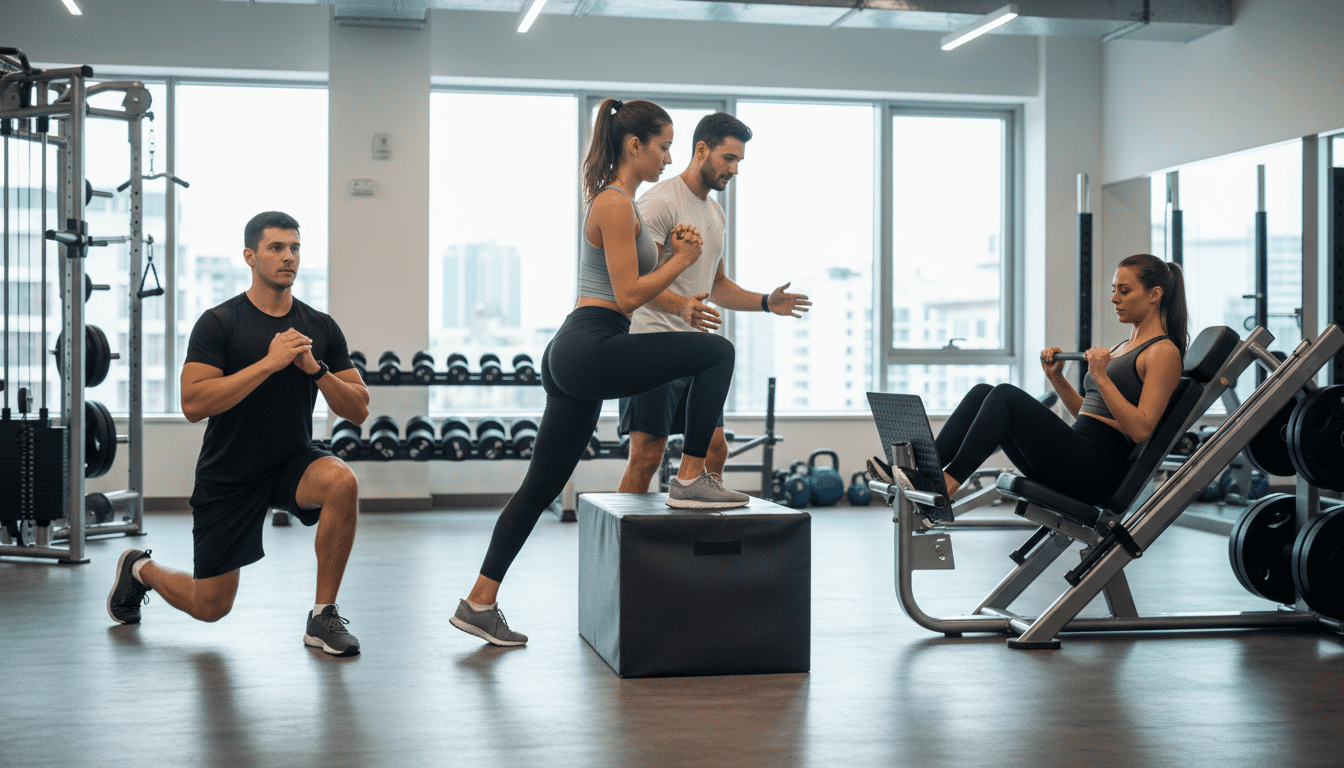
Step-ups place most of the work on a single limb, increasing quadriceps demand compared with two-legged squats.
Joe Hribick, a physical therapist and clinical assistant professor at Lebanon Valley College, says stepping onto a raised surface forces one leg to produce the majority of the lifting and the controlled descent engages the quad through both concentric and eccentric phases.
Higher step heights and deliberate lowering increase muscle activation, but Hribick warns to select a height that preserves an upright trunk and keeps the knee aligned over the toes.
Practitioners recommend pushing through the heel and midfoot, progressing by raising step height or adding external load as technique and strength improve.
Lunges Allow Greater Unilateral Load Than Bilateral Squats
Lunges shift the load to the front leg during the descent and ascent, which can produce stronger quad recruitment than exercises that split the effort between both legs.
Hribick notes that forward and backward lunges demand single-leg strength and balance, offering a scalable path to increased quadriceps development.
Proper alignment is essential: maintain a hip-width split stance, keep the torso upright, and ensure the knee tracks over the mid-foot or second toe.
As with step-ups, resistance can be added with dumbbells, a barbell, or a weighted vest to continue progression while monitoring form.
Seated Knee Extensions Target the Quadriceps Directly
Open-chain knee extensions performed from a seated position isolate the quadriceps and can produce targeted gains when programmed correctly.
Michael Fredericson, a sports medicine physician and professor at Stanford Medicine, explains that controlled knee extension from about 90 degrees toward 45 degrees of flexion emphasizes the quad without overloading the patellofemoral joint.
Progress slowly and avoid forcing the knee to full extension repeatedly, because moving past about 30 degrees toward full lockout raises stress on the kneecap-femur interface.
Patients and athletes with a history of anterior knee pain should consult a clinician and consider conservative ranges that strengthen the quad while limiting joint irritation.
Leg Presses Provide Closed-Chain Strength with Joint Stability
The leg press is a closed-chain alternative that distributes load across multiple joints and muscle groups, often making it a safer choice for beginners or people managing knee issues.
Fredericson recommends limiting the depth of the leg press to roughly a 45-degree knee flexion to reduce unnecessary patellofemoral stress while still loading the quadriceps effectively.
Because the movement is performed with the feet fixed, the leg press can help build strength while offering more support than free-weight squats.
Practitioners emphasize controlled tempo and appropriate foot placement to prioritize quad engagement while avoiding compensatory hip or back strain.
Downhill and Backward Walking Put the Quads to Work Outside the Gym
Walking downhill loads the quadriceps eccentrically, which means the muscle resists lengthening under load and gets substantial stimulus for strength and durability.
Robbie Mann, a physical therapist with FYZICAL Therapy & Balance Centers, says that eccentric quad work from descents can be particularly effective for building strength that translates to everyday activities.
Walking uphill backward or walking backward on flat ground targets the quad concentrically and can be used where hills aren’t available.
Mann suggests keeping the knee flexed while moving backward to maintain continuous quad activation and to vary the training stimulus between eccentric and concentric emphasis.
Single-Leg Balance Activations Build Isometric Quad Strength and Stability
Simple single-leg balance drills engage quadriceps isometrically and support improvements in stability that reinforce other strength gains.
Mann recommends holding a single-leg balance for about 30 seconds to activate the quad without movement, which can be especially useful for people rehabbing or preparing joints for higher-load activity.
Isometric work helps with joint control for tasks like stair climbing and curb negotiation, and it can be done anywhere with no equipment.
Progressions include closing the eyes, performing small knee bends, or adding perturbations to challenge balance and quad endurance.
These Alternatives Can Be Integrated Into Programmes for Balanced Quad Development
Physical therapists and sports physicians note that no single exercise is universally superior; instead, programs that combine unilateral, open-chain, closed-chain, eccentric, concentric and isometric work produce the most robust quadriceps results.
Clinicians advise that individuals adjust intensity and range of motion to match training history, pain levels and functional goals, and to consult a professional when experiencing knee pain.
When performed with attention to alignment, controlled tempo and gradual progression, step-ups, lunges, knee extensions, leg press, hill walking and single-leg balances offer effective pathways to build quads without relying solely on heavy squats.
