
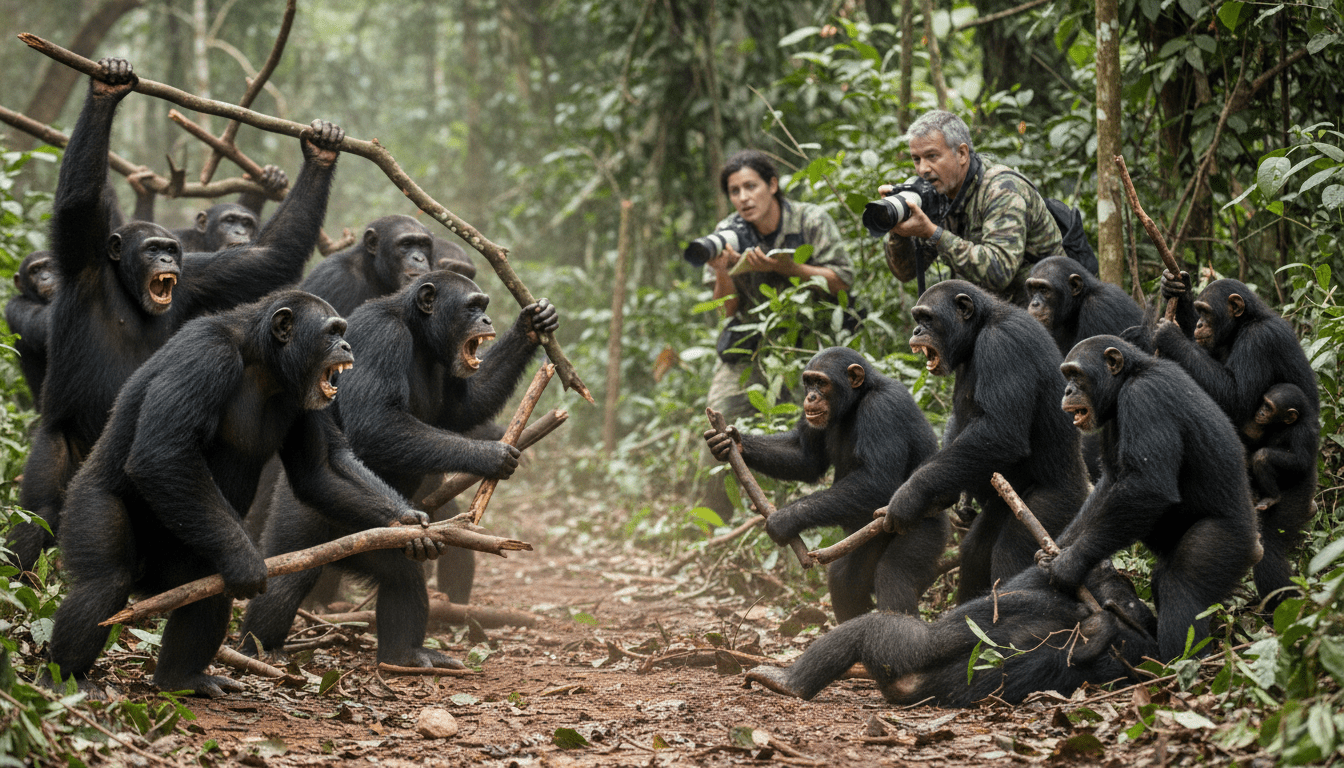
Chimpanzee group split at Ngogo unfolds into lethal raids after years of avoidance
Decades of study show a chimpanzee group split at Ngogo, Uganda, escalated from avoidance to patrols and deadly raids, revealing roots of intergroup violence.
The Ngogo community in Uganda’s Kibale National Park has experienced a dramatic chimpanzee group split that researchers say developed into sustained lethal violence. A study published in Science reconstructs more than a decade of social change for a community that once numbered about 200 individuals. The analysis links an initial rupture and prolonged avoidance to later patrols, targeted attacks and multiple killings between the two emergent subgroups.
Early observations and unusually large community
Since 1995 researchers monitored the Ngogo community, which at roughly 200 members was far larger than most known chimpanzee groups. Long-term field observations and genetic data establish Ngogo as exceptional in size, with the population later dividing into western and central subgroups. Scientists note that the community’s history includes earlier violent expansion, when Ngogo individuals assimilated members from a neighboring group, contributing to the unusually high numbers.
First rupture recorded in June 2015
The first clear sign of division occurred on June 24, 2015, when members from western and central sectors encountered one another at the territory’s center and conflict prompted flight and pursuit. That incident preceded a previously unrecorded six-week period of mutual avoidance between the two sets of chimpanzees. Researchers describe this sustained separation as unprecedented in their long-term records and as the opening stage of a larger polarization process.
From patrols to pitched battles
After the avoidance phase, the conflict evolved into organized intergroup behavior. Male chimpanzees from the western subgroup began conducting patrols in 2016, and by 2017 the central subgroup reciprocated with its own patrols and the first fights were observed. Over time the groups occupied increasingly distinct areas; the former shared territory developed into a boundary that the two sides defended, and individuals bred predominantly within their new affiliations.
2018 split becomes entrenched and violence intensifies
By 2018 the division had become structural: observers recorded the western subgroup with ten adult males and 22 females aged twelve or older, and the central subgroup with 30 adult males and 39 adult females. Despite being smaller, the western subgroup initiated all documented intergroup attacks. In several confrontations an adult male from the central subgroup was killed, and subsequent years saw the violence broaden to include juveniles. Between 2018 and 2024 researchers documented at least seven adult male killings, 17 juvenile deaths attributed to western attackers, and the disappearance of 14 additional central-group chimpanzees.
Factors explored: size, social bonds and disease
The study’s authors highlight multiple factors that may have contributed to the escalation. Ngogo’s exceptional size likely strained the social fabric that ordinarily regulates chimpanzee relations, and the loss of several long-standing group members in 2014 may have weakened cross-cutting social ties. An epidemic in early 2017 killed roughly 25 chimpanzees, including 14 adults, and researchers suggest the death of a male who maintained inter-subgroup contacts could have accelerated the breakdown of cooperation. The paper argues that dense networks of personal relationships play a decisive role in preventing intergroup hostility, and their erosion can enable lethal conflict.
Comparisons with historical primate cases and implications
The pattern at Ngogo evokes a famous series of observations from the 1970s in Tanzania in which a chimpanzee community split and subsequent killings were reported, though those earlier records had gaps and involved human-provisioned animals. Genetic and long-term field data suggest that durable community splits with sustained lethal aggression remain extremely rare across chimpanzee populations. Researchers also note that parallels with bonobo social dynamics are limited, since bonobos demonstrate markedly different social structures and historical splits have not produced analogous mass violence.
The Ngogo findings underscore that chimpanzees possess a sense of group identity that can transcend prior familiarity and everyday social bonds, the authors write. That insight challenges explanations of human warfare that attribute intergroup violence solely to symbolic cultural differences and suggests that deteriorating personal networks can also fuel conflict.
The study leaves open the future trajectory of the Ngogo conflict, reporting that one possible outcome is continued westward expansion by the smaller but cohesive western subgroup, which could imperil the central group over the coming decades. Researchers emphasize the value of long-term observation for understanding how social structure, demographic shocks and disease interact to produce rare but consequential episodes of intergroup violence in our closest living relatives.
