
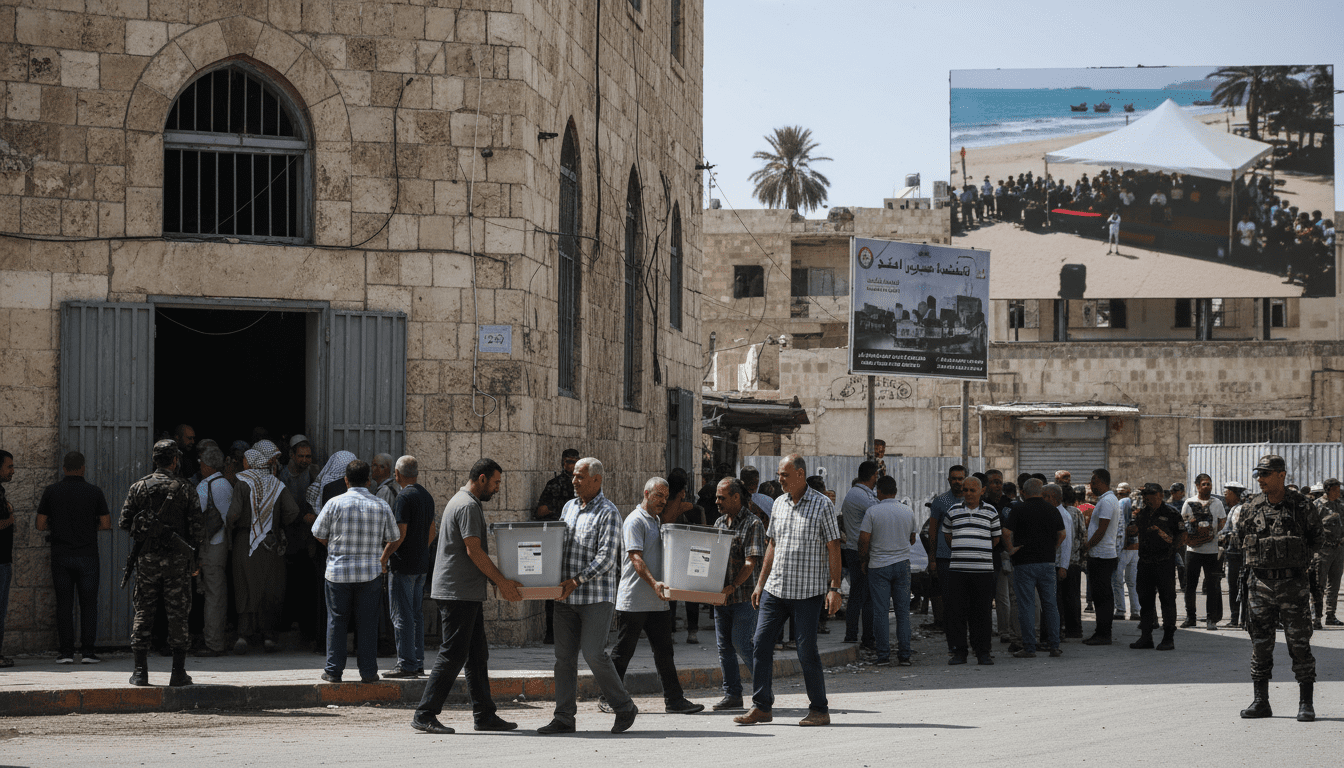
West Bank municipal elections resume with 1.5 million called to vote, Deir al‑Balah included
West Bank municipal elections resumed Monday as around 1.5 million Palestinians were called to the polls, with Deir al‑Balah in the Gaza Strip included in the ballot. The West Bank municipal elections are the first major vote since the outbreak of war in Gaza and are being held amid security, economic and political tensions.
Voting resumes across West Bank municipalities and Deir al‑Balah
Polling opened at 07:00 local time for most districts, where roughly 1.5 million eligible voters were registered to cast ballots. Deir al‑Balah in the Gaza Strip was included in the schedule, with up to 70,000 residents eligible to participate in what officials describe as a largely symbolic vote. Polling stations in the West Bank will close at 19:00, while those in Deir al‑Balah will shut at 17:00 to allow initial counts to begin in daylight.
Candidate landscape dominated by Fatah and independents
Most candidate lists are aligned with or sympathetic to the secular-nationalist Fatah movement or are presented as independents. In several municipalities, including major West Bank cities, only a single list was registered, limiting voter choice in those races. The Islamist movement Hamas did not field official lists, though observers and local officials say at least one list is widely suspected of having close ties to the group.
Deir al‑Balah vote framed as authority-building experiment
Palestinian Authority officials and local analysts described the Deir al‑Balah contest as a test of administrative reach and public backing in Gaza. Voters there chose among four lists of 15 candidates each, with statutory quotas requiring at least four women per list. The top 15 vote-getters will form the municipal council and then select a mayor, giving the PA a formal local body in a city heavily affected by the conflict.
UN and election commission assess process as credible
United Nations coordinator Ramis Alakbarov praised the vote as providing Palestinians the opportunity to exercise democratic rights under difficult conditions and said the Palestinian Central Elections Commission had organized a credible process. Authorities scheduled earlier closing in Gaza to reduce risks from power outages and enable immediate tabulation in daylight. International observers have not yet issued comprehensive assessments, but UN officials framed the elections as an important civic exercise.
Security arrangements and reports of militia policing
Reports indicate an irregular security picture around some polling sites. International news agencies say elements linked to armed groups have been seen providing security at certain locations in Gaza, while Palestinian civil police were also present. Palestinian officials maintain that measures were taken to ensure safe voting, but the mixed security presence reflects the broader post‑conflict environment and complicates efforts to guarantee uniform conditions.
Economic pressures raise stakes for local governance
The Palestinian Authority entered the vote under acute financial strain, with officials warning that withheld tax transfers from Israel have left payroll obligations unmet in parts of the West Bank. Jerusalem has cited PA payments to prisoners and families of Palestinians killed in confrontations as a reason for holding back revenues it collects on the PA’s behalf. Municipal councils elected now will face immediate responsibilities for basic services and reconstruction in some areas, increasing political pressure on local leaders to deliver tangible results.
Occupation, settlements and political backdrop of the vote
The elections took place against the long-standing reality of Israeli occupation in parts of the West Bank since 1967, a context that restricts movement and subjects Palestinians to a dual legal regime. The current Israeli government has advanced settlement expansion and policies critics say further constrain prospects for a two‑state outcome. In August 2025, the Israeli cabinet approved an ambitious settlement project that drew sharp Palestinian and international criticism and has been cited by some Israeli officials as a decisive political pivot.
The result of the West Bank municipal elections will be watched closely for signs of political consolidation or fragmentation within the Palestinian political landscape. Local councils and the municipal leadership chosen in this vote will confront immediate needs for reconstruction, public services and economic relief, while also navigating the broader tensions between the Palestinian Authority, rival political movements and the occupying power.
Turnout figures and detailed tallies are expected to be released by the Palestinian Central Elections Commission in the hours following the polls, and observers say those numbers will be scrutinized for indications of public sentiment following months of conflict and hardship.
