
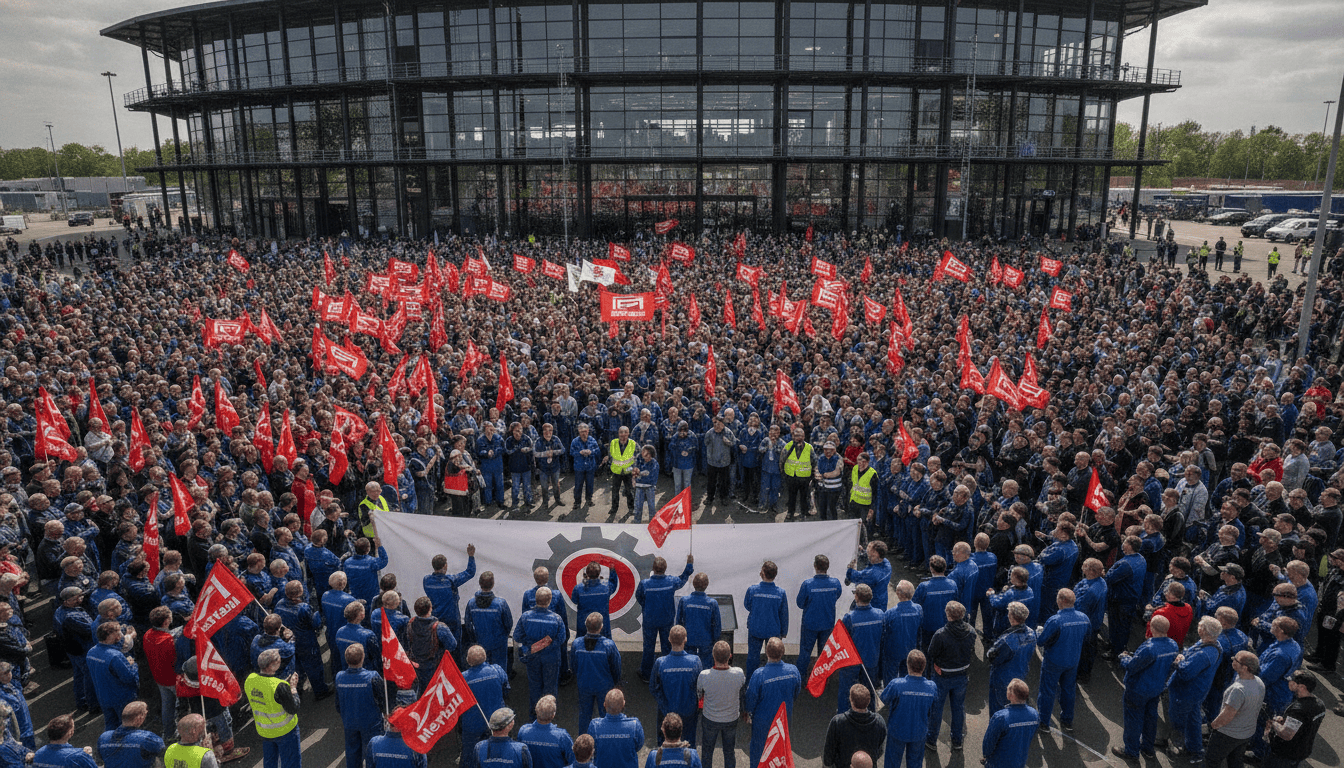
Mercedes protest at Sindelfingen draws 10,000 as workers oppose Mercedes cost-cutting plans
Mercedes protest erupts at Sindelfingen as 10,000 workers join IG Metall actions against cost-cutting, remote-work rollbacks and potential plant shifts.
On Friday, July 3, 2026, an estimated 10,000 Mercedes employees gathered at the Sindelfingen plant to oppose a package of cost-saving measures and workplace changes proposed by the company. The Mercedes protest, organized as part of an IG Metall nationwide action day, brought together assembly-line workers, developers from the research center and members of rival unions in visible demonstrations outside Gate 7. Participants carried red IG Metall flags and blue banners from competing unions while chanting against management decisions they say threaten collective agreements and long-established work arrangements.
Large turnout reflects cross-site anger
The demonstration in Sindelfingen was one of several coordinated actions at Mercedes locations across Germany, including Untertürkheim, Rastatt, Stuttgart, Bremen, Hamburg, Düsseldorf and Ludwigsfelde. Union organizers and company security offered differing estimates, but the works security at Sindelfingen put the crowd at around 10,000 by mid-morning. Workers arrived in organized groups, many bearing flags, rattles and drums, underscoring broad discontent beyond a single plant or shop floor.
Organizers from IG Metall described the mobilization as a nationwide response to what they call a sustained managerial push to shift costs onto employees. The presence of white-collar staff in company polo shirts alongside production employees signaled that the dispute touches development, sales and administrative units as well as manufacturing.
Works council accuses board of attacking social contracts
Ergun Lümali, chair of Mercedes’ central works council, delivered a forceful address on the Sindelfingen stage, calling the proposed measures “an attack on the social state and the tariff system.” Lümali said the company had failed to properly consult employee representatives before announcing the measures and warned that the workforce would resist changes that reduce protections won under collective bargaining. He criticized the timing and tone of a recent internal company letter that framed deeper cuts and longer working hours as necessary to preserve the profitability of a new product offensive.
The works council has reiterated that existing agreements on mobile work remain valid and said management’s announcement that it intends to end hybrid arrangements and restore five-day office presence contradicts earlier commitments. Lümali threatened further demonstrations if discussions with the board do not produce what he called fairer burden-sharing.
Management proposals include hours, presence and cost targets
Company communications obtained by staff outlined a range of measures aimed at lowering hourly costs across development, sales, administration and production. The letter argued that without action, the benefits of a major product offensive could be eroded by excessive costs. Management figures signaled a preference for staff working more hours for the same pay as a direct route to reduce labor costs, a proposal that has alarmed unions and employee representatives.
Five days after the initial company letter, CEO Ola Källenius reportedly intensified the dispute by suggesting a rollback of flexible working arrangements and a return to stricter on-site presence. Production board members, including Michael Schiebe, were singled out by demonstrators who chanted against senior executives and demanded clearer, collaborative processes for any workplace changes.
Financial pressures and production shifts behind the measures
Mercedes’ push for savings follows a period of weakening sales and margins, particularly in China, and higher operational costs at German plants. Company results for the first quarter of 2026 showed a sharp drop in adjusted operating profit, which fell 30 percent to €1.8 billion on revenues of €31.6 billion, yielding a margin of roughly 5.7 percent. In response, Mercedes has capped production capacity in Germany while expanding output in Hungary, notably at the Kecskemét site.
There are reports within the industry that the planned small G-Class model for 2027 could be produced outside Baden-Württemberg, reflecting a broader trend of shifting production locations to lower-cost sites. Such potential relocations have amplified anxiety among workers and local politicians about job security and regional industrial capacity.
Industry leaders and unions signal wider mobilization
The Sindelfingen action drew public criticism of Mercedes’ approach from labor leaders at other manufacturers as well as from within the supervisory and advisory ranks. Executives and works council chairs at Audi and BMW characterized the proposals as blunt attacks on collective agreements, heightening the sense that the dispute could cascade beyond a single company. IG Metall said it expects sizeable participation nationwide and warned of further demonstrations if management maintains its current course.
The union has already scheduled an automotive convoy demonstration in Stuttgart for July 9, 2026, and vowed a sustained campaign “through the summer and autumn” to oppose job cuts and relocations. Organizers see coordinated protests as a means to pressure both corporate boards and political stakeholders to seek alternative solutions to preserve employment terms.
Possible spillover to Volkswagen and sector-wide risks
The ripple effects of the dispute may reach other major automakers this month. Trade union sources indicate that a protest briefing could take place in Wolfsburg on the day Volkswagen’s supervisory board is set to consider decisions related to the future of German plants. Unions say they will use such occasions to brief shop stewards and prepare coordinated responses across the sector.
For automakers, the challenge is balancing investment in new products and competitiveness with labor costs and social stability. The Mercedes protest in Sindelfingen illustrates how quickly management cost-cutting proposals can crystallize widespread opposition and shape industry-level debates about where to locate production and how to organize post-pandemic work.
The coming days will test whether negotiations between Mercedes’ board and employee representatives can defuse tensions or whether the IG Metall-led campaign will escalate into rolling actions that affect production and supply chains.
