
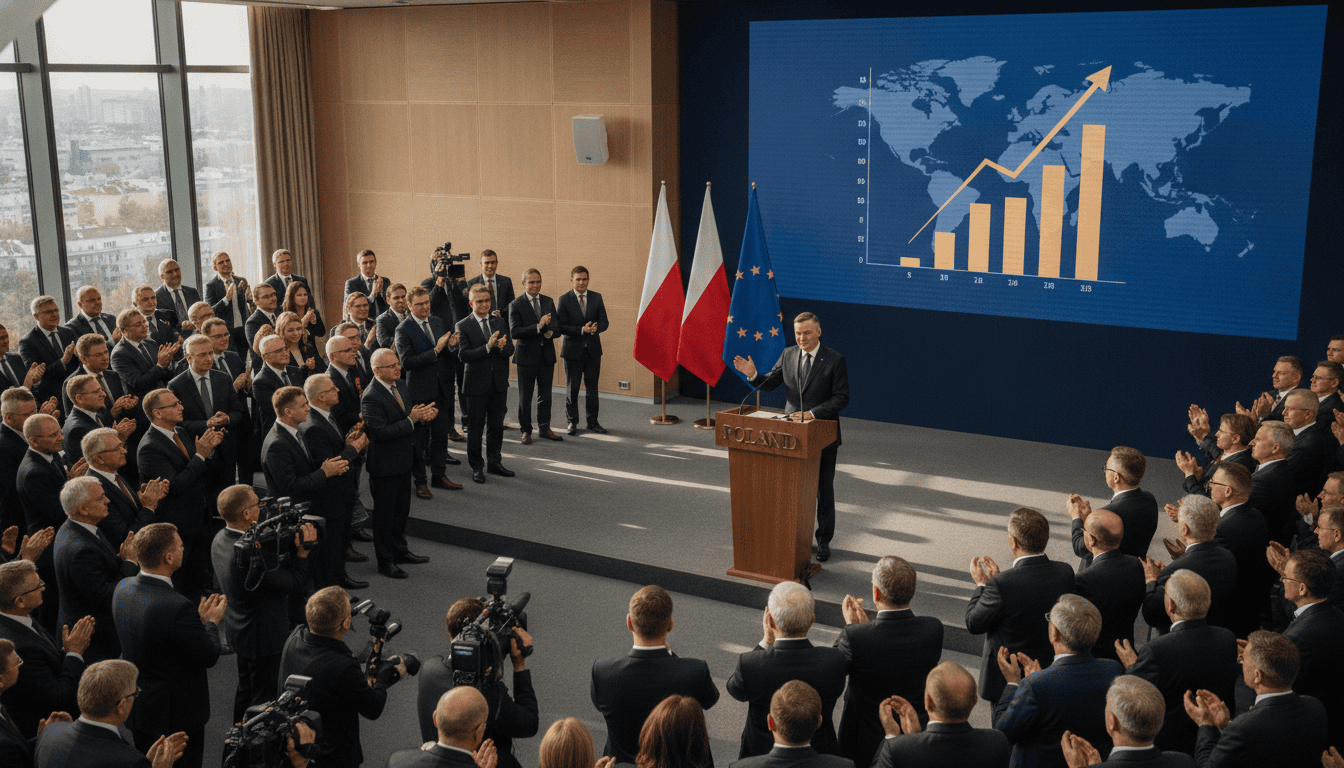
Poland export growth lifts country into top 20 global exporters
Poland’s export growth pushed its world export share from 0.5% to 1.8% between 2000 and 2024, according to UN Comtrade, marking a rapid rise into the ranks of the top 20 export nations. The expansion spans 97 industries and has reshaped Poland’s role in European and global supply chains. While Germany remains the larger exporter with 7.6% of global shipments in 2024, Poland’s trajectory reflects deep structural change and new economic strengths.
Poland export growth in numbers
UN Comtrade data covering 97 sectors show Poland’s share of global exports climbed from roughly 0.5% in 2000 to 1.8% in 2024. That increase reflects both rising volumes and a steady diversification of the goods Poland sends abroad.
The numbers place Poland among the world’s top 20 exporters by value, a notable shift from its image two decades ago as primarily a low-cost assembler for Western manufacturers. The statistical rise is underpinned by stronger domestic production, higher productivity and broader market reach.
Sector mix driving the export surge
Poland’s gains are not concentrated in a single industry but spread across traditional and emerging sectors. Goods such as meat, furniture and tobacco remain important, while higher-value categories—machinery, batteries and even luxury yachts—have grown faster in recent years.
This sectoral breadth has helped Poland avoid dependence on a narrow export base and has attracted foreign investment into supply chains. Increased exports of capital goods and components also point to more sophisticated domestic manufacturing capabilities.
Domestic economy and labour market trends
The export expansion has coincided with robust domestic performance: sustained GDP growth, rising household consumption and falling unemployment rates. Improved productivity in manufacturing and services has lifted wages in many regions, supporting stronger internal demand.
Public initiatives to digitalize administration and streamline business approvals have also reduced frictions for exporters. At the same time, foreign direct investment continues to favour Poland as a production hub for both regional and global firms.
Policy and institutional drivers
Economists point to several structural factors behind Poland’s transformation: the market reforms after 1989, accession to the European Union and effective use of EU structural funds. Proximity to Germany and integrated supply chains across Central Europe have amplified export opportunities.
Stable institutions and a relatively skilled, younger workforce have made Poland an attractive location for investment in production and logistics. Policymakers have leveraged these advantages to support export-oriented clusters and vocational training linked to industry needs.
Innovation gaps and fiscal challenges
Despite rapid export growth, Poland lags many peers in research and development spending and patent generation. Analysts warn that continued reliance on cost competitiveness risks slowing long-term productivity gains without a stronger innovation push.
Fiscal pressures, including elevated budget deficits in some years, and a transitional energy mix that still depends on coal in parts of the economy, add to structural vulnerabilities. Demographic trends—an aging population and out-migration in earlier decades—also pose medium-term labour supply questions.
External exposures and geopolitical risks
Poland’s export performance is closely tied to demand in the European Union, especially Germany, making it sensitive to regional downturns. A prolonged slowdown in major trading partners could quickly temper export momentum, given the integrated nature of Central European supply chains.
Geopolitical tensions and shifts in global trade patterns could alter sourcing and investment decisions, exposing Polish exporters to both risk and opportunity. How Poland adapts to green-transition requirements and reshuffles industrial policy will be critical for its next phase of export expansion.
Poland’s ascent from low-cost supplier to diversified exporter is a notable economic story backed by comprehensive UN Comtrade data. Maintaining that momentum will require deeper investment in research and skills, fiscal consolidation, and an accelerated move toward cleaner energy—measures that will determine whether the country can convert export gains into sustainable, long-term growth.
