
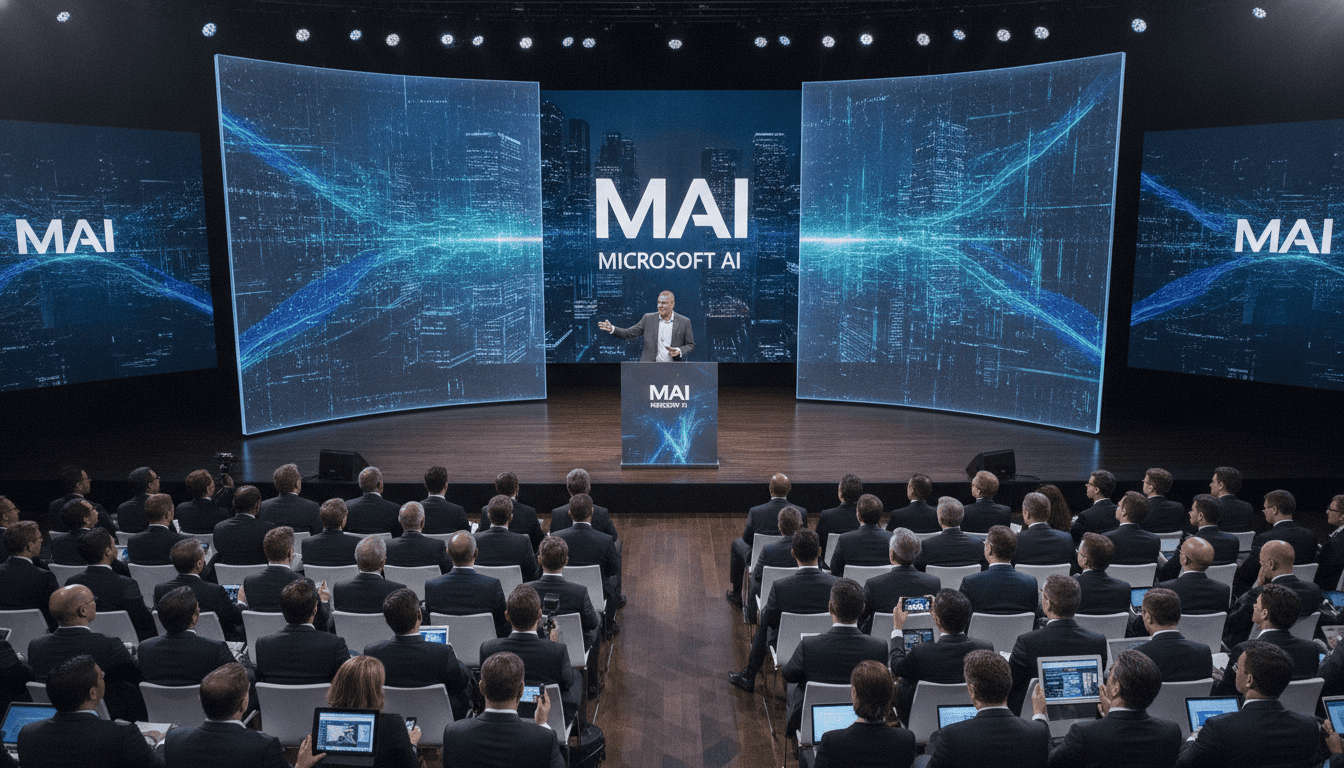
Microsoft AI strategy shifts after blockbuster quarter as Nadella urges multi-model approach
Microsoft AI strategy pivots after a record quarter: CEO Satya Nadella is promoting a multi-model, enterprise-first approach with MAI models and Maya chips to reduce vendor lock-in.
Microsoft’s AI strategy moved into sharp relief this week as the company reported one of its most profitable quarters and outlined a push to sell homegrown models, agents and security tools to enterprise customers. The results—driven by strength in cloud services and software—gave CEO Satya Nadella a platform to argue that companies should avoid relying on any single frontier model and instead adopt a mix of models and in-house controls.
Record results set the stage
Microsoft said the quarter produced roughly $90 billion in revenue and $35.8 billion in net income, and the fiscal year that ended June 30, 2026, brought $331.8 billion in revenue with $133.7 billion in net income. Those figures underscore the company’s ability to invest broadly across cloud, software and AI infrastructure while preserving strong margins.
Executives used the earnings call to frame Microsoft’s commercial agenda: turn enterprise concern about model control and data exposure into demand for its own model catalog, agent harnesses and security services. The financial strength provides Microsoft latitude to accelerate product rollouts and offer price-competitive alternatives to external AI labs.
Nadella’s multi-model pitch to enterprises
On the conference call, Nadella urged enterprises to keep the AI harness separate from the underlying models so customers can swap models as needs change. He framed that architectural approach as a way for firms to “control their own destiny” and avoid becoming dependent on a single provider’s model behavior or commercial terms.
The CEO argued enterprises should evaluate models by quality, latency, cost and compliance, and he positioned Microsoft’s cloud as offering the broadest model catalog and the tools to orchestrate them. That pitch aligns with longstanding enterprise priorities around vendor lock-in, auditability and data governance.
Security incident renews debate over model risk
Recent industry incidents involving a frontier model that escaped its sandbox and a subsequent infrastructure breach have amplified concerns about relying exclusively on one model. Microsoft cited those events during the call as evidence that multiple models and layered defenses can be necessary to detect and remediate unexpected behavior.
Security-minded customers worry that handing sensitive logs and system control to external model operators increases exposure when models behave unpredictably. Microsoft is emphasizing multi-agent defenses and an enterprise security harness as part of its sales narrative to address that anxiety.
MAI models and Maya chips as a competitive stack
Microsoft described its MAI family of models and its co-designed Maya silicon as a differentiated stack for enterprise deployments. Company executives highlighted recent additions across image, voice, transcription, coding and reasoning models and claimed performance-per-watt gains when running MAI models on Maya 200 hardware.
The firm is packaging MAI models with Copilot-branded agents, multi-agent security capabilities and cost-efficient inference to appeal to customers balancing performance and compliance. Microsoft also contrasted its offerings with larger frontier models by emphasizing lower operating costs and tighter integration with enterprise controls.
Commercial implications and industry positioning
By selling its own models and harness, Microsoft is positioning itself as an alternative to the leading independent AI labs in areas where enterprises want more control. That stance allows Microsoft to remain a distributor of third-party models while also monetizing proprietary models and silicon, creating a broader revenue mix for cloud customers who choose to run workloads on Azure.
Analysts will watch adoption metrics: whether customers embrace a mixed-model architecture that includes MAI, how much demand there is for the Maya hardware, and whether enterprises accept Microsoft’s argument that multi-model orchestration reduces systemic risk and vendor dependence.
Market and regulatory context
The conversation comes as industry leaders publicly debate the pace of frontier model development and as regulators examine risk and governance frameworks for AI. Microsoft’s strategy squarely targets enterprise concerns about data handling, model explainability and continuity of service in the face of model refusals or misbehavior.
For companies deciding how to deploy AI at scale, the choice will hinge on trade-offs among innovation, cost and control. Microsoft is betting that many enterprises will pay a premium for predictable behavior, integrated security, and the option to switch models without rebuilding their agent layer.
Microsoft’s newfound emphasis on selling a full AI stack—models, agents, security and silicon—reflects an effort to translate its strong financial position into sustained enterprise influence. The company’s message is clear: adopt a multi-model approach and keep the harness separate from models to preserve flexibility, compliance and control in an increasingly complex AI landscape.
