
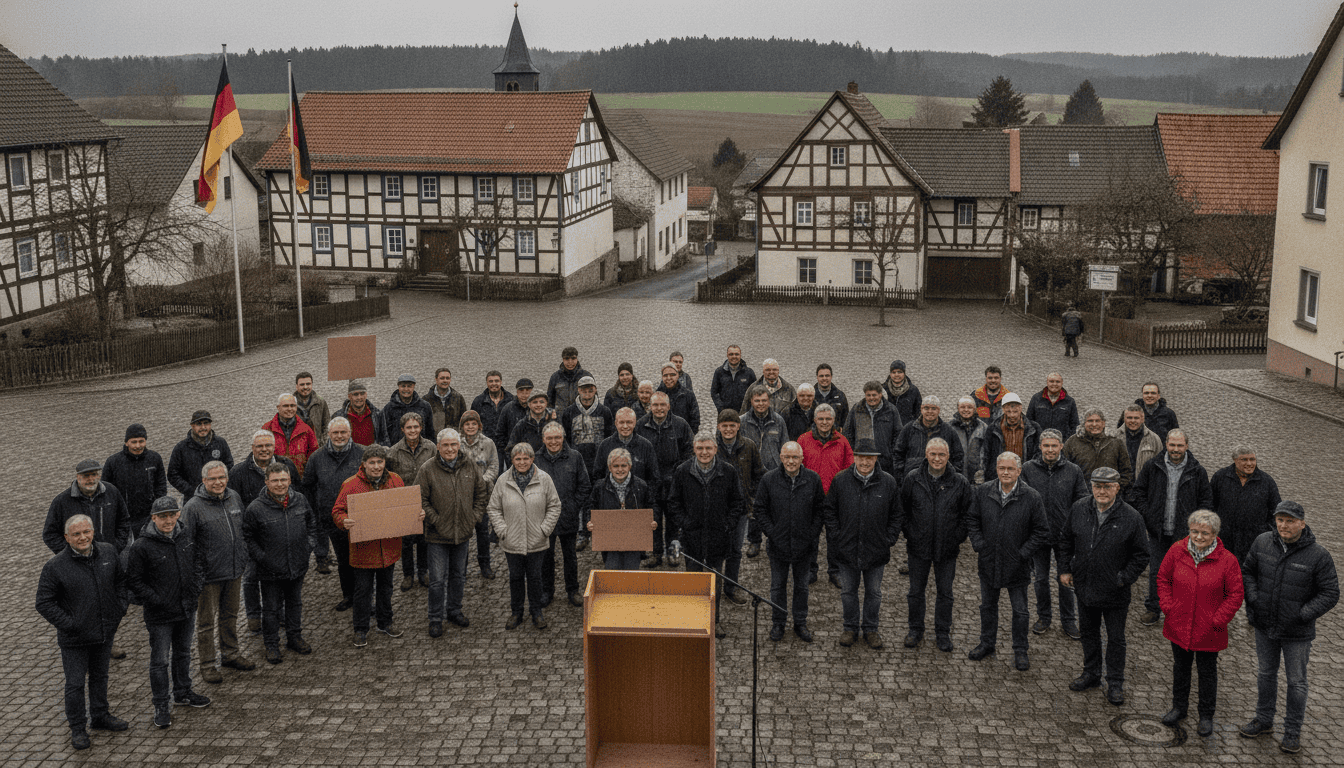
Rural Germany Faces Rising Frustration as Policy Burdens Accumulate
Rural Germany grows frustrated as farm, energy and conservation rules place heavy burdens on the countryside, exposing infrastructure gaps and political risk.
For many residents of rural Germany the frustration that has surfaced in recent years is less about lifestyle than about political decisions that feel detached from everyday realities. Citizens who live outside metropolitan areas accept longer commutes and fewer local services, but they object when national policies impose disproportionate costs or bureaucratic hurdles. That sense of being used as the execution ground for urban-crafted solutions is now shaping local debates and political attitudes in several regions.
Policy burdens are felt more acutely in the countryside
Residents across rural Germany report that regulations on agriculture, land use and emissions often translate into extra paperwork, delayed investments and uncertain returns. These burdens are experienced not only by farm families but by a wide range of businesses — from craft trades to family-owned manufacturers — whose operations depend on clear rules and predictable planning. The result is a growing perception that decision-making centers, mainly located in cities, do not sufficiently account for local conditions.
The countryside remains a central part of the economy
Contrary to stereotypes of decline, rural areas still anchor a large share of Germany’s productive base, supplying food, energy, industrial inputs and skilled labor. Farms, small and medium-sized enterprises and “hidden champions” preserve jobs and regional know-how, often across generations. Treating the countryside as a peripheral political space risks undermining an essential portion of national economic capacity.
Agriculture faces conflicting expectations and practical limits
Farmers are expected to deliver higher animal welfare standards, reduce emissions and protect biodiversity while remaining price-competitive and solvent. Those combined expectations can create contradictory obligations: consumer demand for low-cost food sits alongside social calls for better environmental stewardship. Permitting hurdles, emissions rules and administrative complexity further compress margins, leaving many producers squeezed between public demands and the realities of running a viable business.
Energy transition and conservation shift burdens to local communities
The rollout of wind farms, solar arrays and nature-protection measures has progressed largely on rural land, bringing both benefits and costs to host communities. While regional economies can gain from new infrastructure and local investment, residents also shoulder visual impacts, land-use trade-offs and sometimes contested compensation arrangements. Similar tensions arise over wildlife conservation, where the return of species such as wolves is welcomed by many urban advocates but raises practical risks and costs for pastoral livelihoods.
Eastern regions and small towns still lag on infrastructure and services
Many parts of the countryside, particularly in eastern Germany, continue to struggle with limited transport links, digital connectivity and public services. Local actors repeatedly call for faster permitting, more reliable funding and policies tailored to regional needs rather than one-size-fits-all solutions. Political initiatives such as proposals for a “Heimatagenda” aim to reduce bureaucracy and improve local participation, but officials will be judged on whether reforms translate into measurable change on the ground.
Erosion of trust carries political consequences ahead of state votes
Where citizens feel unheard and institutional responses appear remote, political discontent can translate into electoral shifts and stronger support for populist alternatives. Upcoming state elections mentioned by local commentators underscore how prolonged perceptions of neglect can alter regional political landscapes. Parties and policymakers who want to regain trust must engage in sustained, practical dialogue rather than broad rhetorical gestures.
Local leaders and residents say they do not ask for identical conditions to urban centers, but for policies that respect local trade-offs and enable pragmatic solutions. Many village communities demonstrate adaptability and self-reliance; they respond to problems with initiative and expect regulators to allow room for that judgment. When rules are inflexible or enforcement appears blind to on-the-ground realities, resentment grows and cooperation falters.
Restoring a constructive relationship between capital and countryside requires clearer channels for local input, targeted investment in infrastructure and a willingness to simplify administrative processes where they serve no evident public benefit. Equally important is a shared political language that acknowledges both the necessity of national goals — like climate protection and species conservation — and the need to distribute costs fairly. Without that balance, the policy divide that fuels rural frustration is likely to deepen rather than close.
