
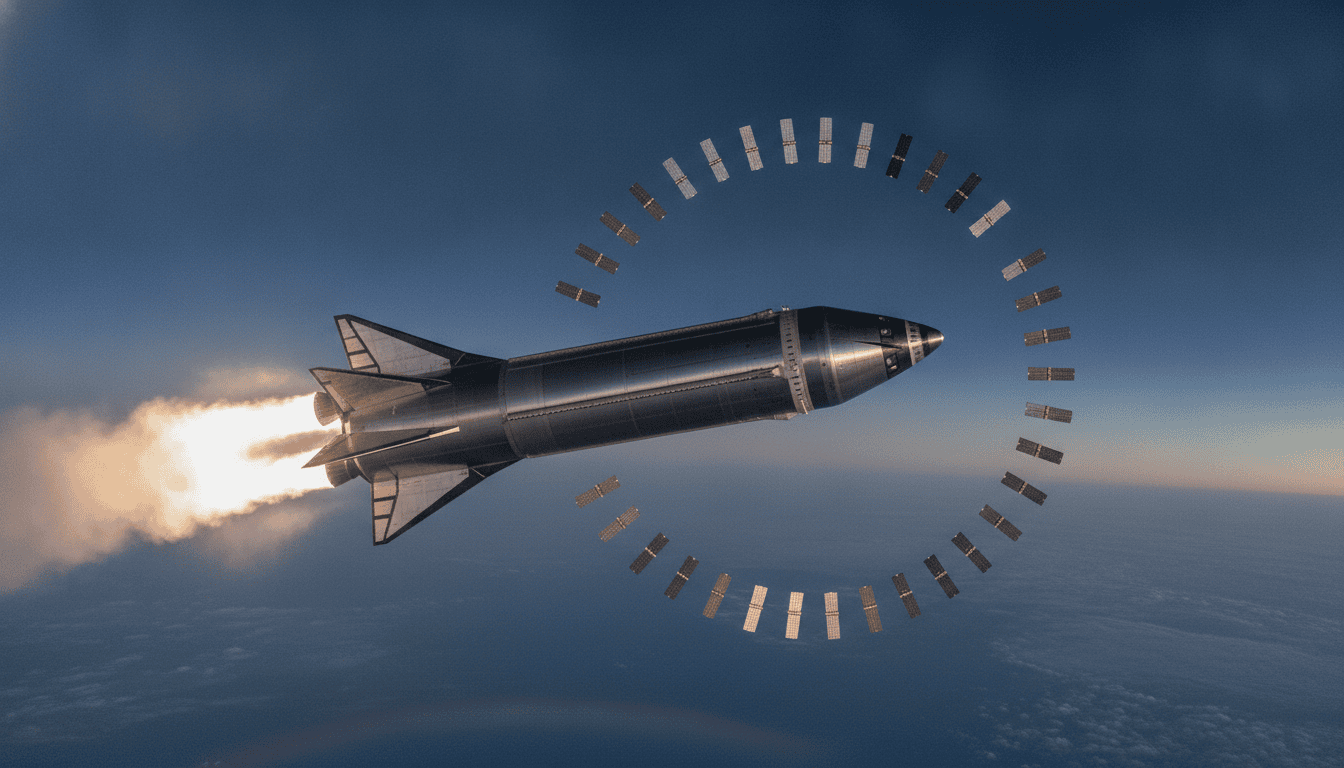
SpaceX Starship test flight 13 completes with upper stage recovered intact in Indian Ocean
SpaceX Starship test flight 13 launched from Starbase Texas, deployed 20 Starlink V3 satellites and saw the upper stage recovered intact in the Indian Ocean. (157 characters)
Mission summary: 13th Starship test largely succeeded
The SpaceX Starship test flight 13 lifted off from Starbase in Texas and proceeded largely as planned, completing its primary mission objectives. The rocket deployed 20 Starlink V3 satellites into orbit and the two-stage vehicle separated as designed during ascent.
SpaceX reported that the lower Super Heavy booster fell into the sea near the launch site shortly after liftoff, while the upper Starship stage reentered and came down in the Indian Ocean about an hour later. Company spokesman Dan Huot described the upper-stage recovery as “the first time that we have an intact Starship in the water,” calling the outcome a significant milestone.
Payload delivered: 20 Starlink V3 satellites
During the flight, the upper stage released 20 Starlink V3 satellites, a next-generation design intended to provide higher bandwidth and faster internet speeds. The newly launched satellites briefly integrated with SpaceX’s existing constellation of roughly 10,000 spacecraft to route traffic and test network performance.
According to SpaceX, the V3 units were designed for increased throughput and improved ground link capacity compared with earlier Starlink models. The satellites were planned to burn up on reentry after completing their mission profile, consistent with the company’s operational design for certain test deployments.
Recovery outcome and significance of ocean landing
The controlled descent and ocean recovery of the upper stage marks a notable step for SpaceX’s reusable architecture, demonstrating a recovery option different from previous attempts. Although the upper stage did not land back on a drone ship, surviving reentry and remaining intact in the water provides engineers with valuable hardware and data for analysis.
SpaceX engineers will examine recovered components to validate thermal protection, avionics performance, and structural integrity after reentry. The company views water recovery as a beneficial contingency for future flights while iterative testing continues toward routine reuse.
Technical details of Starship Version 3
The flight again used Starship Version 3, a substantially redesigned iteration of the 122-meter rocket system that SpaceX says improves performance and manufacturability. The vehicle comprises the roughly 70-meter Super Heavy booster and the approximately 50-meter upper-stage called Starship, each intended to be reusable after return.
Version 3 incorporates design, propulsion, and avionics updates aimed at increasing payload capacity and operational reliability. Those enhancements are central to SpaceX’s roadmap for regular launches, larger Starlink deployments, and eventual crewed missions.
Flight history and recent schedule changes
The 13th test was originally scheduled about a week earlier but was postponed after engines on the booster failed to ignite during prelaunch operations, forcing a scrub. A subsequent weather delay pushed the mission to its eventual launch window, a pattern that has characterized several earlier Starship tests.
Starship’s flight history includes the first orbital attempt in April 2023, when the vehicle experienced an early in-flight breakup minutes after liftoff. Since then, SpaceX has carried out multiple tests that progressively extended altitude and operational complexity, producing mixed outcomes while driving iterative improvements.
Program stakes: Starlink expansion, NASA and Mars ambitions
Version 3 is critical to SpaceX’s broader ambitions: expanding the Starlink satellite internet service, meeting NASA objectives for lunar crewed missions, and enabling far-term plans for Mars exploration. NASA has selected Starship as the lander for planned Artemis missions and aims to return astronauts to the lunar surface in the coming years.
SpaceX has also highlighted a future in which thousands of satellites could support advanced orbital computing and artificial intelligence workloads, a strategy that depends on reliable, high-capacity launch capability. The company’s mid-June 2026 public listing further intensified market focus on Starship’s ability to scale commercial and government payloads.
The 13th flight provides engineers and planners with flight data crucial to those ambitions and signals that the program is moving into a phase of more consistent, performance-driven testing.
SpaceX will continue to analyze telemetry and recovery findings from this flight as it prepares for the next test campaign, seeking to refine procedures and improve the reusability that underpins its long-term goals.
