
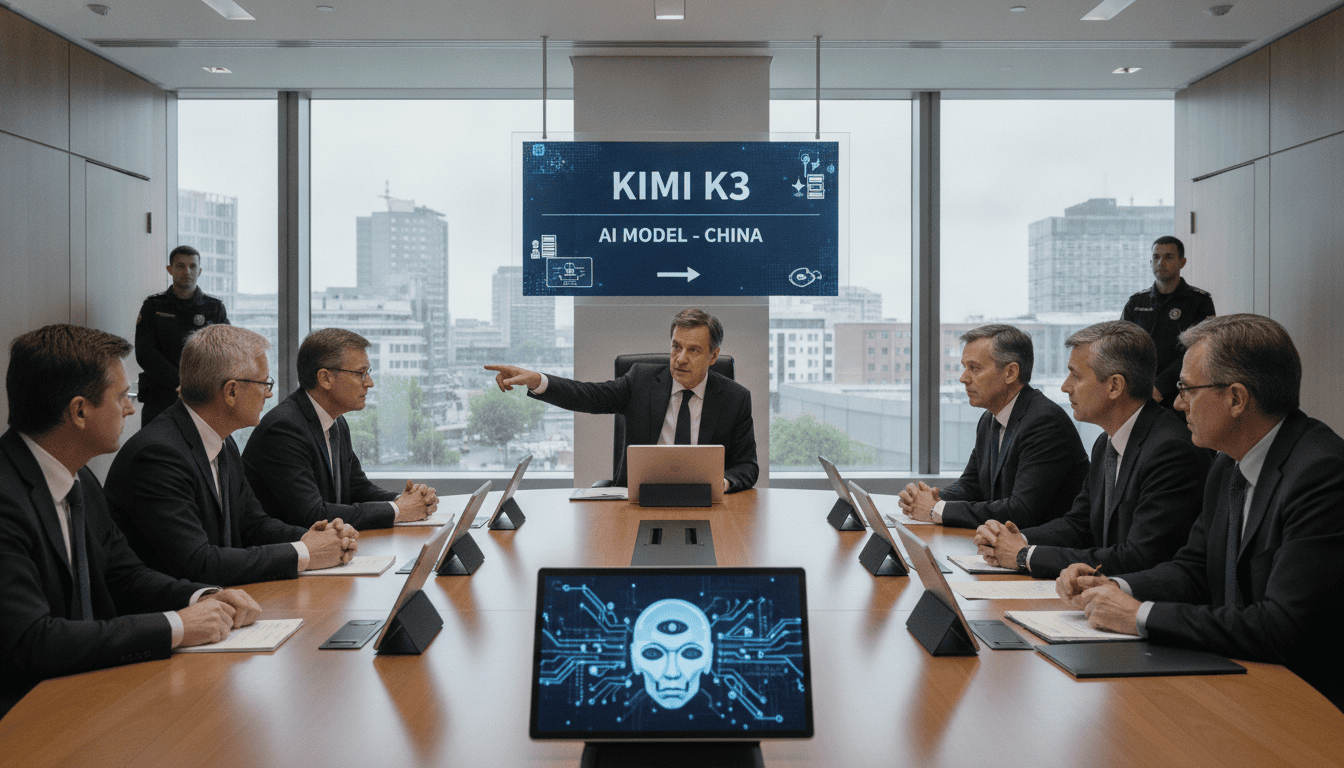
Kimi K3: Moonshot’s 2.8T Model Jolts AI Industry and Raises Security Questions
Moonshot’s Kimi K3, a new Chinese open-weight AI model, is being hailed as a rival to top U.S. systems and has immediately prompted debate over performance and safety. The model’s release has intensified scrutiny from policymakers and corporate customers as analysts test whether Kimi K3 can match or exceed technologies from OpenAI and Anthropic. (washingtonpost.com)
Moonshot unveils Kimi K3 at pivotal moment
Moonshot AI introduced Kimi K3 as its latest flagship system, positioning it as a successor in the company’s Kimi series and a step up in scale and capability. The move comes amid heightened global competition over generative AI, with firms racing to deliver models that combine power, cost-efficiency and business-ready features.
Company briefings and industry coverage emphasize that Moonshot designed Kimi K3 to be broadly usable by enterprises and developers, a strategy intended to accelerate adoption outside China. Many observers say the timing—coinciding with major AI industry gatherings—amplified the model’s visibility and the international response.
Technical profile and architectural claims
Moonshot has described Kimi K3 as a multi-trillion-parameter system with a large context window and native multimodal inputs, claims that place it among the most ambitious open models released to date. Reports note a parameter count in the multi-trillion range and highlight features aimed at long-context reasoning and multimodal understanding. (tomshardware.com)
The firm positions Kimi K3 as optimized for coding, document analysis and agentic workflows, which it says makes the model particularly attractive to commercial users seeking automation for complex tasks. Moonshot’s public materials emphasize flexibility and the ability to run on private infrastructure as a selling point for enterprise customers.
Benchmark results and developer reaction
Independent and industry benchmarks published since the release show Kimi K3 scoring strongly on several coding and reasoning tests, and developers have reported impressive results in specific use cases. Early rankings put Kimi K3 near the front of several comparative metrics, fueling claims that it rivals top-tier Western models in targeted domains. (apnews.com)
Open-source developers and smaller AI vendors have responded with both enthusiasm and caution, running experiments that suggest the model can excel in narrow tasks while also revealing variability across different benchmarks. The combination of strong benchmark performance and an open-weight posture has encouraged integration attempts and rapid community testing.
Security, copying allegations and policy fallout
The launch has prompted immediate policy scrutiny, with U.S. officials and independent watchdogs raising questions about whether Kimi K3 was developed through lawful and secure means. Some government and research groups have publicly alleged that aspects of the model’s development mirror techniques used by advanced Western models, and there are active inquiries into potential intellectual-property and export-control issues. (oecd.ai)
Security analysts warn that widely available, high-capability models can accelerate both legitimate research and malicious uses, complicating national efforts to manage risks without stifling innovation. The combination of an open-weight distribution model and high technical capability has re-ignited debates over whether stricter controls, coordinated testing or new international standards are needed.
Commercial appeal and European interest
Businesses in Europe and elsewhere are watching Kimi K3 for its promise of strong coding assistance, document analysis and agentic automation that can be run on-premises or behind company firewalls. The model’s openness and the possibility of local deployment make it especially attractive to firms that prioritize data sovereignty and cost control.
European vendors and integrators are evaluating whether Kimi K3 can be incorporated into enterprise stacks while meeting regulatory requirements such as data-protection rules and forthcoming AI laws. Procurement decisions will hinge on detailed security assessments and assurances about provenance and usage limitations.
Moonshot’s funding, strategy and market implications
Moonshot’s recent capital raises and public positioning have signaled an aggressive growth strategy focused on open-source frontier models aimed at developers and enterprises. The company’s fundraising and valuation milestones have underpinned investments in large-scale model engineering and infrastructure. (techcrunch.com)
Analysts say Moonshot’s approach—coupling high capability with an open distribution model—could change cost dynamics for advanced AI and prompt incumbents to reconsider licensing and hosting strategies. The competition may accelerate innovation but also compress margins in some service areas if open models become the basis for commercial offerings.
Final paragraph text only: Industry watchers say Kimi K3’s arrival will force a recalibration across technical, commercial and policy fronts as companies weigh the model’s capabilities against security and compliance obligations.
