
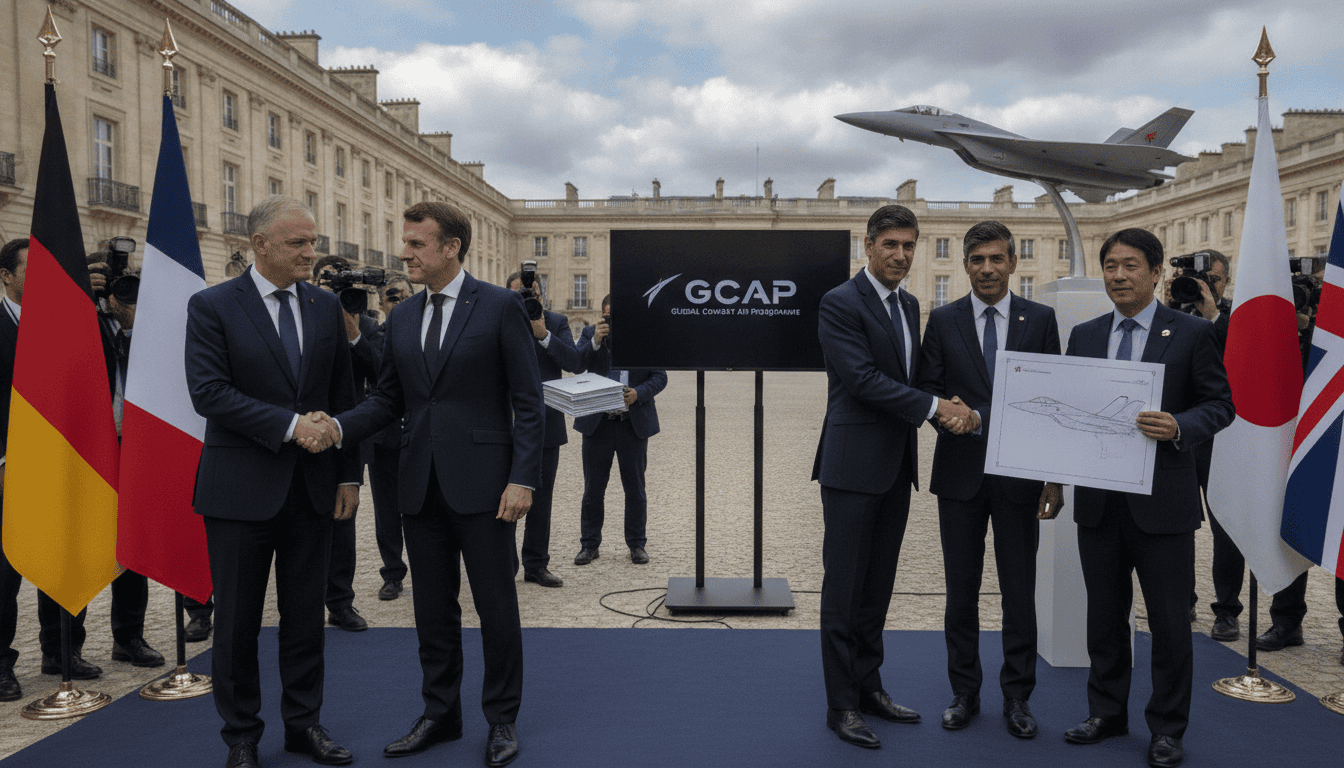
Franco-German fighter project stalls as Dassault explores national demonstrator and new partners
France and Germany scramble for alternatives after the Franco-German fighter project collapsed, with Dassault moving toward a national demonstrator and fresh industrial partners.
Franco-German fighter project collapses
The long-running Franco-German fighter project has effectively disintegrated, prompting both capitals to explore alternative routes for next-generation combat aircraft. Officials and industry sources say three clear options are on the table: a purely national French program, a new multinational partnership, or France joining the existing GCAP effort led by Britain, Italy and Japan.
French leaders and Dassault executives have signalled that joining GCAP is functionally unattractive because the programme is already mature and would likely offer only marginal industrial shares to a late entrant.
Industry split at the heart of the breakdown
Senior executives describe the impasse as as much a corporate dispute as a bilateral political failure. Dassault Aviation and Airbus’s defence arm in Germany fell out over industrial shares and programme governance, leaving no common roadmap for a shared jet. Dassault’s president publicly declared the cooperation chapter closed and blamed the imbalance of planned work distribution for undermining the partnership.
Dassault insists it could have delivered the lion’s share of engineering work under a more balanced arrangement, while Airbus and German industry have emphasised their own bid to lead elements of the programme — a stance that made a continued joint development politically and commercially unworkable.
Combat Cloud and joint standards now vague
One early hope after the breakdown had been to salvage cooperative elements such as a pan‑European Combat Cloud — a digital backbone intended to link sensors, weapons and command systems. That ambition has been diluted in recent Franco‑German defence consultations, where commitments narrowed to broadly worded aims to define a “common European combat standard” and a “secure system connection.”
Observers say these phrasing changes reflect a shift from concrete technical work to high‑level political intent, reducing the scope for a coordinated, timely Franco‑German contribution to a future air combat system.
Dassault eyes a French demonstrator for early 2030s
Against this backdrop, Dassault is preparing a fallback plan: a demonstrator tailored to French operational requirements that could fly in early 2031 or 2032. Company and state sources characterise the effort as either a purely national project or one conducted with selected partners. The demonstrator would be driven by French specifications and could feed into later acquisition choices.
Dassault officials have said there is no immediate industrial panic; the firm points to the ongoing success of the Rafale, strong export sales and the planned F5 upgrade and new large combat drone as reasons it can stagger investments and move deliberately.
Rafale strength reduces urgency for rapid partner deals
France’s airframe exporters and Dassault in particular enter this transition from a position of relative strength. The Rafale continues to sell abroad, with sizeable orders — including a reported new tranche of 114 aircraft from India — and a modernization path that extends its relevance into the 2030s. That commercial momentum lowers immediate pressure to accept an unfavourable collaborative model.
Industry watchers note that France’s economic constraints still make international burden‑sharing attractive, but the calculus has shifted. Paris is now seeking partners on terms that preserve significant French responsibility and influence.
Saab and Sweden emerge as a likely collaborator
Among potential collaborators, Sweden’s Saab has surfaced as a leading candidate for a European partnership. Saab’s experience with the Gripen lineage, prior involvement in Dassault’s Neuron drone demonstrator and ongoing systems deliveries to Airbus position it as a plausible co‑developer. Saab’s leadership has publicly signalled openness to cooperation while declining to name a preferred partner.
French procurement officials have also pointed to recent bilateral exchanges — such as French orders of Swedish GlobalEye early‑warning aircraft and Swedish orders for French frigates — as evidence of deepening security ties that could support a defence industrial partnership.
Political and procurement implications for Europe
The collapse of the Franco‑German project reconfigures more than just aircraft procurement: it alters European defence industrial politics and the balance of influence among national firms. Germany’s insistence on a leading industrial role and France’s resistance to accept a junior position illustrate a widening divergence in strategic industrial policy.
European defence planners will now have to reconcile national ambitions with the need for interoperability, scale and shared research investments if a new collaborative path is to emerge that satisfies both political and fiscal constraints.
France will continue to seek partners while also protecting domestic industrial capabilities, and Germany must decide whether to press its leadership claim, pursue other partners, or double down on national industrial initiatives. The choices made in the next months will determine whether Europe fragments its fighter development effort or finds a renewed, more inclusive model for next‑generation air combat systems.
