
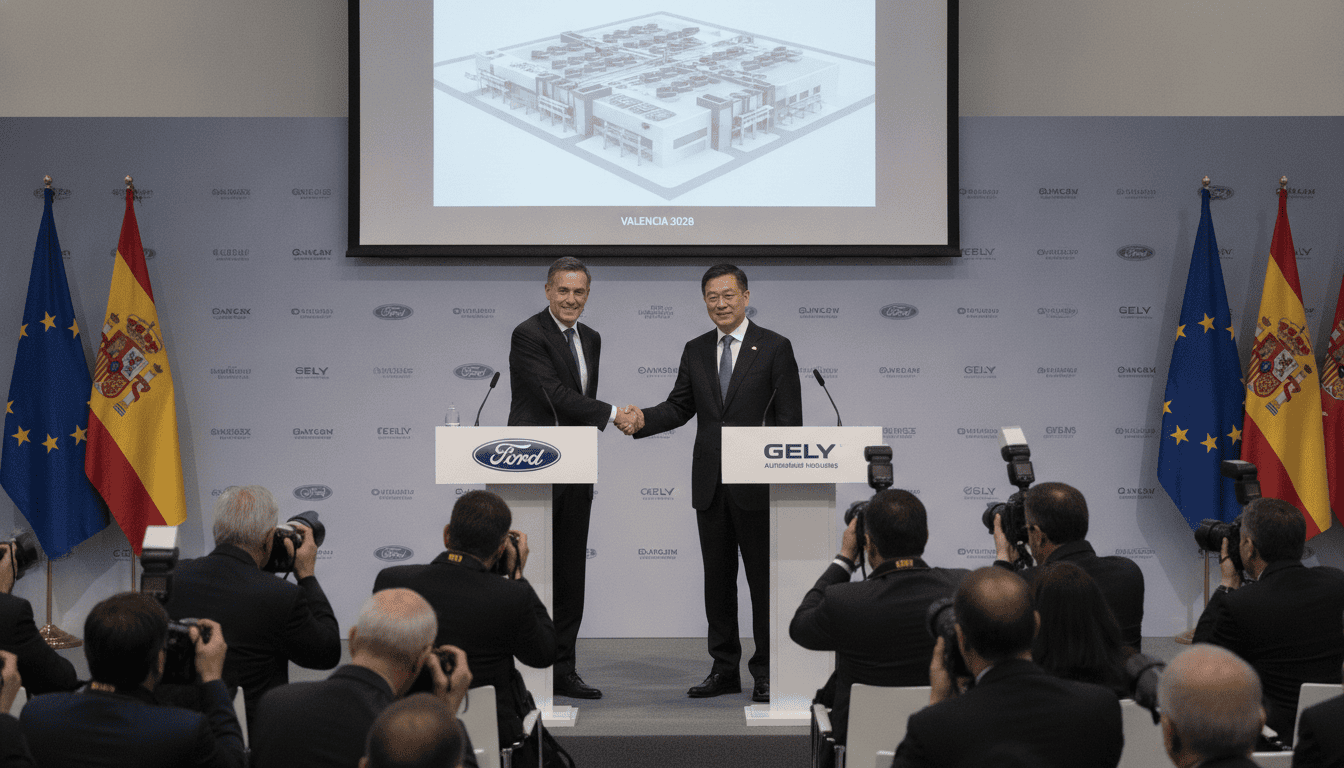
Ford-Geely Joint Venture to Convert Valencia Plant for Shared Production from 2028
Ford-Geely joint venture will turn Ford’s Valencia factory into a shared production hub from 2028, boosting capacity to 500,000 cars and protecting jobs.
The Ford-Geely joint venture announced this week will convert Ford’s Valencia factory into a shared production hub, with first Geely models due to roll off the line in 2028. Under the agreement, Ford will contribute its existing Spanish assembly plant to the partnership and retain a 66 percent stake, while Geely will hold 34 percent. The move signals a major step in Geely’s strategy to establish a manufacturing foothold in Europe and reshapes Ford’s footprint on the continent.
Ford and Geely to Form Valencia Joint Venture
Ford will transfer its Valencia facility, currently producing the Kuga mid-size SUV, into the newly created joint venture with Geely. The ownership split gives Ford majority control with 66 percent while Geely takes a 34 percent equity share. Company statements describe the partnership as a long-term industrial collaboration rather than a simple supply agreement.
Production Plans and Model Line-up
The Valencia plant is slated to assemble five core models on a mixed platform approach beginning in 2028. Ford will continue producing the Kuga and introduce a smaller, Europe-focused version of the Bronco SUV at the site. In addition, a jointly developed family crossover will be built initially under the Ford brand, with plans for a later Geely-branded variant, and Geely will manufacture two electric SUVs for the European market from the same plant.
Capacity, Employment and Political Presence
Sources close to the project say Valencia’s output could reach as many as 500,000 vehicles per year, a figure that would represent more than four percent of annual EU new-car registrations. That projected capacity prompted Spanish Prime Minister Pedro Sánchez to attend the announcement in Valencia, underscoring the project’s political and regional economic importance. Officials are signaling that employment will need to be expanded to meet production targets, reversing earlier plans for job reductions at the site.
Geely’s Strategic Motive and Tariff Pressures
Geely has limited direct sales presence in Europe for its China-made models, and the company has publicly cited high import tariffs as a barrier to market entry. Reports earlier this year identified potential EU import duties on certain Chinese-made electric vehicles rising into double digits, strengthening Geely’s rationale for local assembly. Building cars inside the EU allows Geely to avoid steep import levies and align product specifications more closely with European demand.
Risks for Ford’s Cologne EV Hub
Industry analysts and company insiders warn the Valencia agreement could intensify pressure on Ford’s Cologne operations, which were retooled to produce pure-electric models. Cologne currently manufactures two electric SUVs, the Explorer and Capri, on a platform shared with a major European rival, but sales have reportedly fallen short of expectations. A profitable and high-capacity Valencia operation would create a competitive benchmark within Ford’s European network and could influence future allocation decisions for platforms and investment.
Implications for European Automotive Competition
The partnership further integrates a range of brands and suppliers already linked to Geely, including established names such as Volvo and emerging European marques in which the group holds stakes. By producing vehicles locally with Ford’s manufacturing footprint, Geely gains a pragmatic route to scale in Europe while Ford secures industrial capacity and shared development costs. The JV also tightens competitive dynamics for traditional European manufacturers that face both price and technology pressure from China-based automakers expanding their reach.
The joint venture establishes a clear timeline and commercial framework: Ford retains control of the site and most production responsibility in the near term, while Geely secures manufacturing presence and a faster path to European customers. With production expected to begin in 2028, the announcement sets a multi-year transition for both companies and for the regional supply chain that will support higher output in Valencia.
