
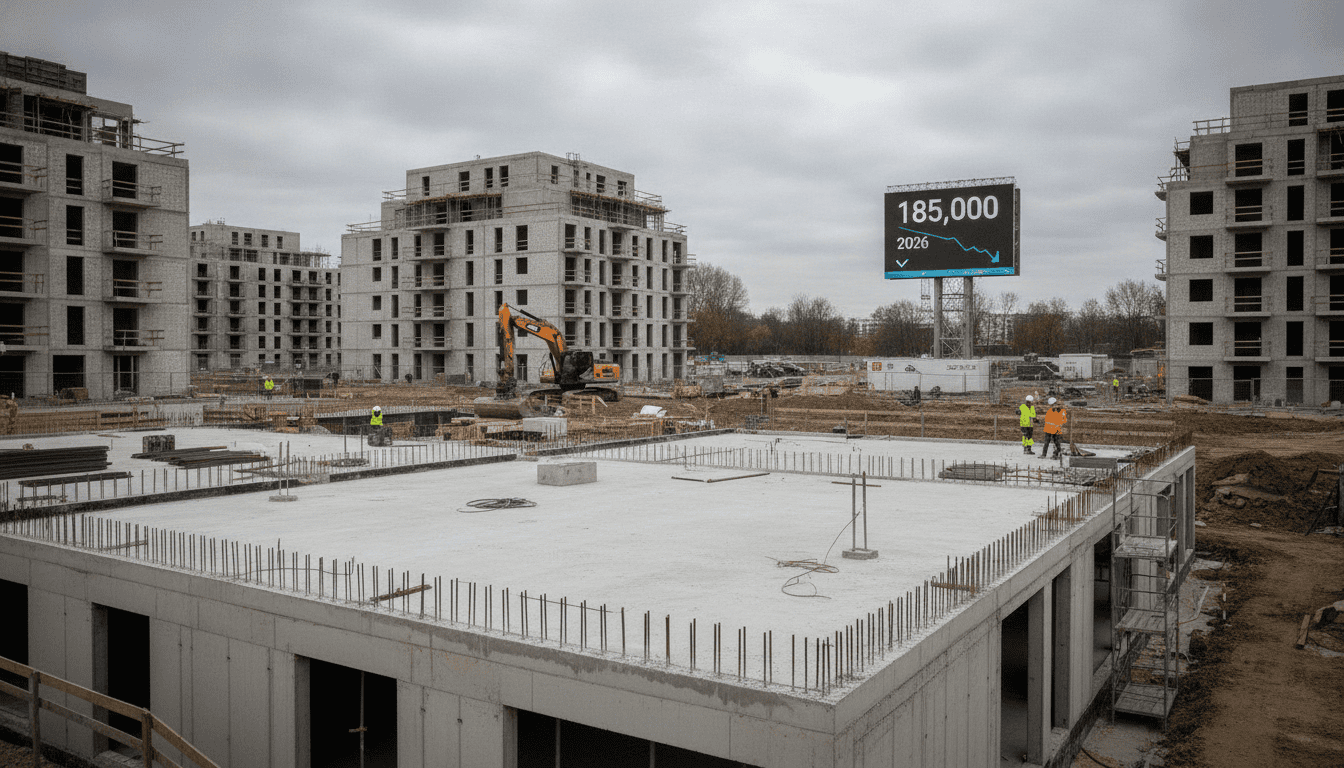
German housing construction set to fall to 185,000 completions in 2026, ifo forecasts
ifo forecasts German housing construction will fall to 185,000 completions in 2026; recovery to 210,000 by 2028 faces inflation, delays and policy hurdles.
Germany’s housing construction is set to contract again in 2026, with the ifo Institute projecting 185,000 completed dwellings this year. The forecast, based on the European research network Euroconstruct, marks a fall from 206,600 completions in 2025 reported by the Statistisches Bundesamt. The decline deepens concerns about an existing shortfall of roughly 1.4 million homes across the country, particularly in large cities where demand remains acute.
ifo projects 185,000 completions in 2026
The ifo Institute’s estimate for 2026 represents a significant step down from last year’s total of 206,600 units, the lowest annual figure since 2012. The projection was released alongside Euroconstruct’s wider European outlook and reflects data through early 2026. ifo sector analyst Ludwig Dorffmeister warned that recent global and domestic pressures could blunt developers’ capacity to translate permits into finished apartments.
Inflation and geopolitical shocks weigh on projects
Dorffmeister said that prospects had brightened up to February 2026 but that the outbreak of the Iran war and rising construction inflation have renewed headwinds for project developers and private homebuilders. Rising input costs for materials and energy squeeze margins and complicate planning assumptions for many projects. Those cost pressures are combining with elevated financing costs in some segments to reduce the pipeline of viable new schemes.
Modest rebound expected by 2028 but still below 2024 levels
Euroconstruct and ifo expect a gradual recovery thereafter, with 195,000 completions forecast for 2027 and 210,000 units in 2028. The 210,000 completions projected for 2028 would slightly exceed the 2025 level but would remain roughly 17 percent below the peak recorded in 2024, according to the analysts’ estimates. That slow rebound underlines the mismatch between near-term supply constraints and ongoing housing demand.
Permitting lags extend construction timelines to 27 months
A key structural factor slowing output is the growing interval between building approval and project completion, which ifo reports has lengthened by about six months to around 27 months since the start of the decade. Extended processing times, labour shortages and complex planning procedures are cited as contributors to those delays. The longer lead times mean that any policy measures or market improvements will take years to show up in completion statistics.
Shortage concentrated in cities; government unveils “Bauturbo” measures
Experts estimate a shortage of approximately 1.4 million dwellings in Germany, with the tightest conditions in major urban centres. In response, the federal government has promoted a so-called “Bauturbo” package intended to accelerate infill development, adding storeys, expanding building footprints and repurposing underused properties. The measures also include increased funding for social housing and regulatory relief to shorten approval cycles and reduce certain construction standards subject to safety and environmental limits.
European outlook: growth elsewhere, only modest gains for Germany
Euroconstruct’s pan-European projection foresees a moderate expansion of building activity, with roughly 1.57 million dwellings expected to be completed across Europe in 2028. The forecast anticipates stronger upsides in countries such as Spain, France and the United Kingdom, while Germany and Italy are expected to record only modest gains. Overall, the European construction sector is projected to grow by about two percent per year from 2026 through 2028, reflecting divergent national dynamics.
The ifo and Euroconstruct forecasts underscore that reversing Germany’s housing shortfall will require sustained policy focus on cost inflation, planning reform and construction capacity. Even with the government’s Bauturbo and increased social-housing funding, the combination of longer approval-to-completion timelines and elevated building costs means supply is likely to lag demand for several more years.
