
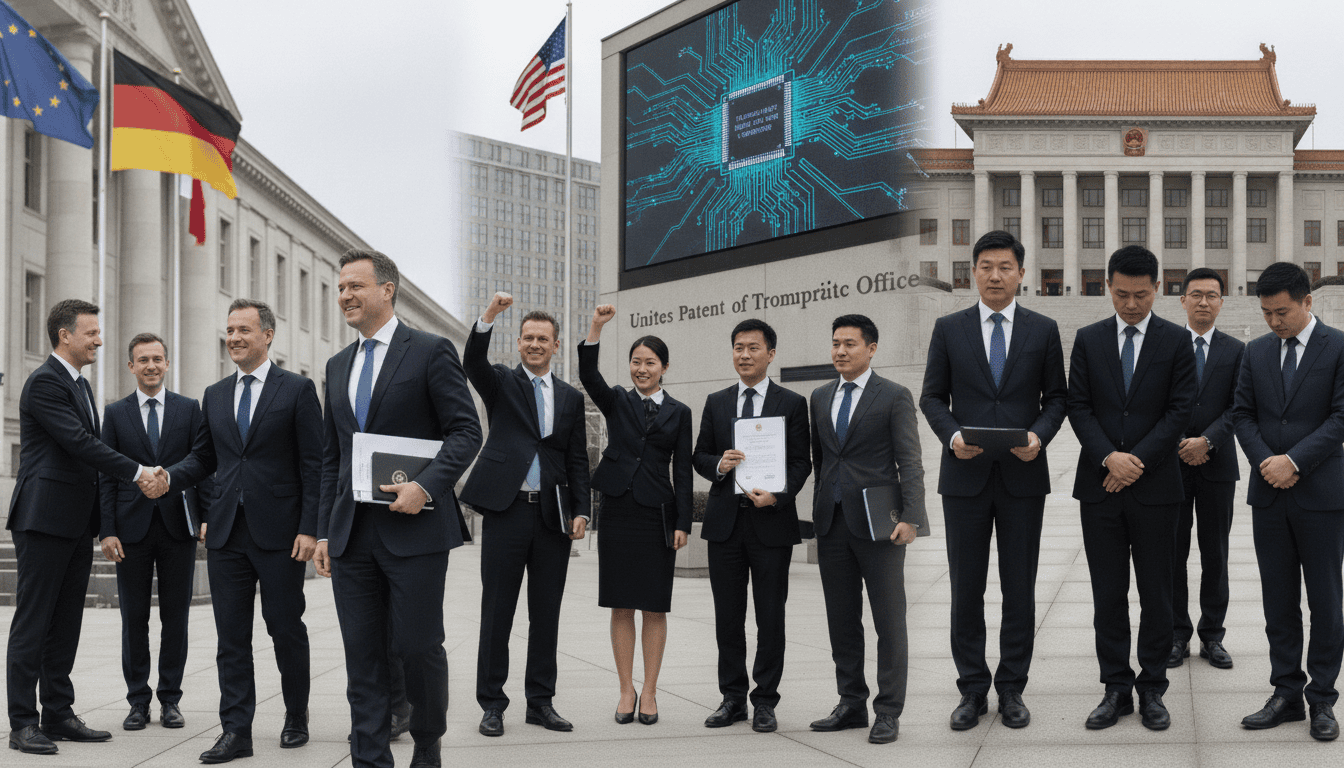
Infineon GaN patent dispute: Court wins in Germany and US, setback remains in China
Infineon wins patent rulings in Germany and the US over GaN chips but faces a sales ban in China; the company relies on deep R&D, patents and global scale.
Infineon’s GaN patent dispute has produced mixed results across jurisdictions, with the Munich-based chipmaker prevailing in Germany and the United States while suffering a legal setback in China. The German court and the US International Trade Commission have ruled in favor of Infineon on multiple patent claims, but a sales prohibition in China remains in place after appeal efforts there have so far failed. The outcome leaves Infineon with strong protection in two of its most important markets even as uncertainty persists in the world’s largest semiconductor marketplace.
German courts bar Innoscience from marketing disputed GaN products
German litigation has repeatedly gone Infineon’s way, with the Landgericht München I finding that Innoscience infringed key patents and ordering a ban on importing, selling and marketing the contested GaN components in Germany. The rulings also include an award of damages to Infineon, underscoring the court’s finding of patent infringement. Legal victories in Germany reinforce Infineon’s position in Europe’s largest market and constrain Innoscience’s ability to build market share on the continent.
Executives at Infineon have pointed to these decisions as confirmation of the strength of their intellectual property, and German judges have applied established patent-law standards in reaching their conclusions. The effect is immediate for distributors and vendors in Germany, who must comply with the injunctions or face legal consequences under the court’s orders.
US trade body enforces import ban after presidential review
In the United States the International Trade Commission concluded that Innoscience violated Infineon patents, and the commission’s remedy took effect after the mandatory 60-day presidential review period. The decision bars the importation and offering for sale of the infringing GaN products into the US market, a move that restricts Innoscience’s access to American customers and supply chains. For Infineon, the US ruling secures protection in one of the world’s largest markets for advanced power semiconductors.
The ITC action is particularly consequential because it operates at the border, preventing infringing devices from entering the country and thereby preserving channels for compliant suppliers. Market participants now face clearer rules on which GaN designs are permissible for sale in the United States.
Chinese courts issue setback; appeals so far unsuccessful
By contrast, Infineon has hit a legal roadblock in China where a court ruling has produced a sales ban on certain GaN parts and its subsequent appeals have not overturned that outcome. Infineon challenged the measures, but a high court rejected a procedural objection and a final resolution has not yet been reached, leaving the sales prohibition standing for now. At a recent trade event in Shanghai the company was required to remove information on the affected GaN products after objections by the organizer.
Company statements indicate the Chinese ban covers only a small portion of Infineon’s overall revenue, but the reputational and market-access implications in China are significant given the country’s role in the global semiconductor ecosystem. Infineon has indicated it will continue to pursue legal remedies while weighing commercial and operational responses.
GaN technology’s role from data centers to electric vehicles
Infineon has emphasized the broad applicability of gallium nitride power semiconductors across markets ranging from AI-focused data centers and robotics to electric vehicles and renewable energy systems. The company reports that GaN-based power supplies can achieve substantially higher efficiency and power density; in server environments Infineon has highlighted potential loss reductions of as much as 30 percent versus traditional topologies. For motor drives in robotics, GaN designs can shrink size and improve motion control, with cited reductions in drive volume of roughly 40 percent.
Despite the technical upside, GaN remains a nascent segment of the power-semiconductor market and typically commands a price premium relative to mature silicon-carbide solutions. That combination of high growth potential and early-stage economics is driving intense competition and the defensive litigation seen between Infineon and Innoscience.
Patents, R&D and production underpin Infineon’s strategy
Infineon’s legal and commercial posture is backed by an aggressive intellectual-property strategy and heavy investment in research and development. The company reported roughly 29,700 patents and pending filings at the end of 2025, and it says its GaN holdings include about 450 patent families specific to the technology. Infineon disclosed spending of approximately €2.2 billion on R&D in the last reported year, equivalent to roughly 15 percent of sales, and about a quarter of its 14,000 employees are assigned to research roles.
The company has also moved to secure supply and technology through deals and capacity expansion; Infineon completed the acquisition of GaN Systems in March 2023 for $830 million and manufactures GaN devices in Villach, Austria, and Kulim, Malaysia. That combination of IP, capital investment and in-house production underpins the firm’s aim to scale GaN volumes and defend market share against emerging rivals.
Market shares and the competitive landscape for GaN chips
Analyst estimates show the GaN power-device market remains relatively small but fast-growing, with current global revenues around $1 billion and forecasts pointing to about $3 billion by 2030. Market-tracking services attribute a rising share to challengers: Innoscience accounted for roughly 30 percent of the GaN market in 2023 and 2024, while Infineon’s share was estimated near 11 percent in that period. These figures help explain the intensity of the patent fight as suppliers jockey for early dominance.
With volumes still concentrated among a few players, firms are using patents, factory capacity and customer relationships to secure footholds in high-growth segments such as data-center power supplies, EV inverters and industrial automation. For Infineon, sustaining leadership in GaN will require converting its IP advantage into cost-competitive production and broad customer adoption.
The mixed legal outcomes leave Infineon with strong protections in Europe and the United States but an unresolved situation in China that could influence commercial plans and partnerships in Asia. The company’s extensive patent estate and sizable R&D base provide tools to defend its position, while market growth forecasts mean the dispute remains strategically important for all GaN suppliers.
