
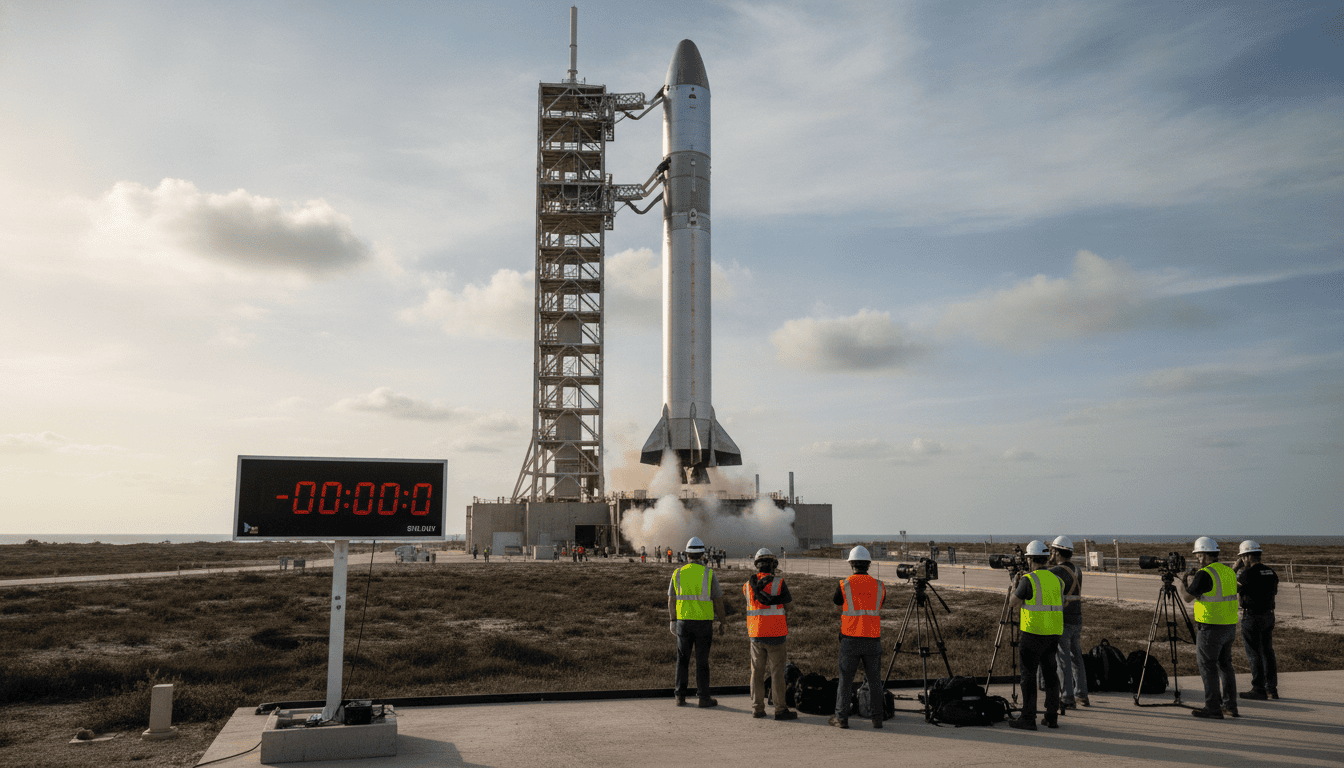
SpaceX Starship Test Stalled at Pad as NASA Pushes Rocket for Moon Missions
Starship did not lift off during a scheduled test flight, underscoring development hurdles as NASA positions the SpaceX Starship for future Moon missions and SpaceX eyes Mars. The stalled attempt highlights technical and regulatory challenges for the massive two-stage vehicle designed for reuse.
Test Flight Did Not Lift Off
A planned Starship test that had been prepared at the launch pad failed to achieve liftoff, according to witnesses at the site. Ground teams reported the vehicle was fueled and in position but did not commence the ascent sequence scheduled for the attempt.
Engineers halted the countdown before ignition, citing what officials described as anomalous conditions that required inspection and additional checks. The pause interrupted one of the most visible demonstrations of SpaceX’s next-generation heavy-lift capability.
NASA’s Mission Plans with Starship
NASA has designated Starship as a key element in its plan to return astronauts to the lunar surface, integrating the spacecraft into crewed lunar architecture. The agency’s selection frames Starship as the vehicle that would ferry crew or cargo in future Artemis-related operations.
SpaceX has also publicly positioned Starship as the backbone of its longer-term ambition to conduct missions to Mars. That dual civil and commercial interest has focused regulatory and public attention on the program’s testing cadence and safety margins.
Architecture and Scale of the Vehicle
Starship is a two-part rocket system consisting of a powerful lower booster and an upper stage that together form one of the tallest launch vehicles ever built. The booster, known as Super Heavy, measures roughly 70 meters while the upper stage — also called Starship — is approximately 50 meters in length.
Both stages separate after ascent and are engineered with reusability in mind, a defining feature intended to lower costs for large-scale space transport. The combined height of the assembled launcher exceeds that of several well-known landmarks, emphasizing the program’s scale.
Reusability and Recovery Strategy
SpaceX designs both the Super Heavy booster and the Starship upper stage to return to Earth intact for refurbishment and reuse, a departure from traditional expendable rockets. Recovery concepts include controlled descents and propulsive landings that would enable multiple flights from the same hardware.
Achieving routine reuse requires precise coordination between staging events, thermal protection systems, and landing procedures. The program’s engineers continue to iterate on hardware and software to reach a reliable turnaround cycle.
Technical and Regulatory Challenges
Complex systems integration, engine reliability, and range safety protocols remain central technical obstacles for the program as it transitions from experimental flights to operational missions. Each ground test and flight attempt is scrutinized for anomalies that could indicate design or process shortcomings.
In addition to engineering hurdles, Starship’s high-powered flights have prompted scrutiny from aviation and environmental regulators over launch safety, debris control, and the impact on nearby communities. Compliance with those requirements affects scheduling and the scope of testing.
Implications for SpaceX and Partners
Delays or aborted launches can affect timelines for NASA’s lunar plans and SpaceX’s broader commercial commitments, but they also provide data that developers say is essential for maturing the system. Program managers typically analyze every test outcome to refine hardware and procedures.
For partners and customers, the pace and results of Starship testing will inform contracting decisions, risk assessments, and future mission planning. Success on subsequent flights will be critical to restoring momentum and confidence in the vehicle’s flight profile.
Despite the setback, the program remains a high priority for SpaceX and its partners because of the vehicle’s potential to transform heavy-lift access to space. Continued testing will determine how quickly Starship can progress from experimental demonstrator to operational launcher.
Industry watchers say the next test attempts will focus on resolving the specific anomalies identified during this attempt and validating recovery maneuvers under real flight conditions. Those assessments will guide when the vehicle can be scheduled for crewed or cargo missions with greater certainty.
