
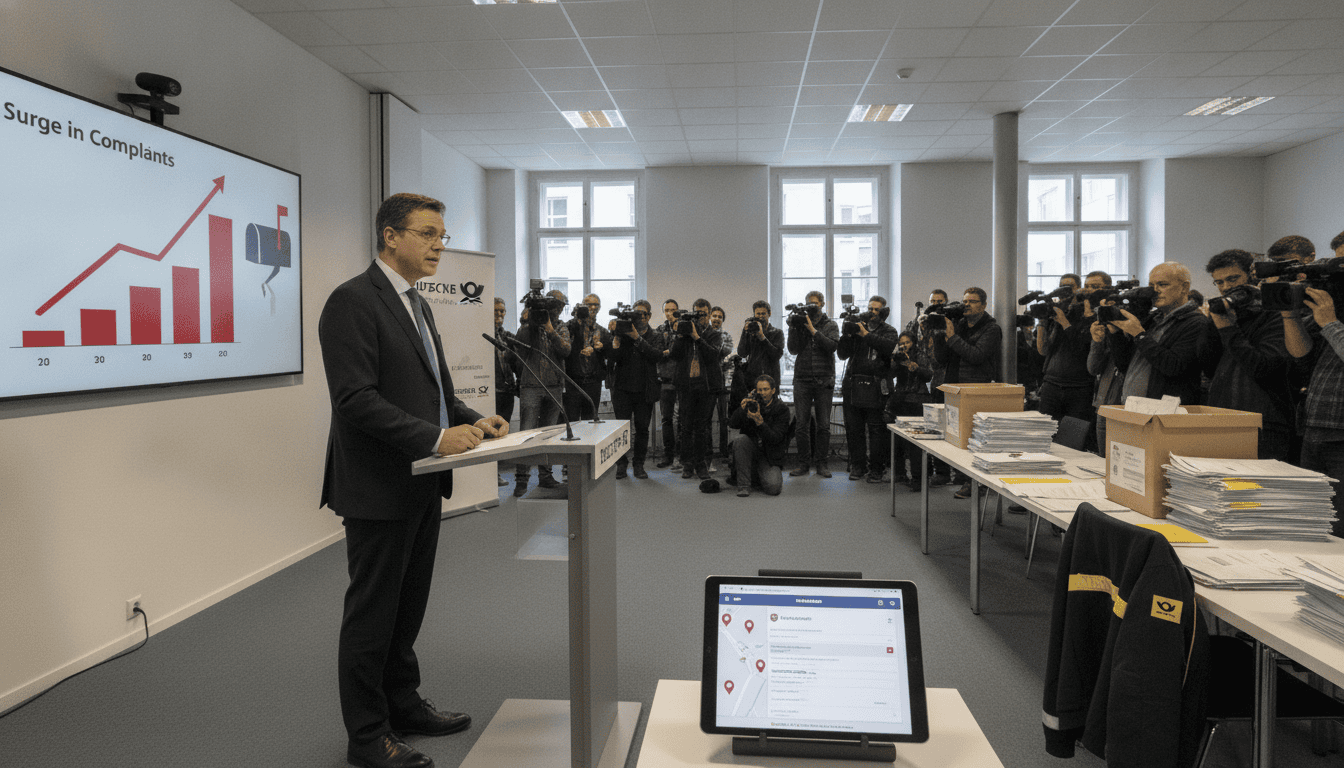
Postal complaints rise on Bundesnetzagentur Mängelmelder as Deutsche Post draws majority
Bundesnetzagentur logged 35,728 postal complaints via the Mängelmelder in Jan–Jun 2026; Deutsche Post accounted for 87% as reporting methods changed amid scrutiny.
Germany’s federal telecoms regulator recorded 35,728 postal complaints in the first half of 2026 through its new Mängelmelder portal, a sharp increase from 22,981 complaints in the January–June 2025 period that the agency itself says are not directly comparable. The surge—registered between January and June 2026—coincides with the introduction of a simplified online complaints form launched in autumn 2025.
Agency data and methodology change
The Bundesnetzagentur’s published figures show the total number of entries submitted to the Mängelmelder between January and June 2026 stood at 35,728, compared with 22,981 in the same six-month span in 2025. The regulator has cautioned that the new reporting format and multiple-choice structure mean year-on-year comparisons should be treated with care.
Under the revised system, complainants select options rather than composing free-text descriptions, a change the agency says speeds case collection and helps identify potential local problems more rapidly. The content of individual complaints is not substantively verified within the portal, a factor regulators say affects how the raw counts should be interpreted.
Deutsche Post/DHL accounts for most complaints
The Bundesnetzagentur data show Deutsche Post and its DHL parcel unit were the subject of roughly 87 percent of complaints logged in the Mängelmelder. That dominance reflects Deutsche Post’s unique position as the only operator that handles both letters and parcels at national scale.
Deutsche Post has countered that the new system lowers the barrier to filing and therefore draws in subjective reports that sometimes overstate service failures. The company points to its own direct complaint rate of 0.003 percent of total mail and parcel volumes as an internal benchmark of delivery reliability.
How the Mängelmelder changed reporting behavior
The Mängelmelder, introduced in autumn 2025, replaces a system that required free-text submissions with a streamlined questionnaire and multiple-choice fields. Industry observers and carriers say the redesign encourages higher participation by reducing the time and effort needed to file a complaint.
Postal operators argue this convenience may increase entries for incidents that, on closer inspection, do not reflect systemic failures. Regulators, however, contend that broader reporting reduces the previous “dark figure” of unreported problems and enables faster detection of clustering in complaints.
No regional hotspots and fewer inspections
Despite the uptick in recorded complaints, the Bundesnetzagentur said it found no concentrated regional “hotspots” in the first half of 2026 that would trigger local supply reviews. That absence of clusters contrasts with January–June 2025, when the regulator opened eight targeted inspections based on complaint patterns.
The lack of fresh occasion-driven probes suggests regulators did not identify areas with sustained, elevated disruption during the first half of 2026. Officials point to the improved granularity of the Mängelmelder as a tool that will, over time, better distinguish isolated incidents from genuine service breakdowns.
DPD’s share among parcel complaints and carrier responses
Among parcel carriers, DPD registered a relatively high share of complaints in the Mängelmelder data, accounting for roughly four to five percent of monthly entries in the first half of 2026. That proportion is notable given DPD’s smaller national parcel volume compared with Deutsche Post/DHL and reflects the portal’s aggregation of parcel-specific issues.
DPD told the regulator and the press that it takes complaints seriously but urged a contextual view, noting its direct complaint rate fell from 0.11 percent of shipments in 2024 to 0.09 percent in 2025. The company also pointed to its annual throughput of some 370 million delivered parcels as evidence that the vast majority of consignments reach recipients reliably.
Political and oversight responses
Political actors signalled support for the regulator’s expanded complaint capture while urging responses to any verifiable failures. Sebastian Roloff, the economic policy spokesman for the SPD parliamentary group, welcomed the reduction of the unreported “dark figure” and said the expectation remains that faults be corrected “swiftly and consistently” to ensure high-quality delivery services.
Regulator representatives emphasised that the Mängelmelder is intended as an early-warning instrument rather than a substitute for formal investigations, and they said follow-up work will focus on corroborating patterns that indicate persistent deficiencies. Industry groups and carriers expressed willingness to engage on data interpretation and on measures to improve customer communication where needed.
The Mängelmelder’s first major dataset provides both regulators and carriers with a new picture of consumer concerns, but it also raises questions about how raw complaint counts should be weighted against delivery volumes and internal carrier metrics. As the Bundesnetzagentur continues to refine its reporting and analysis, officials and operators alike face the task of translating the portal’s increased transparency into targeted service improvements.
