
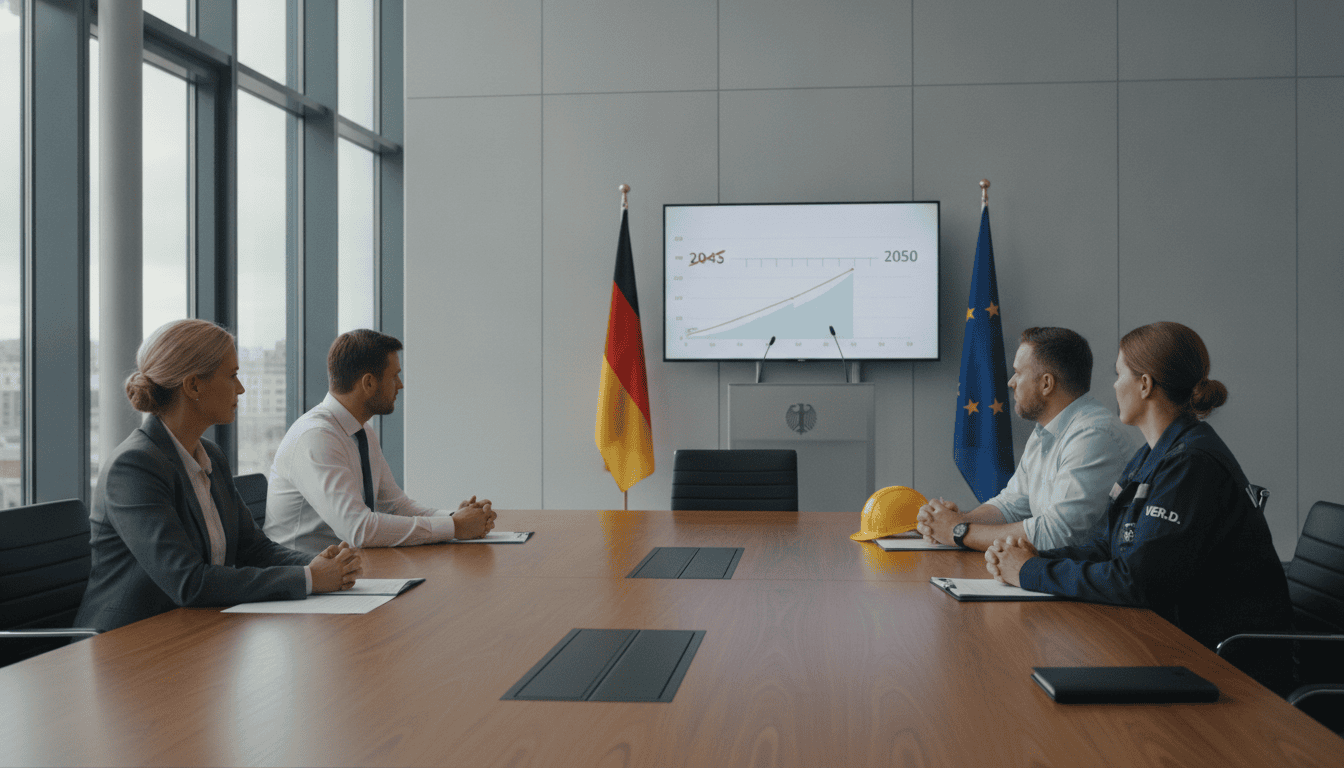
Industry and unions urge shift in German climate neutrality target to 2050
Industry leaders and unions call to move the German climate neutrality target from 2045 to the EU’s 2050 date, citing competitiveness and time for industrial transition.
Calls from industry and unions for a five-year postponement
Representatives from major industrial employers and trade unions have proposed delaying Germany’s climate neutrality target from 2045 to 2050.
They argue the alignment with the EU-wide timetable would ease costs for energy-intensive sectors while preserving emissions reduction ambitions.
IGBCE chair Michael Vassiliadis and RWE CEO Markus Krebber are among the prominent figures advocating the change.
Their message frames the shift as a way to protect industrial capacity without sacrificing long-term climate goals.
Arguments on competitiveness and cost pressure
Proponents say the earlier German deadline imposed a competitive disadvantage compared with firms operating under the EU’s 2050 horizon.
They contend that accelerating decarbonisation domestically raises location and investment costs without proportionally increasing global emissions reductions.
Executives point to rising compliance costs driven by a tighter national timetable and warn of potential production relocation if measures are not adjusted.
Unions, while supportive of emissions cuts, emphasize the need for orderly transition paths that preserve jobs and industrial know‑how.
Positions from political and business representatives
Political actors representing the business-friendly wing of the center-right have also backed a more gradual timetable.
They describe a later target as “realistic,” arguing it would better match the pace of technological and infrastructural change required by heavy industry.
At the same time, union leaders framed their demand as pragmatic: more time would allow companies and workers to implement low‑emission technologies without abrupt disruption.
Both camps stress that the objective remains fewer greenhouse gases, not deindustrialisation.
Implications for the European Emissions Trading System
A core part of the debate centers on the EU Emissions Trading System, the bloc’s principal market mechanism for cutting greenhouse gases.
Under the ETS, the number of emissions allowances declines over time, raising their price and incentivising reductions, a dynamic industry groups say must be managed to avoid undue shocks.
Germany’s current earlier target has influenced national expectations for allowance scarcity and prices, according to industry actors.
An alignment to 2050, they argue, would smooth the trajectory of certificate scarcity and offer predictable horizons for capital investments.
Upcoming EU proposals and the policy timeline
The European Commission has signalled further reforms to the emissions trading framework, with proposals expected in July that could reshape allowance supplies and sectoral obligations.
Stakeholders say national adjustments should be considered in light of those pending EU-level changes to avoid conflicting signals to markets and investors.
Observers note that any national change to the climate neutrality date would require political debate and could prompt legal and regulatory reviews.
Ministries, parliamentarians and industry associations will likely weigh the trade-offs between ambition, feasibility and economic impacts in the weeks ahead.
Risks, benefits and sectoral impacts
Supporters of postponement stress potential benefits such as reduced short-term investment pressure on steel, chemical and energy firms and fewer risks of carbon leakage.
They also argue for targeted measures to ensure emissions continue to fall steadily under a revised timeline.
Critics caution that delaying the target could weaken Germany’s leadership role on climate, undermine investor confidence in green technologies and slow deployment of clean solutions.
Environmental groups and some economists warn that moving the date without binding interim milestones could dilute the accountability needed to meet Paris-aligned goals.
The debate foregrounds difficult choices about sequencing decarbonisation steps, compensatory industrial policies and the distribution of costs across firms and consumers.
A range of transition measures is likely to be discussed, including phased ETS adjustments, targeted investment support, retraining programs and safeguards for regions dependent on carbon‑intensive activity.
Policymakers will face pressure to design packages that combine emissions integrity with economic resilience.
The German climate neutrality discussion now moves from statements to a political and technical process that will test how ambition, competitiveness and social cohesion can be balanced during the low‑carbon transition.
