
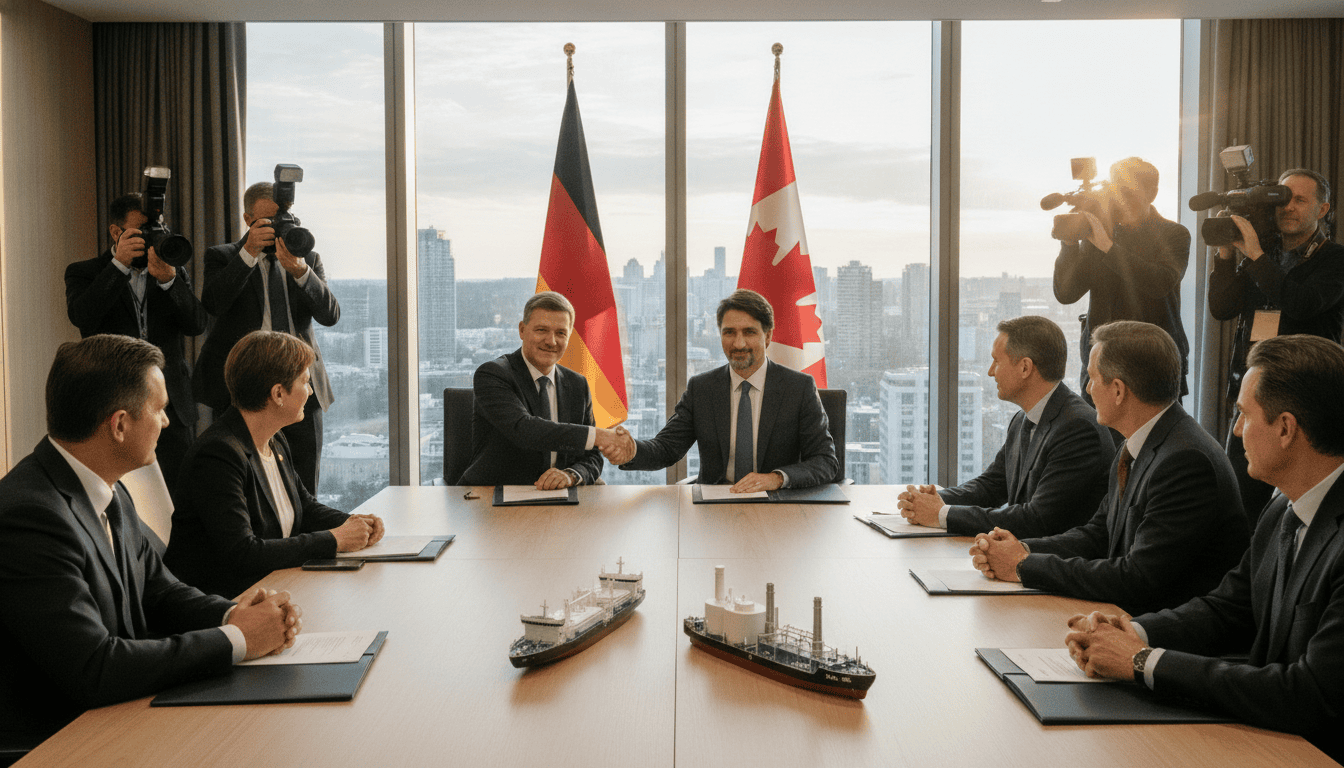
Germany signals long-term LNG imports from Canada in 20-year intent deal
Germany plans long-term LNG imports from Canada under a 20-year intent with Sefe and Ksi Lisims, raising questions about energy security and climate commitments.
Germany has signaled support for long-term LNG imports from Canada after a state-owned energy firm and a major Canadian project announced an intent to agree a two-decade supply arrangement. The memorandum, disclosed at the end of May, envisions deliveries of roughly one million tonnes of liquefied natural gas each year beginning in the early 2030s. The proposed timeline would carry supply commitments past Germany’s stated goal of national climate neutrality in 2045, prompting debate among policymakers and industry observers.
Terms announced and parties involved
The intention statement was issued jointly by Sefe — Securing Energy for Europe, a German state-controlled energy company — and Ksi Lisims, a large Canadian liquefied natural gas development. Under the plan, Ksi Lisims would provide about one million tonnes of LNG annually to Sefe starting in the early 2030s, with an option to continue shipments for up to 20 years. The announcement described the arrangement as an expression of strategic cooperation rather than a finalized purchase-and-sale contract.
The declaration stops short of full commercial finalization and leaves many details to be negotiated, including pricing, delivery windows and binding contract terms. Industry analysts note that memoranda of intent often precede formal offtake agreements, regulatory approvals and final investment decisions by the project sponsor.
Timeline extends beyond Germany’s 2045 climate pledge
Germany has set an explicit national target to reach climate neutrality by 2045, a commitment that shapes domestic energy policy and European climate planning. The proposed two-decade supply horizon from the early 2030s would extend well past that target year, raising questions about how long fossil fuel imports will factor into Germany’s energy mix. Critics argue long-term supply contracts risk locking in infrastructure and demand patterns that could hinder decarbonization efforts.
Government ministers framed the arrangement as part of a broader energy-security strategy while acknowledging its long horizon. Supporters say securing diverse supply channels is essential to maintain stable industry and household energy availability during the transition to renewables and low-carbon gases.
Berlin frames the deal as a strategic partnership
Economic and political leaders emphasized the bilateral dimension of the announcement, portraying the plan as a strategic energy partnership between Germany and Canada. Germany’s Economy Ministry described the pact as more than a commodity transaction, highlighting diplomatic and industrial ties that could expand cooperation on energy projects. Canadian officials welcomed the potential access to the European market, which would mark a significant commercial milestone for a North American LNG development.
For the Ksi Lisims project, an agreement with a European counterpart would represent its first confirmed link to the continent, according to the companies’ statements. For Sefe, securing long-term import routes is presented as a means to reduce reliance on any single supplier and to reinforce supply resilience across seasons and geopolitical shifts.
Implications for European gas security and infrastructure
Securing predictable LNG flows is central to European efforts to diversify gas supplies and reduce exposure to geopolitical risk. A multi-decade framework with a Canadian supplier could bolster storage planning, terminal utilization and forward procurement strategies for Germany and potentially for neighboring markets. LNG delivered by sea can complement pipeline networks and offer flexibility in routing, especially during periods of constrained pipeline capacity.
However, the scale of imports envisioned will also require investment in import infrastructure, regasification capacity and long-term logistics. Policymakers will need to weigh these infrastructure costs against the expected lifetime and utility of such facilities as the continent moves toward electrification and renewable gas alternatives.
Environmental and policy questions arise
Environmental groups warn that long-term LNG contracts may create a form of carbon lock-in, where continued investment in fossil fuel supply and supporting infrastructure delays deeper emissions reductions. Concerns extend beyond CO2 to methane leakage and life-cycle emissions associated with gas production, liquefaction and shipping. European climate policy debates will likely address how long-term fossil fuel agreements align with emissions budgets and net-zero pathways.
Proponents counter that carefully managed LNG imports can serve as a transitional fuel, replacing more carbon-intensive or geopolitically risky sources while renewable capacity and hydrogen technologies scale. They also point to possible contractual clauses and blending strategies that could mitigate the climate impact over the term of any final agreement.
Key milestones and what to watch next
The intent declaration is an initial step; observers will look for subsequent milestones that translate the memorandum into binding commitments. These include final investment decisions by the Ksi Lisims developers, detailed offtake agreements with pricing and indexation formulas, and regulatory clearances in both Canada and the European Union. Timetables for construction, terminal readiness in Germany and shipping logistics will determine whether deliveries can begin in the early 2030s as planned.
Market participants will also monitor whether the deal prompts other European buyers to pursue similar North American supplies and how contract terms will address environmental and transition-related risks. Transparency around emissions accounting and potential decarbonization measures could shape public and parliamentary debate as the agreement progresses.
As negotiations proceed, the core tension will remain between securing reliable energy supplies and meeting legally enshrined climate goals, with both policy-makers and industry weighing the strategic value of long-term LNG ties against commitments to decarbonize.
