
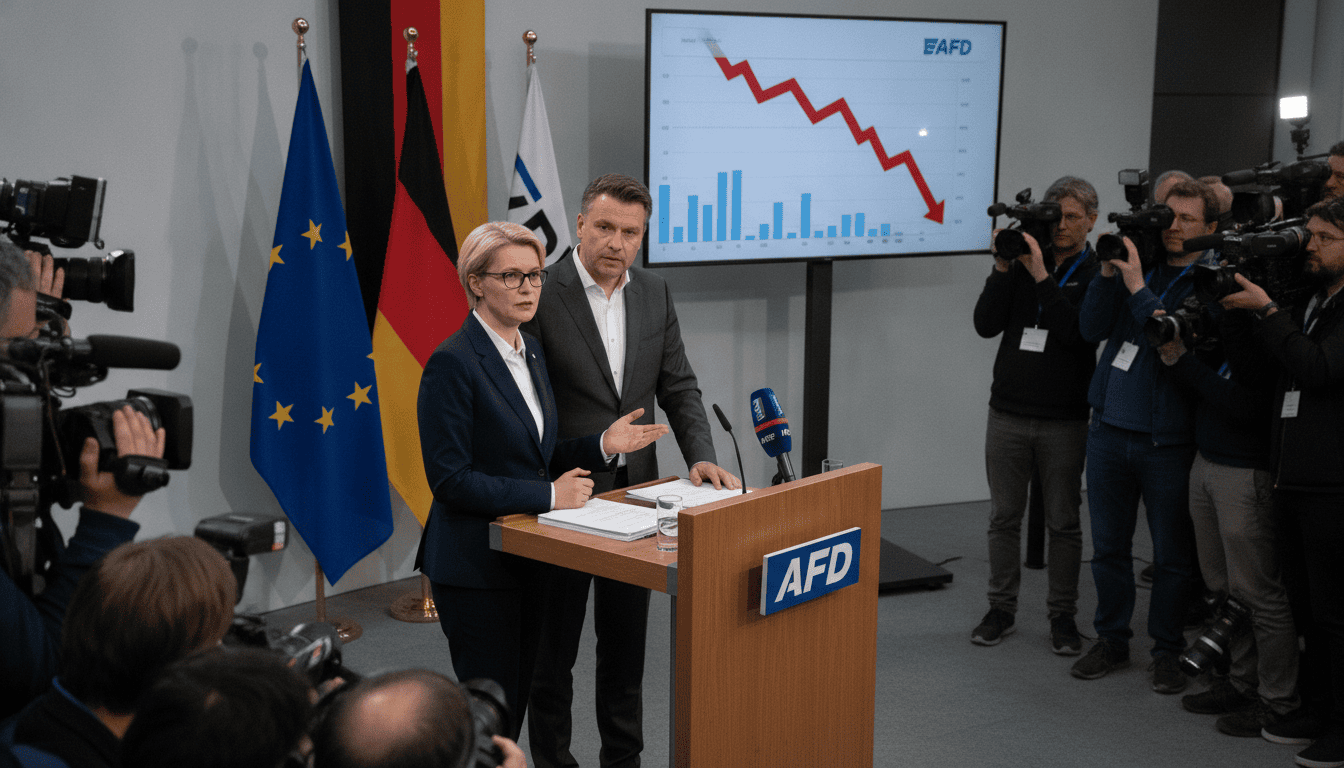
AfD party congress in Erfurt warns of ‘state bankruptcy’ and pledges sweeping economic overhaul
At the AfD party congress in Erfurt, leaders Alice Weidel and Tino Chrupalla framed Germany as approaching economic collapse, attacked Chancellor Friedrich Merz and promised deep spending cuts. The speeches sought to sharpen the party’s critique of the governing coalition while setting out broad policy priorities on energy, welfare and fiscal restraint. Delegates heard rhetoric positioning the AfD as the sole corrective force to what its leaders called a failed economic course.
Weidel and Chrupalla frame Germany as nearing economic collapse
At the podium in Erfurt, Weidel painted a stark picture of deindustrialisation and depleted public finances, while Chrupalla echoed the message that traditional voters had been abandoned. Both presented the narrative that the current government has left a “scherbenhaufen” — a shattered legacy — for any successor to repair. The duo used the language of crisis to justify a sharper, more populist policy agenda and to rally their base ahead of regional and federal ambitions.
Targeting Chancellor Merz and the coalition’s reform package
Speakers singled out Chancellor Friedrich Merz and the black-red coalition’s reform efforts as emblematic of political failure, accusing the government of broken promises and inadequate tax relief. Weidel said the coalition’s measures fell short of what was needed for taxpayers and businesses, and Chrupalla accused mainstream parties of abandoning workers’ rights. The attacks were framed both as an effort to delegitimise the coalition and to present the AfD as the only party positioned to defend certain segments of the electorate.
Austerity pledge without a detailed costed program
Party leadership admitted that assuming power would not instantly reverse economic decline and warned delegates that fiscal repair would require “rigorous spending cuts.” Weidel described the current fiscal situation in stark terms, using the phrase “de facto a state bankruptcy,” and presented spending restraint as the only viable exit from rising deficits. However, the congress did not include a concrete, itemised savings package; the emphasis was on intent rather than on a detailed plan of implementation.
Welfare and support for residents from Ukraine proposed for cuts
Weidel and other speakers proposed tightening social benefits and conditioning them on prior contributions, suggesting that some recipients should instead receive in-kind assistance. The leadership explicitly criticised what it described as large transfers related to Ukraine and signalled plans to reduce support for Ukrainians living in Germany. Those remarks were presented as part of a broader fiscal-savings argument and as a political appeal to voters concerned about social spending and immigration.
Energy policy reversal: end the Energiewende and revive nuclear and fossil imports
A central pillar of the AfD platform outlined in Erfurt was a reversal of Germany’s Energiewende in favour of a broader energy mix including nuclear power and increased imports of fossil fuels. Chrupalla called for a return to nuclear energy and for diversifying supplies to include gas and oil from global partners, while Weidel dismissed concerns about the costs of rebuilding nuclear capacity. The leaders framed this shift as necessary to restore competitiveness and lower energy costs, arguing that past phase-outs had left Germany at a disadvantage.
Electoral strategy and the claim of singular political relevance
Throughout the congress the leadership framed the AfD as indispensable to the political landscape, asserting the party’s readiness to govern first at the state level and then nationally. Weidel and Chrupalla pointed to rising membership and favourable poll numbers as evidence of momentum and urged delegates to view upcoming regional contests as stepping stones. The messaging combined economic alarmism with promises of decisive action to mobilise both long-standing supporters and disillusioned voters from other parties.
The AfD’s statements at Erfurt set a clear agenda but left significant implementation questions unanswered, notably on how proposed cuts would be distributed and what legal or diplomatic consequences a turn back to fossil imports might bring. Observers will be watching whether the party’s rhetoric translates into policy detail as it prepares for regional elections and seeks to broaden its appeal.
