
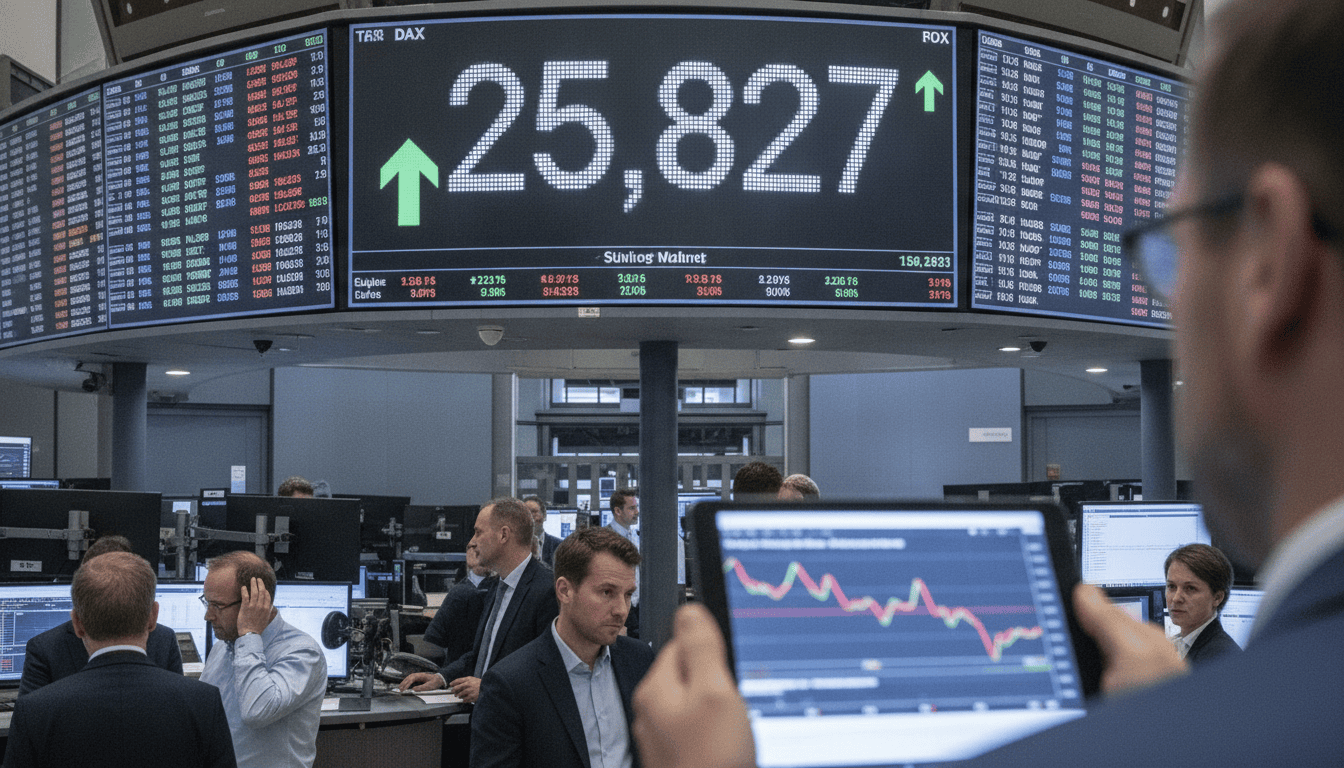
Dax record at 25,827 points masks uneven market strength
Dax record at 25,827 on July 5, 2026 masks uneven gains as AI momentum stalls and government reform promises temper investor expectations and subdued US trading.
The German benchmark Dax reached an intraday high of 25,827 points on July 5, 2026, registering a fresh record even as market drivers showed fractures beneath the surface. The Dax record arrived amid diminished AI euphoria abroad and thin trading volumes as major US investors were largely absent ahead of the Independence Day holiday. Market participants cautioned that headline levels disguise a patchwork of winners and laggards inside the 40-company index.
Dax hits a milestone on low-volume backdrop
The Dax 40’s peak on July 5 stands as the highest reading since the index expanded to 40 constituents, but trading conditions complicate the signal. With many international investors out for the US holiday, activity fell and short-term flows likely amplified price moves on a smaller base of participants. Analysts say that record levels reached under these circumstances warrant scrutiny rather than celebration.
Trading distortions and holiday impact
US markets observed the Independence Day holiday on July 4, leaving several American institutional investors less active, which reduced cross-border liquidity. Reduced transatlantic participation can accentuate intraday swings in European indices, particularly one as internationally oriented as the Dax. Traders note that when heavy international flows are absent, sector-specific moves or concentrated buying in a handful of large-cap names can push headline indices higher.
AI enthusiasm has cooled but effects are uneven
Global excitement about artificial intelligence has lost momentum in recent weeks, yet its influence on equity prices has not vanished uniformly. Some Dax components that had been positioned to benefit from AI-related demand continued to attract investor attention, while others with limited exposure to the technology lagged. The result is an index-level advance that does not reflect a synchronized improvement across the German market.
Winners and losers within the index
Industry observers point out that the Dax’s international composition means performance often hinges on sector dynamics and global demand rather than domestic growth alone. Export-oriented industrials and technology-adjacent firms that can monetize AI applications have tended to outperform, while companies tied to structural domestic markets or legacy sectors faced pressure. This divergence makes it harder for investors to read the Dax record as a clear sign of broad-based economic recovery.
Government reform package offers promise but limited immediate relief
The federal government unveiled plans for a reform package intended to spur investment and growth, a development that markets have noted as a signal of political willingness to act. Officials framed the measures as a medium-term boost for competitiveness, but financial market analysts warned that such reforms typically take time to affect corporate earnings and valuations. Investors were advised not to overestimate the short-term market impact of the announced proposals.
International context and long-term challenges
Beyond holiday and sectoral effects, the Dax’s record performance must be seen against structural pressures such as shifting global market share and heightened competition from US and Asian firms. Several German large caps have seen their relative influence decline internationally, a trend that complicates the link between domestic policy promises and immediate market outcomes. Currency moves, supply-chain dynamics, and global capital allocation patterns will continue to shape the index’s trajectory.
Investor commentary in the wake of the Dax record emphasized vigilance: headline milestones can mislead when underlying breadth is weak and external factors distort trading. Market professionals recommend focusing on company-level fundamentals, sector trends, and liquidity conditions rather than treating the record as a wholesale confirmation of sustained strength.
Overall, the Dax record on July 5, 2026 reflects a confluence of technical conditions, selective sector gains, and political signals rather than an unequivocal recovery across Germany’s largest listed firms. Observers will be watching trading volumes, corporate earnings reports, and the implementation timeline of government reforms to judge whether the record marks the start of a durable uptrend or a transitory peak.
