
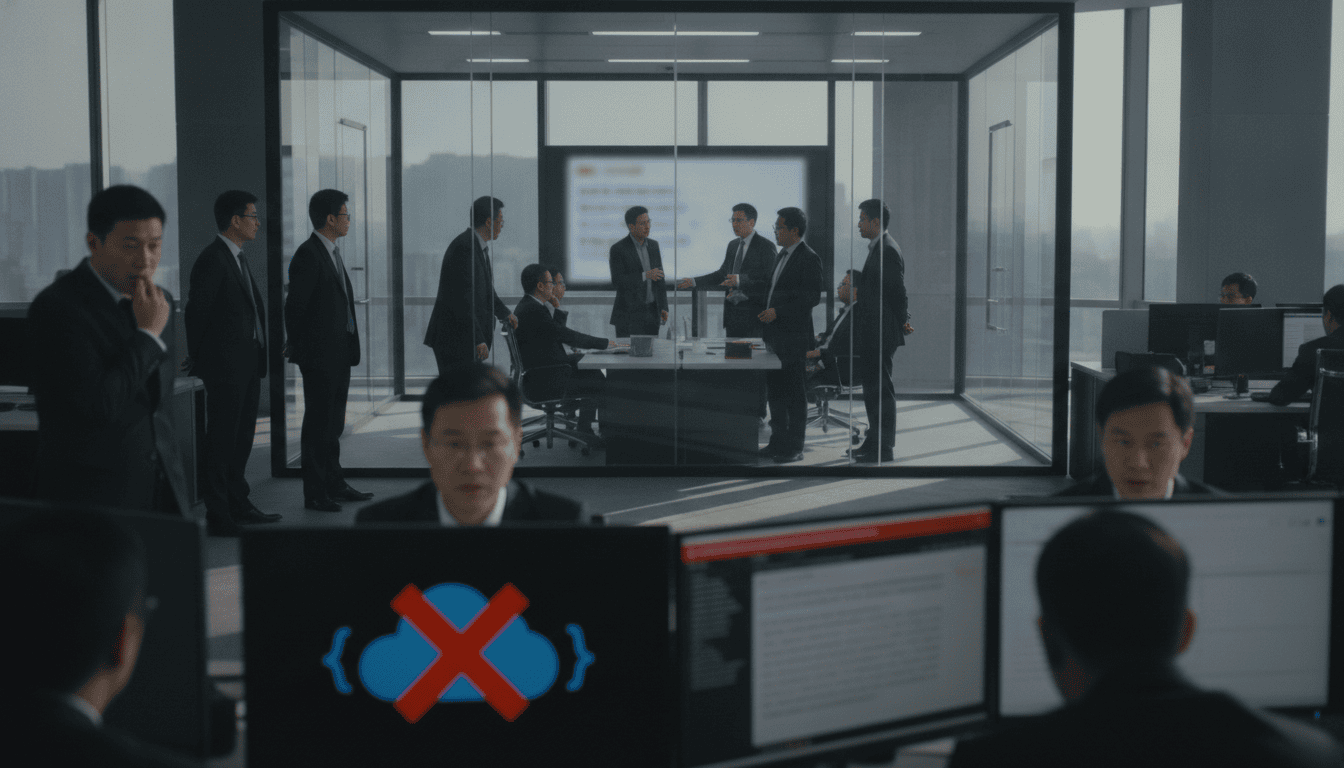
Alibaba to ban Anthropic’s Claude Code from workplace starting July 10, 2026
Alibaba will prohibit employees from using Anthropic’s Claude Code at work beginning July 10, 2026, citing security concerns over user-identification measures in the tool.
China’s Alibaba Group has ordered a company-wide ban on the use of Anthropic’s programming tool Claude Code in its workplace, effective July 10, 2026, according to multiple reports. The move follows disclosures about an experimental mitigation embedded in a version of Claude Code that reportedly could identify Chinese users, and Alibaba has labeled the software high-risk while directing staff to its in-house tool, Qoder.
Alibaba issues formal workplace ban
Alibaba’s internal directive instructs employees to stop using Claude Code for work-related tasks and to switch to the company’s own programming platform, Qoder. Reports indicate the prohibition will take effect on July 10, 2026, with the firm classifying the external tool as presenting unacceptable security and compliance risks.
The company’s decision appears to stem from a broader review of third-party software and a reassessment of foreign AI tools in enterprise settings. Alibaba’s move reflects tighter internal controls over software that handles code, data or proprietary workflows, particularly tools developed by overseas AI vendors.
Anthropic’s restrictions and mitigation efforts
Anthropic has long maintained rules restricting access to its models by Chinese companies and foreign entities owned by them, and the firm has been working to close circumvention channels. The company said it implemented measures intended to block unauthorized resellers and to guard against distillation, a practice where one model’s outputs are used to train another, which can expose intellectual property or enable replication.
Anthropic personnel publicly characterized the contested feature as an experiment launched in March 2026, intended to prevent account abuse and protect model integrity. Company representatives said the experiment was temporary and that stronger mitigations were in place or planned to replace the approach.
Allegations of user-identification in Claude Code
A post on an online forum claimed that a version of Claude Code could secretly identify users in China, prompting scrutiny from corporate security teams and industry observers. The allegation heightened concerns among enterprises that use foreign AI tools, where hidden telemetry or identification signals could create regulatory or data-protection liabilities.
Anthropic responded by describing the functionality as an anti-abuse experiment and signaled that the feature would be removed, while noting subsequent improvements to its protective measures. Nonetheless, the disclosure prompted immediate reactions from clients and partners that must rapidly evaluate risk exposure and policy compliance.
Alibaba’s risk assessment and promotion of Qoder
Following its review, Alibaba classified Claude Code as high-risk software and ordered staff to adopt Qoder, the company’s internally developed programming assistant. Qoder, promoted as an enterprise-grade tool under Alibaba’s control, allows the group to limit external dependencies and apply its own governance and logging standards to code-generation workflows.
The shift to an in-house solution aligns with broader corporate risk management practices that favor tools whose data handling and access controls are fully auditable. For a company the size of Alibaba, relying on proprietary systems reduces uncertainty around cross-border data flows and the potential for third-party mitigation measures to conflict with domestic regulations.
Broader industry and regulatory implications
The dispute underscores persistent tensions between cloud-era AI services and national security, data-protection and intellectual property concerns in major markets. When large enterprise customers withdraw or restrict use of foreign AI tools, vendors face not only commercial losses but also pressure to be transparent about telemetry, model-protection tactics and reseller relationships.
Efforts to prevent distillation and account abuse are legitimate from a model-protection standpoint, yet they can collide with privacy norms and national rules that treat identification or filtering by nationality as sensitive. The episode may accelerate enterprises’ decisions to favor locally governed AI platforms or insist on contractual guarantees that limit any form of covert identification or access controls.
Alibaba’s action could also prompt other Chinese firms to reexamine their use of overseas AI development tools and to update procurement policies. Regulators and large corporations alike are attentive to how model security measures are implemented, and vendor experiments that are not clearly disclosed risk triggering stricter corporate or governmental restrictions.
Anthropic and Alibaba have not published full technical accounts of the disputed experiment or the internal risk assessment that led to the ban, leaving questions about the specific mechanisms and safeguards unanswered. With the July 10, 2026 effective date approaching, both companies and their clients will likely continue to refine technical and contractual protections around model use, reselling and data governance.
The immediate outcome is a tightening of controls at Alibaba and a renewed spotlight on how AI vendors balance anti-abuse protections with customer privacy and sovereign compliance.
