
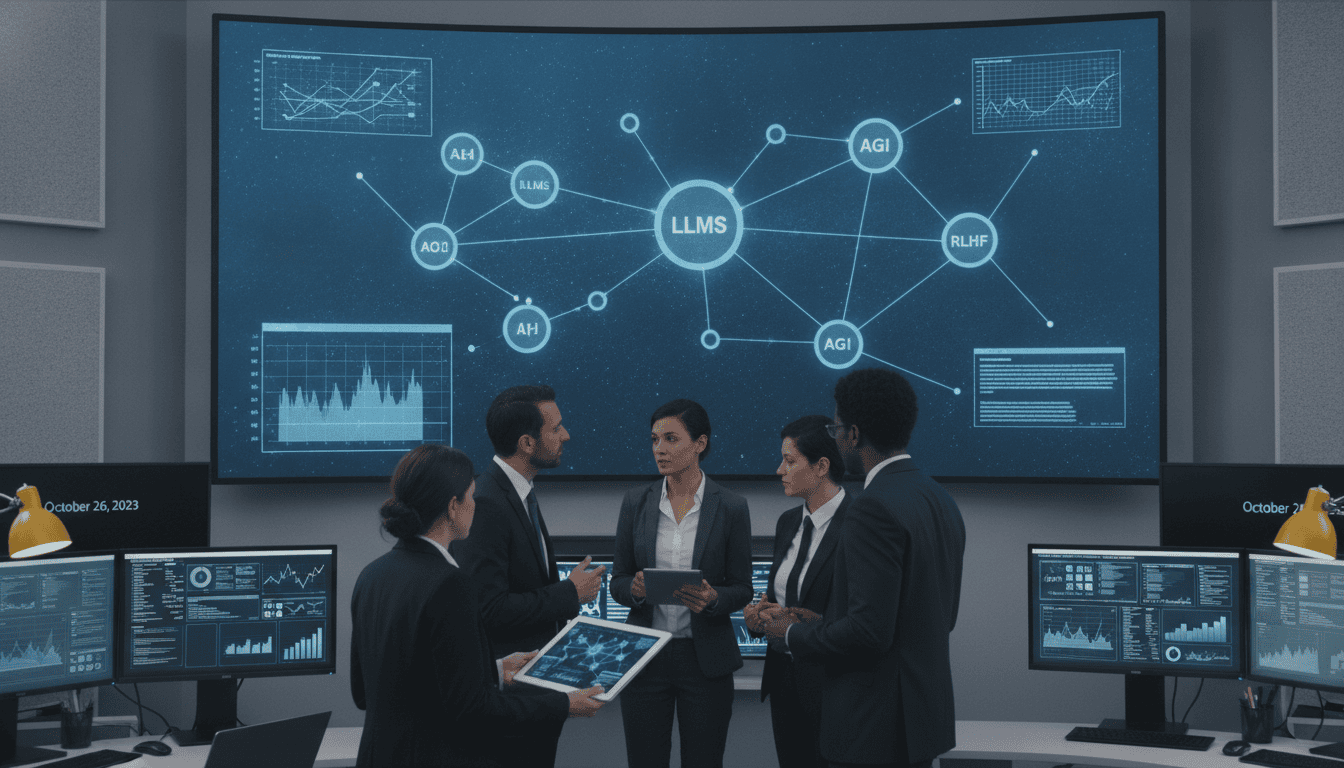
AI Glossary Updated to Decode Complex Terms from AGI to LLMs
Updated AI glossary decodes terms from AGI and LLMs to MCP, RLHF and RAM shortages, clarifying industry jargon for builders, investors and readers, clearly.
Updated glossary maps fast-moving AI vocabulary
The updated AI glossary provides clear, plain-language definitions for the technical terms now dominating product meetings, investor pitches and policy debates. The resource positions itself as a living reference for anyone working with or following artificial intelligence developments. The entry set focuses on concepts that have become central to deployment, governance and commercial strategies across the industry.
Experts remain divided on definitions for AGI and RSI
Debate persists over what constitutes artificial general intelligence and the related idea of recursive self improvement. Some organizations describe AGI as systems that match or exceed human ability across most economic tasks, while other researchers frame it more narrowly around cognitive parity. The glossary lays out these differing definitions and highlights why consensus remains elusive as labs pursue varied research agendas.
Large language models, AI agents and coding agents explained
Large language models or LLMs are defined as deep neural networks trained on massive text corpora to predict and generate language. The glossary explains how LLMs power modern assistants and how they interact with tools such as web connectors and code interpreters. Entries on AI agents and coding agents describe systems that can execute multistep workflows autonomously, from booking services to writing and testing software, and note the current reliance on human oversight for high-stakes tasks.
Infrastructure entries address compute, parallelization and RAMageddon
Key infrastructure terms have been expanded to reflect supply pressures and architectural trends. Compute is presented as shorthand for the GPUs, TPUs and other hardware that enable training and inference. Parallelization is covered as a design and scaling strategy that permits many computations to run simultaneously. The glossary also introduces RAMageddon to describe global shortages of memory chips that are affecting device makers and data centers alike.
Training techniques and model efficiency receive detailed coverage
The resource breaks down training, fine tuning, transfer learning and distillation in accessible terms. It explains how large models are often fine tuned to specialized domains, how transfer learning accelerates development, and how distillation produces smaller models by teaching a compact “student” to mimic a larger “teacher.” Reinforcement learning and reinforcement learning from human feedback are explained as interactive methods that reward desired behaviors and have become central to improving model helpfulness and safety.
Safety, hallucinations and emerging standards are highlighted
Entries on hallucinations warn that models can generate incorrect or fabricated information and discuss the real world risks that follow. The glossary emphasizes engineering and governance approaches intended to reduce such errors, including specialized vertical models and human-in-the-loop processes. It also covers emerging interoperability standards such as the Model Context Protocol that let models access external tools and data without bespoke connectors, and notes the industry momentum behind adoption of open standards.
Technical building blocks such as tokens, contexts and MoE architectures
The glossary unpacks lower level concepts that shape model performance and cost. Tokens and tokenization are described as the atomic units of input and output that influence pricing and throughput. Context management and memory caching techniques are explained as ways to speed inference and reuse computation. The mixture of experts architecture is summarized as a routing approach that activates small specialist subnetworks to make large models more efficient to run.
The updated AI glossary aims to make the sector’s language more navigable for practitioners, investors and policy makers by translating jargon into operational explanations. It is presented as an evolving tool that will be updated as new techniques, shortages and standards reshape the field.
