
Netherlands Lobbies U.S. to Drop MATCH Act Over Risk to ASML and Global Chip Supply
Dutch Trade Minister Sjoerd Sjoerdsma lobbied US lawmakers in Washington to oppose the MATCH Act, warning the bill would sharply hurt ASML and chip supply.
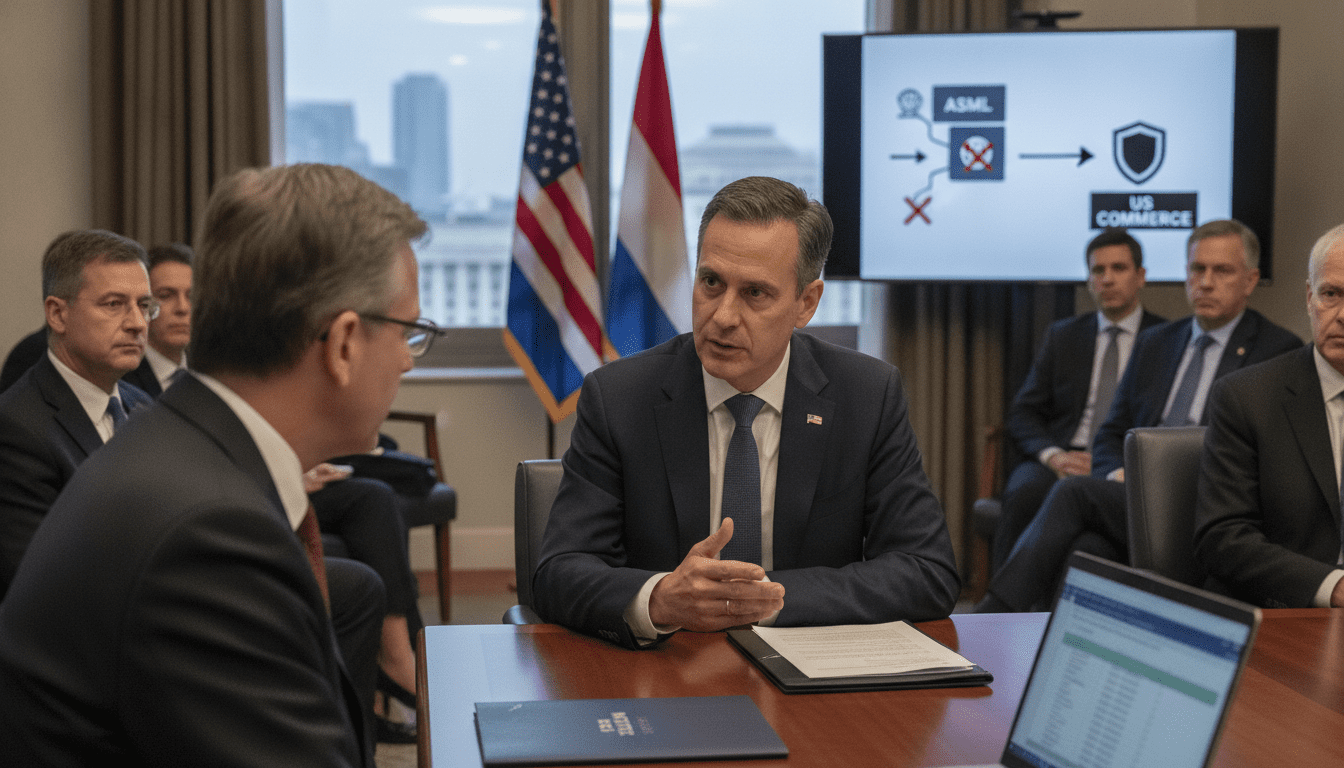
The Dutch trade minister traveled to Washington this week to press officials and members of Congress to reconsider the MATCH Act, a proposal that would widen export curbs on semiconductor equipment to China. Sjoerd Sjoerdsma held meetings with Commerce Secretary Howard Lutnick and senior congressional staff, portraying the legislation as a measure with serious economic and diplomatic consequences for the Netherlands. The minister warned that the measure could hit ASML, the Dutch maker of critical lithography machines, and that allies must weigh security concerns against commercial fallout.
Dutch Minister Presses Washington on MATCH Act
Sjoerdsma framed his discussions in Washington as an effort to outline Dutch concerns directly to U.S. policymakers, emphasizing bilateral consultation ahead of any restrictive measures. Officials described the meetings as substantive, covering both the technical details of the equipment at issue and wider implications for Dutch industry. The minister told reporters that the stakes for the Netherlands are especially high because of ASML’s central role in the global semiconductor supply chain. Dutch diplomats have made clear they seek a solution that protects security aims without unduly penalizing a national industrial champion.
ASML’s Market Position and China Exposure
ASML, headquartered in the Netherlands, is the only company worldwide that manufactures extreme ultraviolet (EUV) lithography machines used for the most advanced chips, making it uniquely important to modern semiconductor manufacturing. China represents a significant customer market for ASML, accounting for roughly 19% of the company’s net system sales, a share that Dutch officials say must be considered when calibrating export controls. Beyond EUV systems, ASML sells other classes of lithography tools and services to a range of global clients, and disruptions or sudden prohibitions could ripple through foundries and chip designers. Dutch leaders argue that blunt restrictions risk unintended damage to both European industry and allied technology resilience.
Technical Scope of Proposed Curbs
The MATCH Act, as drafted in April, would extend U.S. curbs beyond the long-standing block on the most advanced EUV machines to include older-generation deep ultraviolet (DUV) immersion equipment. Those DUV tools, many of which were first shipped more than a decade ago, are used in large volumes across mature-node chip production and remain commercially important. Industry executives have warned that prohibiting sales of such equipment to China would close off a category of hardware that currently lands inside the country’s fabs and service providers. Policymakers supporting the bill argue the move is intended to slow China’s ability to produce semiconductors for advanced applications, but opponents say the technical line between security-sensitive and routine gear can be blurred.
Potential Economic and Supply-Chain Impact
Analysts and company leaders caution that an abrupt expansion of export controls could disrupt chip supply chains and raise costs for manufacturers worldwide. Foundries and electronics firms that rely on a continuous flow of replacement tools and maintenance parts could face delays that affect production schedules and product roadmaps. Suppliers of upstream chemicals and precision components tied to lithography equipment might see sales and investment patterns change rapidly, with knock-on effects for employment and regional industrial clusters. Dutch and European officials are urging a calibrated approach that balances legitimate security objectives with predictable commercial rules.
Legislative Outlook and Political Calculus
The MATCH Act has not yet been voted on by either chamber of Congress and backers may need to include its provisions in broader trade or technology packages to secure passage. Legislative strategists note that stand-alone export-control bills often face complex negotiations over scope, enforcement mechanisms and exemptions for allies. Congressional supporters of tighter controls frame the proposal as part of a larger effort to manage strategic supply chains, while opponents worry about unilateral measures that do not coordinate with partners. Washington’s legislative timetable and whether the proposal will be folded into a larger bill will determine how quickly companies like ASML need to respond.
Diplomatic Friction Between Allies
The Netherlands’ decision to send its trade minister to lobby U.S. lawmakers underscores increasing diplomatic friction among Western partners over how far to extend technology curbs on China. Dutch officials stress that effective controls require close allied consultation so that security goals do not inadvertently fragment markets or punish firms that operate globally. The diplomatic outreach reflects concern inside European capitals that divergent rules could complicate international cooperation and supply-chain resilience. Brussels and The Hague have signaled a preference for multilateral mechanisms and targeted restrictions calibrated to specific capabilities rather than broad prohibitions.
The coming weeks will test whether Congress, industry and allied governments can reconcile security priorities with the commercial realities of the semiconductor sector. Stakeholders on all sides say they favor careful, coordinated policy-making, but differences over scope and timing remain significant. As debate continues, ASML and its customers will watch legislative developments closely, aware that regulatory decisions in Washington could reshape global chip production strategies for years.
