
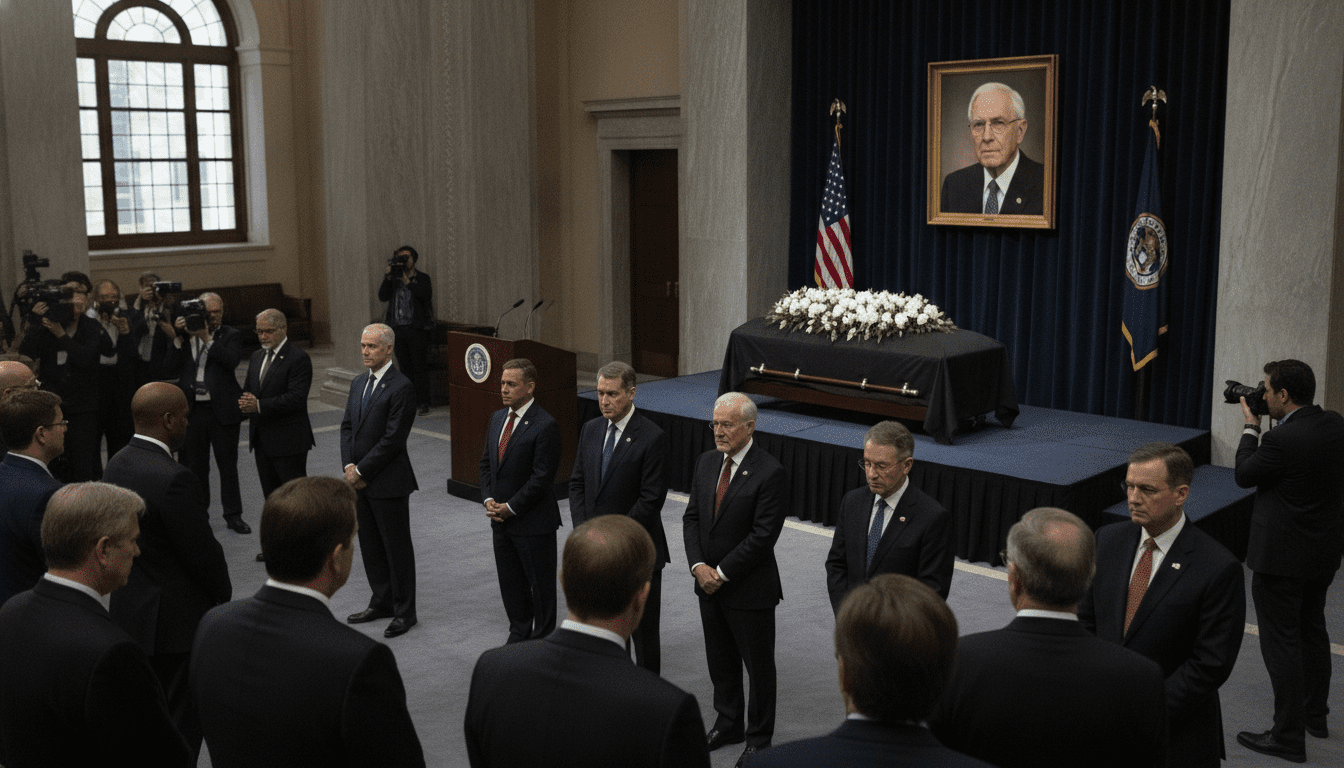
Alan Greenspan, former Federal Reserve chair, dies at 100
Alan Greenspan, the long-serving former chair of the U.S. Federal Reserve, has died at 100, the Fed confirmed. Greenspan’s death, attributed to complications from Parkinson’s disease by his wife Andrea Mitchell, closes a contentious chapter in modern American monetary history.
Federal Reserve confirms Alan Greenspan’s death at 100
The Federal Reserve issued a brief statement confirming the passing of Alan Greenspan, who led the central bank from 1987 to 2006. The notice identified his age and noted his decades-long influence on U.S. and global financial policy.
Family statements relayed to the press said Greenspan had been living with Parkinson’s disease and died from complications related to that condition. Several news organizations reported the details citing his wife, Andrea Mitchell, and the Fed’s announcement provided institutional confirmation.
From music student to White House adviser
Born in New York in 1926, Alan Greenspan began his education studying music before turning to economics at the City University of New York and later the New School and New York University. Early in his career he became associated with libertarian intellectuals and built a reputation as an influential consultant.
Greenspan advised multiple administrations before his nomination to the Federal Reserve by President Ronald Reagan. Over the course of his public life he worked with or during the terms of six U.S. presidents, becoming one of the most recognizable figures in American economic policy.
Managing markets: 1987 crash and the ‘irrational exuberance’ remark
Greenspan assumed the Fed chairmanship in August 1987, just months before the stock market’s Black Monday crash in October of that year. His handling of the immediate aftermath helped define the central bank’s crisis response model, emphasizing liquidity and market functioning.
In 1996, his comment about “irrational exuberance” in equity markets reverberated beyond Washington and triggered a sharp global market reaction. That phrase has since come to symbolize Greenspan’s role as both a market observer and an actor whose words could move prices.
Decades of low rates and the 1990s expansion
Throughout the 1990s Greenspan presided over a period of sustained U.S. economic expansion, during which the Fed generally maintained relatively low interest rates. Supporters credit that stance with encouraging investment and helping to sustain growth while inflation remained subdued.
His approach to monetary policy—favoring accommodative settings to bolster employment and growth—became a hallmark of his tenure and shaped the expectations of investors and policymakers worldwide. Those policy choices also set the stage for later debates about risk buildup in financial markets.
Financial crisis fallout and public reckoning
The global financial crisis that erupted in 2007–2008, shortly after Greenspan left office, cast a long shadow over his legacy. Critics argued that his faith in market self-regulation and prolonged low rates contributed to excessive leverage and an overheated housing sector.
In congressional testimony in 2008 Greenspan acknowledged errors in judgment, saying he had been surprised by the extent to which some banks had exposed themselves and had underestimated the housing bubble. That admission intensified scrutiny of earlier regulatory stances and prompted calls for tighter oversight.
Responses expected from officials and market watchers
Tributes and reflections from former colleagues, lawmakers and central bankers are expected in the days ahead as institutions and commentators assess Greenspan’s impact. He remained a frequent voice in economic debates after leaving the Fed, sustaining his profile as a key commentator on public policy.
Global market participants and economists have long debated the balance of Greenspan’s achievements against the risks critics cite, and those debates are likely to resurface as analysts revisit policy choices from his era. Formal remembrances and institutional statements are likely to outline both the achievements and controversies of his career.
Alan Greenspan’s death closes the life of a figure whose policies and pronouncements shaped late 20th-century and early 21st-century economic thinking, leaving a complex legacy that will be examined by historians, economists and policymakers for years to come.
