
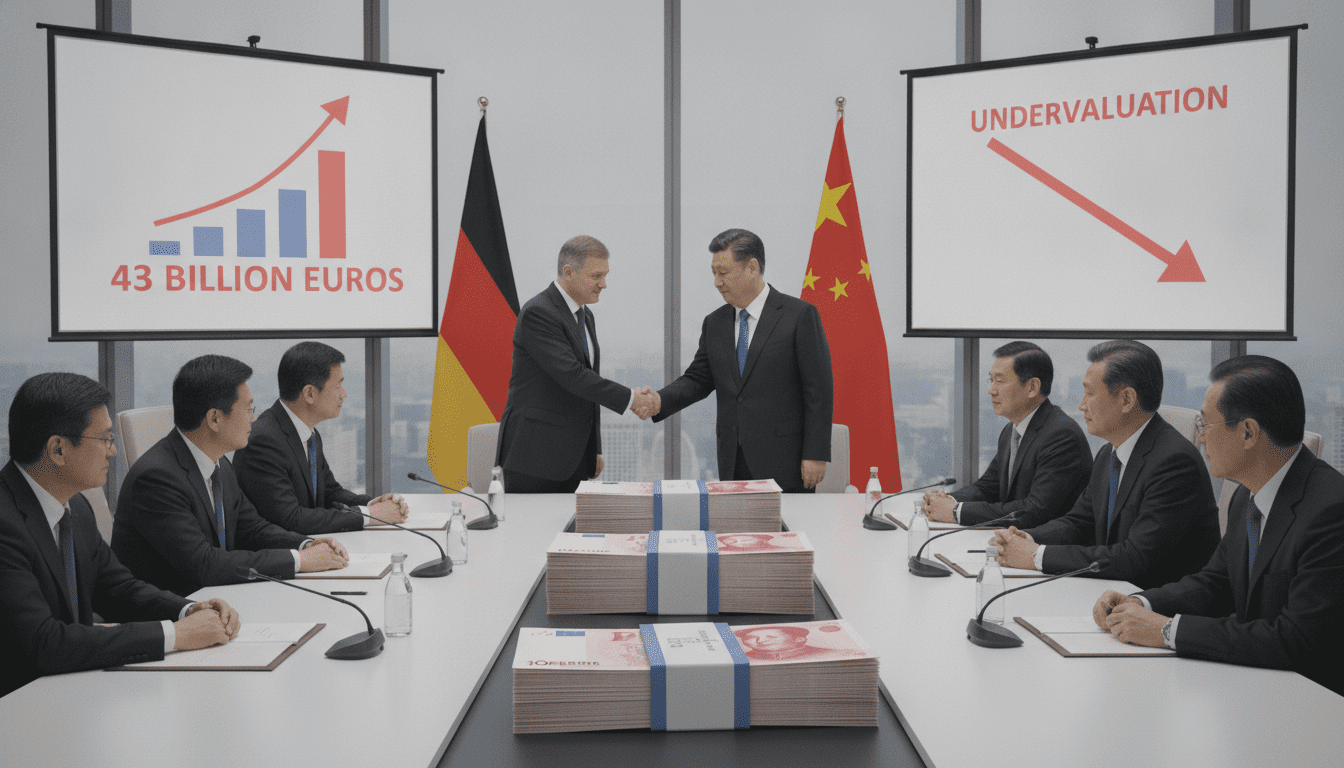
Yuan undervaluation costs German economy billions, IW study finds
IW study says China’s yuan undervaluation costs Germany billions; a 40% simulated appreciation could boost GDP by 0.3% and add €43bn by 2028 overall.
The Institut der deutschen Wirtschaft (IW) study, funded by the German Foreign Office, finds that the Chinese government’s deliberate suppression of the yuan is costing the German economy billions of euros annually. The report models a hypothetical 40 percent appreciation of the yuan and concludes that real GDP could be up to 0.3 percent higher in 2028, with cumulative gains of roughly €43 billion across 2026–2028. The study’s findings sharpen concerns about the economic impact of sustained currency undervaluation on German exporters and industrial competitiveness.
Study methodology and headline findings
The IW’s simulation applies a sharp, hypothetical 40 percent revaluation of the yuan to assess macroeconomic effects on Germany. Researchers translated exchange-rate shifts into price-adjusted measures of GDP and trade flows to isolate the impact of currency valuation from other factors.
Authors report that, under their baseline model, the immediate effect of a stronger yuan would be a measurable improvement in Germany’s real GDP by 2028. The cumulative €43 billion figure aggregates the change in price-adjusted output across three years and is presented as an order-of-magnitude estimate rather than a precise forecast.
Why the study uses a 40 percent appreciation
The paper adopts a 40 percent appreciation scenario that the authors say approximates a move toward what some economists describe as a “fair” valuation. That parameter is intended to capture the potential gap between current policy-influenced rates and an exchange rate driven more by market fundamentals.
By choosing a large but plausible shift, the IW aims to show the scale of economic effects if Beijing were to allow the currency to strengthen substantially. The simulation is not a prediction that the yuan will move by that amount, but a tool to quantify how sensitive Germany’s economy is to such a policy change.
Trade imbalance with China and effects on German exports
The IW highlights a widening trade deficit between Germany and China, reporting that the bilateral deficit reached about €90 billion in 2025 as German exports to China declined while imports from China continued to rise. The study links at least part of this shift to the yuan’s low valuation, which makes Chinese goods cheaper for foreign buyers.
A persistent deficit of this scale has raised alarm among policymakers and industry groups, who point to lost market share and pressure on domestic manufacturers. For sectors that rely heavily on exports to China, the currency-discount effect compounds other competitive challenges such as supply-chain shifts and technological competition.
Mechanics of an appreciating yuan on China’s economy
The IW’s model suggests that a stronger yuan would immediately dampen the price competitiveness of Chinese exports, reducing external demand. That contraction in export volumes would be offset over time by rising domestic demand as lower export volumes leave more goods available for the home market.
According to the simulation, falling domestic prices and higher real incomes in China could stimulate consumption and investment, producing a countervailing expansion that allows China’s overall GDP to return near the baseline by 2028. The study frames this as an internal rebalancing of an export-heavy growth model rather than permanent economic harm.
Calls for European countermeasures from IW experts
IW expert Jürgen Matthes characterized China’s exchange-rate management as “poison” for free trade, arguing that intentional undervaluation confers unfair advantages in global markets. The study’s authors and commentators in Germany therefore advocate for European policy responses, including countervailing duties, to level the playing field.
Proposals for targeted tariffs or anti-dumping measures aim to offset the price advantage enjoyed by subsidized or currency-favored goods. Critics warn such measures could escalate trade tensions and complicate diplomatic relations, but supporters say they are necessary to protect strategic industries and employment in Europe.
Policy options and potential consequences for EU trade strategy
European policymakers face a choice between punitive trade measures, coordinated diplomatic pressure, and efforts to strengthen competitiveness at home. The IW report adds data to arguments for a common EU approach that blends trade remedies with investment screening, supply-chain diversification, and incentives for reshoring critical production.
Implementing countervailing duties would require legal and political coordination across EU institutions and member states. Any tariffs would likely prompt Chinese countermeasures, and officials must weigh short-term protection for domestic firms against broader risks to trade and economic relations.
The IW study places the spotlight on the macroeconomic consequences of exchange-rate policy and fuels a renewed debate in Berlin and Brussels about how to respond. As EU officials consider their options, industries and investors will be watching whether policymakers move toward trade remedies, diplomatic engagement, or a mix of measures to address what the study frames as an unfair currency advantage.
